If you have ever typed fast and ended up writing “stich” instead of “stitch,” you are not alone. This is one of the most common spelling slip-ups in English. One missing letter creates two very different situations, and getting it wrong can make your writing look careless.
This guide covers everything you need to know about stich vs stitch. By the end, you will know exactly which word to use, when to use it, and how to avoid the most common mistakes writers make.
Define Stich
Stich (pronounced “stik”) is a literary term that refers to a single line of verse, most commonly used in the study of ancient Greek and Hebrew poetry. In classical prosody, a stich is one unit of a poetic line. You may also encounter the plural form “stichs” in academic texts when scholars break down metrical patterns in scripture or classical verse.
Outside of literary and scholarly circles, “stich” has almost no presence in modern everyday English. Both the Oxford Dictionary and Merriam-Webster do not recognize “stich” as a standard modern word for sewing or any craft-related context. If you see it used that way, it is almost always a spelling error.
| Word | Part of Speech | Meaning |
| Stich | Noun | A line of verse in poetry or scripture |
| Stitch | Noun / Verb | A loop of thread used in sewing, knitting, or surgery |
Define Stitch
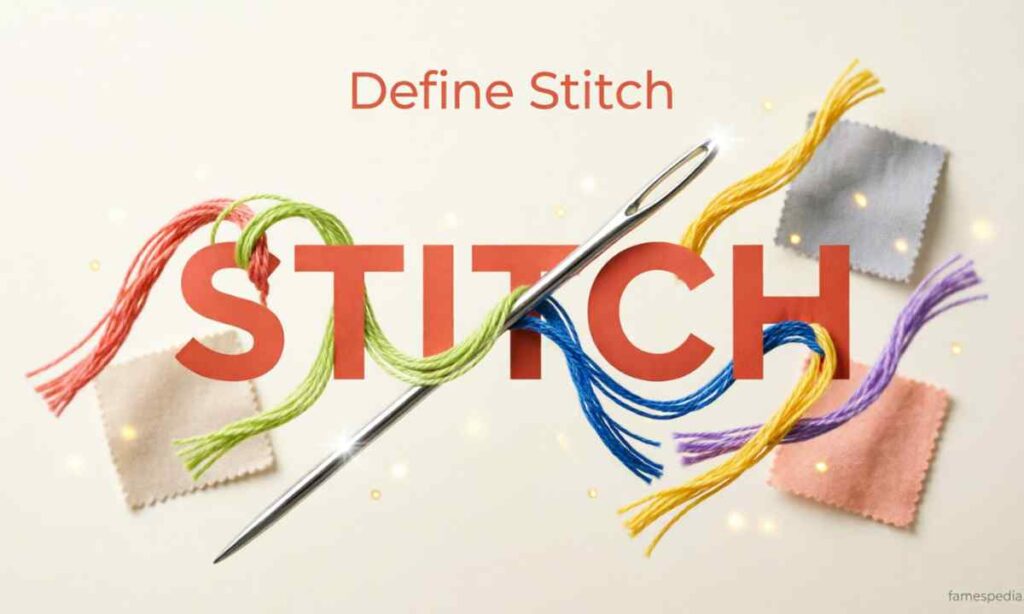
Stitch (pronounced “stich” with a soft “tch”) is the correct and widely accepted English word used across sewing, knitting, crocheting, embroidery, and medical contexts. As a noun, it refers to a single loop of thread or yarn formed by one pass of a needle. As a verb, it means to sew, mend, or join two pieces of material together using thread.
“Stitch” also appears in common idioms and everyday expressions, such as “in stitches” (meaning to laugh uncontrollably) and the well-known proverb “a stitch in time saves nine.”
The word “stitch” is versatile and appears across multiple fields:
- Sewing and tailoring (running stitch, backstitch, cross-stitch)
- Knitting and crochet (cast on 20 stitches, drop stitch)
- Medical procedures (sutures used to close a wound)
- Physical sensations (a stitch in your side after running)
- Idiomatic expressions (in stitches, without a stitch)
How To Properly Use The Words In A Sentence
Knowing the definition of a word is only part of the equation. Knowing how to use it properly in a real sentence is what builds writing confidence.
How To Use Stich In A Sentence
Because “stich” is a specialized literary term, it belongs almost exclusively in academic or poetry analysis writing. Here are correct examples:
- The poem was broken down into individual stichs to analyze its rhythmic structure.
- In Hebrew scripture, each stich represents a rhythmic half-line with distinct meaning.
- The professor asked students to identify the number of stichs in each verse.
- Classical scholars often debate how to translate a single stich from ancient Greek texts.
Outside of this literary context, “stich” should not appear in your writing. If you are writing about sewing, knitting, or medicine, the correct word is always “stitch.”
How To Use Stitch In A Sentence
“Stitch” is the word you will use in almost every practical situation. Here are proper examples of it used as both a noun and a verb:
As a noun:
- She used a running stitch to sew the hem of her dress.
- The doctor placed one final stitch to close the incision.
As a verb:
- He decided to stitch the torn sleeve back onto the jacket.
- The nurse showed her how to stitch the wound carefully.
In idioms:
- The comedian had the entire audience in stitches within minutes.
- A stitch in time saves nine, so fix small problems before they grow.
More Examples Of Stich & Stitch Used In Sentences
Examples Of Using Stich In A Sentence
These examples show “stich” correctly placed in literary and academic contexts only:
- The biblical passage was divided into stichs to reflect its poetic rhythm.
- Each stich in the ancient manuscript had been carefully preserved.
- Scholars noted that this particular stich was likely added in a later revision.
- The poem’s final stich carried the most emotional weight of the entire verse.
- She wrote her thesis on how stichs function in early Germanic heroic verse.
Examples Of Using Stitch In A Sentence
These examples reflect correct everyday usage of “stitch” across a range of contexts:
- The tailor used a fine stitch to repair the torn lining of the coat.
- After the accident, the emergency doctor applied seven stitches to close the cut.
- She dropped a stitch while knitting, which threw off the entire pattern.
- The quilt featured hundreds of hand-sewn stitches in different colors and styles.
- He learned the backstitch, the blanket stitch, and the chain stitch in one session.
- After running for twenty minutes, she felt a sharp stitch in her right side.
- The entire office was in stitches after hearing his story about the printer.
Common Mistakes To Avoid
Mistake #1: Using “Stich” Instead Of “Stitch”
This is by far the most frequent error. Writers typing quickly often drop the second “t” and produce “stich” when they mean “stitch.” Because both words look similar at a glance and sound nearly identical when spoken, the mistake is easy to make and easy to miss during proofreading.
Incorrect: She used a stich to mend the hole in her jeans.
Correct: She used a stitch to mend the hole in her jeans.
Incorrect: The doctor applied three stitches to close the wound.
Correct: The doctor applied three stitches to close the wound.
How to avoid it: Think of the Disney character Stitch from “Lilo and Stitch.” His name is spelled with a double “t.” That mental image is a helpful anchor for the correct spelling. You can also remember that “stitch” follows the same pattern as “switch,” “witch,” and “ditch,” all ending in the same “tch” combination.
Mistake #2: Using “Stitch” Instead Of “Stich”
This mistake is far less common, mostly because “stich” is so rarely needed in everyday writing. However, if you are writing about classical poetry, ancient scripture, or literary analysis, replacing “stich” with “stitch” can make your work technically inaccurate.
Incorrect: The poem was divided into stitches to study its meter.
Correct: The poem was divided into stichs to study its meter.
In literary scholarship, using the wrong term signals unfamiliarity with the subject. If you are writing outside of an academic or poetry context, this mistake is unlikely to affect you. But if you do work in that field, it is worth knowing the distinction.
Context Matters
The word you choose depends entirely on the context around it. “Stich” and “stitch” may sound almost alike, but they each belong to very different worlds of writing.
Examples Of Different Contexts
| Context | Correct Word | Example |
| Sewing and tailoring | Stitch | She sewed the seam with a tight stitch |
| Knitting and crochet | Stitch | Cast on 30 stitches to start the scarf |
| Medical / surgical | Stitch | The surgeon placed five stitches in the wound |
| Physical pain | Stitch | He got a stitch in his side while running |
| Idioms | Stitch | We were all in stitches by the end of the show |
| Literary analysis | Stich | Each stich of the verse has a distinct rhythm |
| Biblical scholarship | Stich | The stich appears twice in the original Hebrew text |
Understanding context helps you make the right call without second-guessing yourself. Ask one simple question: are you writing about poetry or scripture? If yes, “stich” may apply. For everything else, use “stitch.”
Exceptions To The Rules

1. Medical Terminology
Some older medical texts and certain regional clinical environments have historically used “stich” to refer to a surgical suture. You may occasionally encounter this in older case studies or historical healthcare documents. However, modern medical practice and documentation standards now universally use “stitch” or “suture.” If you are writing for a healthcare audience today, always use “stitch” to ensure clarity and professionalism.
2. Regional Variations
In some parts of the United Kingdom, particularly in older dialects and historical knitting patterns, “stich” has been used in place of “stitch.” This regional variation is becoming increasingly rare as standardized spelling takes over across publishing and digital content. Modern British style guides and knitting publications now consistently use “stitch.” Being aware of this variation helps when reading older British texts, but it is not a pattern worth following in new writing.
3. Idiomatic Expressions
Most idioms involving this word use “stitch” exclusively. The phrase “a stitch in time saves nine” always uses “stitch.” The expression “in stitches” always uses “stitches.” There is no widely recognized idiom that uses “stich.” If you are writing an idiomatic expression, the answer is always “stitch.”
Also Read This: In Line or Inline or In-Line? Here is How to Use Each One Correctly
Practice Exercises
Test your understanding with these short exercises. Each one will help you apply what you have learned.
Exercise 1
Fill in the blank with the correct word (stich or stitch):
- The seamstress repaired the torn hem with a careful ______.
- The ancient poem was analyzed one ______ at a time.
- After the surgery, the nurse told him not to pull at the ______.
- The comedian had the crowd in ______ from his very first joke.
Answer Key: 1. stitch, 2. stich, 3. stitch, 4. stitches
Exercise 2
Identify the error and rewrite the sentence correctly:
- She fixed the jacket using a fine stich along the collar.
- The biblical verse was broken into stitches for academic study.
- The doctor closed the deep cut with seven stiches.
Answer Key:
- She fixed the jacket using a fine stitch along the collar.
- The biblical verse was broken into stichs for academic study.
- The doctor closed the deep cut with seven stitches.
Exercise 3
Choose the correct word for each context:
- A knitting pattern asks you to “drop a ______.” (stich / stitch)
- A literary essay discusses the meter of each ______ in the Greek verse. (stich / stitch)
- Running for too long gave her a sharp ______ in her left side. (stich / stitch)
Answer Key: 1. stitch, 2. stich, 3. stitch
Exercise 4
True or False:
- “Stich” is the correct word to use when describing a sewing technique. (True / False)
- “Stitch” is the standard spelling recognized by both Oxford and Merriam-Webster for sewing and knitting contexts. (True / False)
- The phrase “in stiches” is the correct spelling of the common idiom. (True / False)
- “Stich” can correctly refer to a line of verse in literary analysis. (True / False)
Answer Key: 1. False, 2. True, 3. False (correct: “in stitches”), 4. True
Conclusion
The stich vs stitch question comes down to one key principle: know your context. For sewing, knitting, medicine, idioms, and everyday writing, “stitch” is always the right choice. For literary analysis involving ancient Greek verse, Hebrew scripture, or classical prosody, “stich” has its place.
In nearly every writing situation you will encounter, “stitch” is the word you need. One simple habit will protect you from the most common error. Slow down when proofreading, check for that double “t,” and remember that this one small letter makes a real difference in how professional and credible your writing appears.
When in doubt, think of the word “witch” and add “st” to the front. The “tch” ending is the key, and getting it right every time is easier than you think.

Arslan is the creator and author behind FamesPedia, a platform focused on grammar, writing skills, and English language learning. Passionate about clear communication and effective writing, Arslan shares practical grammar tips, easy-to-follow language guides, and educational content to help readers improve their English with confidence.