You are writing an email, a web article, or a technical report and suddenly you stop. Should you write “in line,” “inline,” or “in line” with a hyphen? All three look almost identical, but each one serves a completely different purpose in English writing.
The good news is that this confusion is extremely common, and the fix is simple once you understand the logic behind each form. This guide breaks down every version with clear examples, practical rules, and real-world context so you can always pick the right one without second-guessing yourself.
In Line or Inline or In-Line? Which is Correct?
All three forms are grammatically correct. The version you choose depends entirely on context and sentence structure, not personal preference.
Here is a quick overview before we go deeper:
| Form | Type | Main Use |
| In line | Two-word phrase | Queues, alignment, conformity |
| In-line | Hyphenated adjective | Technical writing, machinery, equipment |
| Inline | One word | Web development, coding, digital contexts |
The phrase “in line” is the most common form in everyday English. The hyphenated version “in-line” appears mostly in technical and industrial writing. The single word “inline” belongs to the world of programming, web design, and digital communication.
In Line: Meaning and Usage
What Does “In Line” Mean?
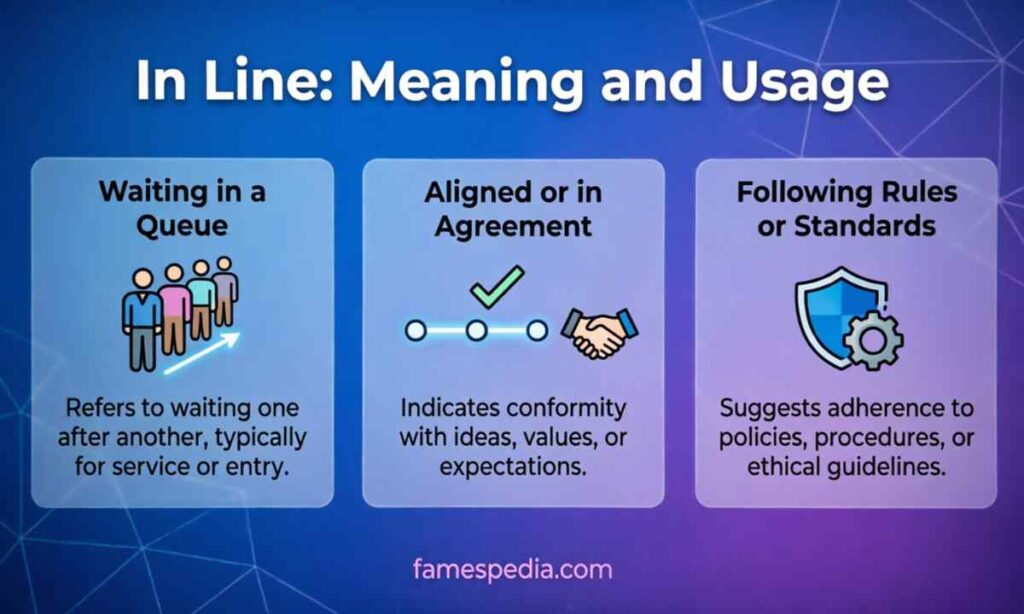
“In line” is a two-word phrase used in standard, everyday English. It carries two main meanings. First, it describes the physical act of waiting in a queue or sequence. Second, it describes something that matches, agrees with, or conforms to a set of rules or expectations.
Both meanings are rooted in the idea of order, arrangement, and alignment. When people or things are “in line,” they are properly positioned, either physically or figuratively.
How It Works in Sentences
“In line” almost always follows a verb. That position in the sentence, what grammarians call the predicate position, is your clearest signal that you need the two-word form. If you can place “stand,” “wait,” “keep,” or “fall” directly before it, you are looking at a two-word situation.
Think of it this way: the phrase describes a state or condition, so it never needs to be attached directly to a noun as a modifier.
Where You Will Use It
You will reach for “in line” in these situations:
- Describing people waiting their turn in a physical queue
- Expressing that a decision or behavior matches a standard
- Talking about plans that follow official guidelines or policies
- Using common idioms like “fall in line,” “stay in line,” or “step out of line”
This is the form you will use most often in everyday writing, business communication, and general professional content.
Real Examples of “In Line”
- We waited in line for over an hour to get concert tickets.
- Her proposal is in line with the company’s long-term goals.
- The new policy must stay in line with existing labor laws.
- Students formed a neat line outside the classroom door.
- The budget figures are in line with our quarterly forecast.
In-Line: Meaning and Usage
Understanding the Hyphenated Version
“In-line” is a compound adjective. That hyphen exists for a specific grammatical reason: it links two words together so they function as a single descriptive unit placed directly before a noun. Without the hyphen, the meaning can become unclear or ambiguous.
The Cambridge Dictionary and the Oxford Dictionary both include entries for “in-line” as a legitimate adjective, particularly in technical, engineering, and industrial contexts.
When You Need That Hyphen
The rule is straightforward. Use “in-line” when the phrase sits directly before a noun and acts as a modifier. The moment it moves to the predicate position (after the verb), the hyphen disappears and you use “in line” instead.
- Before a noun: “an in-line fuel injection system”
- After a verb: “the system is in line with safety standards”
AP Style tends to drop hyphens when meaning stays clear, nudging writers toward “inline” in technical contexts. The Chicago Manual of Style recommends hyphenating compound modifiers before nouns, which supports “in-line” in those same situations. Always check which style guide your industry or publication follows.
Where This Version Appears
You will encounter “in-line” most often in:
- Engineering and mechanical documentation
- Automotive writing (in-line engine, in-line cylinder arrangement)
- Industrial equipment descriptions
- Formal technical reports and product manuals
- Audio and recording equipment descriptions
Sample Sentences Using “In-Line”
- The car features an in-line six-cylinder engine for better performance.
- An in-line water filter keeps contaminants out of the supply.
- The in-line volume control on the microphone cable is very convenient.
- Engineers installed an in-line pressure valve to regulate flow.
- The factory uses an in-line conveyor system to move products efficiently.
Inline: Meaning and Usage
The Modern One-Word Form
“Inline” as a single word is the modern, streamlined version used primarily in digital and technical environments. It functions as both an adjective and an adverb. Web developers, software engineers, graphic designers, and technical writers all rely on this one-word form constantly in their daily work.
The trend toward compressing compound terms into single words is well-established in computer science. Think of how “online,” “offline,” and “inline” all follow the same pattern.
Computer and Web Contexts
In HTML and CSS, inline refers to styling or elements placed directly inside a tag rather than in a separate file. An inline style applies rules to a single element without affecting the rest of the page. In programming, inline functions are small pieces of code inserted directly at the call point to improve execution speed.
Inline elements in web design do not create a new line or break the text flow. They sit within the surrounding content. Understanding this is fundamental to front-end development work.
Where You Will See It
“Inline” appears regularly in:
- HTML and CSS documentation (“inline styles,” “inline elements”)
- Programming manuals and software guides (“inline functions,” “inline comments”)
- Web design tutorials and articles
- Code editors and developer tools
- Some modern references to inline skating (though engineers often prefer “in-line skates”)
Examples Using “Inline”
- The developer added inline CSS to style that specific button quickly.
- Inline elements like bold and italic text do not break the content flow.
- Using too much inline code can make large projects harder to maintain.
- The inline comment explained what that section of the function does.
- Web design beginners often start by writing inline styles before learning external stylesheets.
Key Differences Explained Simply
How They Work Differently
The three forms look similar but occupy completely different spaces in the language. “In line” lives in everyday spoken and written English. “In-line” belongs to formal technical documentation. “Inline” is native to digital communication and programming. Their contexts rarely overlap, which actually makes choosing between them easier than it first appears.
Choosing the Right One
Ask yourself one question before you write: what is my topic?
- Are you talking about people waiting or ideas matching a standard? Use in line.
- Are you describing machinery, equipment, or a technical component before a noun? Use in-line.
- Are you writing about code, web design, or digital content? Use inline.
Quick Decision Guide
| Situation | Correct Form | Example |
| People waiting in a queue | in line | We stood in line at the store. |
| Plans matching a policy | in line | The plan is in line with the budget. |
| Machine or equipment description | in-line | An in-line fuel injection system |
| HTML or CSS styling | inline | Add inline styles to the tag. |
| Programming functions | inline | Use inline functions for speed. |
| Skating sport | in-line or inline | In-line skates or inline skates |
Common Phrases You Should Know
Understanding “In Line With”
The phrase “in line with” means matching, agreeing with, or conforming to something. It is a staple of business writing and professional communication. You will see it in reports, policy documents, corporate emails, and news coverage.
- “Our pricing strategy is in line with current market trends.”
- “The new regulations are in line with international safety standards.”
Always use two words here. This phrase never takes a hyphen or merges into one word, regardless of the context.
The Right Way: “Fall In Line”
“Fall in line” is always written as three separate words. It is a traditional idiom meaning to start following rules, obeying authority, or conforming to expected behavior. You will often see it in military, organizational, and leadership contexts.
Writing “fall inline” is a common and noticeable error. Because the phrase has nothing to do with coding or digital content, the single-word “inline” form never applies here. The phrase is rooted in everyday language and follows the two-word rule without exception.
Other Useful Expressions
These related phrases all follow the two-word rule:
- Wait in line: to queue up for something
- Stand in line: to physically position oneself in a queue
- Step out of line: to behave inappropriately or break a rule
- Keep in line: to maintain order or discipline
- Out of line: describing something inappropriate or beyond acceptable limits
None of these expressions ever take a hyphen or become one word. They all belong to the everyday language category of “in line.”
Avoiding Common Mistakes

Mistakes People Make Often
The most frequent error writers make is using “inline” when they mean people waiting or ideas conforming to a standard. That pulls a digital communication term into a situation where it simply does not belong.
The second most common mistake is dropping the hyphen in technical descriptions. Writing “in line engine” instead of “in-line engine” removes clarity and makes the phrase feel grammatically incomplete. A reader might interpret it as two separate ideas rather than one compound modifier.
A third mistake is treating all three forms as interchangeable and choosing whichever looks familiar. Since they all sound identical when spoken aloud, many writers default to the one they see most often in their own field and apply it universally. That leads to errors across all three usage areas.
Simple Memory Tricks
These three rules will stick with you:
- People and policies? Two words. Any time humans, plans, or rules are involved, write “in line” with a space.
- Machines and equipment? Add the hyphen. Technical components described before a noun always take the “in-line” form.
- Code and digital content? One word. Anything in a browser, a stylesheet, or a programming environment uses “inline” without any space or hyphen.
You can also think of it as a spectrum. At one end, physical and abstract everyday usage uses “in line.” At the technical hardware level, “in-line” appears. At the fully digital software level, “inline” takes over. Match your word choice to where your topic falls on that spectrum and you will almost never make a mistake.
You May Also Like This: Realist Vs. Realest: How Are These Different? When To Use
Conclusion
The difference between “in line,” “in-line,” and “inline” comes down to three simple contexts: everyday language, technical hardware, and digital writing. Once you connect each form to its home territory, the confusion disappears completely.
Use in line for people, queues, and ideas that align with rules. Use in-line for engineering components and machinery described before a noun. Use inline for anything in a browser, stylesheet, or codebase. Keep your word choice matched to your topic and your writing will always be clear, correct, and professional.

Arslan is the creator and author behind FamesPedia, a platform focused on grammar, writing skills, and English language learning. Passionate about clear communication and effective writing, Arslan shares practical grammar tips, easy-to-follow language guides, and educational content to help readers improve their English with confidence.