You are writing a recipe card, a product label, or a social media caption and then you pause. Is it home made or homemade? Two words or one? Maybe with a hyphen? This small spelling question trips up a lot of writers, and the confusion is completely understandable because all three forms look familiar at a quick glance.
This article gives you a clear, direct answer. You will learn which spelling is correct, why it is correct, how it compares to the hyphenated form, and how to use it naturally in sentences. Whether you are writing for a blog, a business, or everyday communication, this guide covers everything you need.
Home Made or Homemade? Which is Correct?
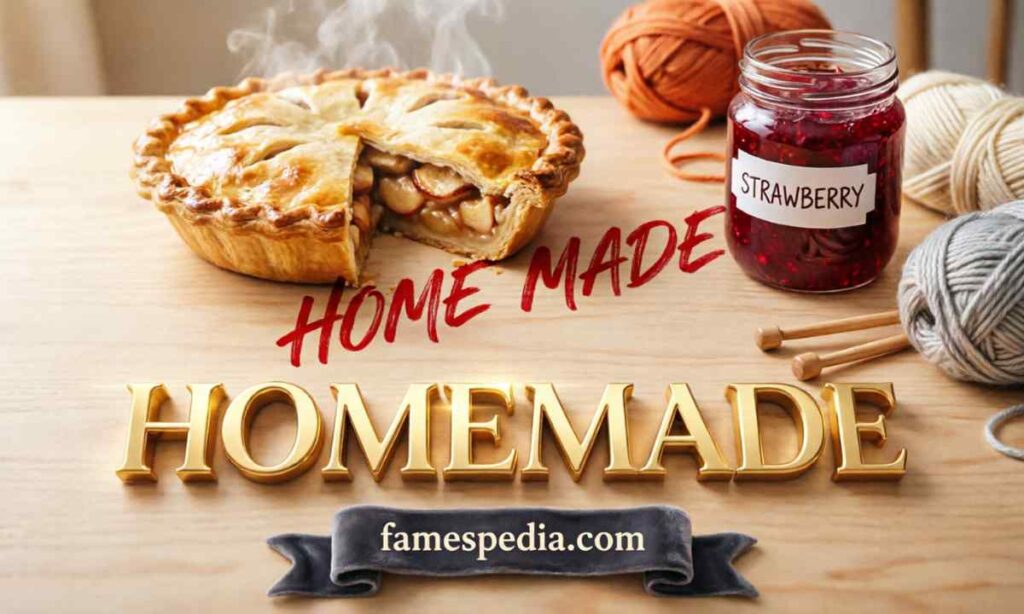
The correct spelling is homemade, written as one single word with no space and no hyphen.
Homemade is a compound adjective, meaning two words have joined together to describe a noun. “Home made” as two separate words is incorrect, and “home-made” with a hyphen is an older form that some older publications still use, but the one-word form is now the standard in both British and American English.
Here is a quick reference table:
| Form | Correct? | Notes |
| Homemade | Yes | Modern standard spelling |
| Home-made | Acceptable in some contexts | Older British form, still seen in AP Style |
| Home made | No | Incorrect in modern English |
Home Made or Homemade Meaning
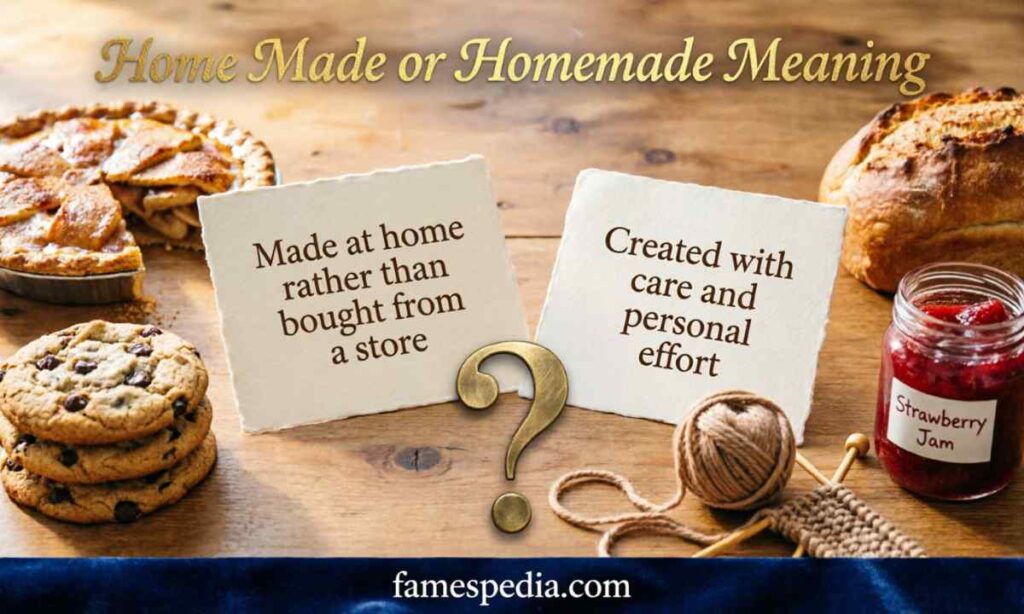
Both “home made” and “homemade” point toward the same idea: something produced at home rather than in a factory or store. However, only one of them works as a real English word.
When you write “home made” as two separate words, “home” becomes a noun and “made” becomes a verb, but there is no usual grammatical context where these two words naturally sit next to each other as separate units. This creates confusion in the message you are trying to convey.
The correct spelling is “homemade” because it is a compound word that describes anything made at home. Unlike “home made,” which uses two separate words, “homemade” works as an adjective to clearly show that something, like food, crafts, or remedies, is prepared at home rather than bought.
Why Homemade is the Correct Spelling
English compound words follow a predictable pattern. They start as two separate words, then pick up a hyphen, and eventually merge into one solid word. “Homemade” completed that journey long ago.
Data from Google Ngram Viewer, a tool that tracks word usage across millions of published books, shows that “homemade” overtook “home-made” as the dominant form in print during the mid-twentieth century. Since then, the one-word version has continued to grow in usage while the hyphenated form has declined steadily.
All major English dictionaries list “homemade” as the standard form. Choosing the correct spelling matters because it shows attention to detail and communicates care, precision, and professionalism, whether on a recipe card, in a blog, or on product packaging.
There is also a practical grammar reason. “Homemade” functions as a single adjective that modifies a noun directly. It describes a characteristic of the thing you are talking about. Splitting it into two words removes that function and leaves you with a grammatically awkward phrase.
Homemade: Meaning and Usage
Merriam-Webster defines “homemade” as “made in the home, on the premises, or by one’s own efforts.” The Cambridge Dictionary offers a similar definition: “made at home and not bought from a shop.” Both definitions agree on the core idea: something a person made themselves, rather than something produced commercially in a factory or sold in a store.
The word carries emotional weight beyond its literal meaning. When you call something homemade, you signal authenticity, personal effort, and care. A jar of homemade jam tells a different story than a jar bought from a supermarket shelf.
You can use “homemade” across a wide range of contexts:
- Food: homemade bread, homemade soup, homemade cookies
- Crafts: homemade candles, homemade decorations, homemade gifts
- Personal care: homemade remedies, homemade soap, homemade skincare
- Everyday objects: homemade furniture, homemade tools, homemade costumes
“Homemade” always works as an adjective. Place it directly before the noun it describes for the clearest, most professional result.
Homemade vs Home-made: Is the Hyphenated Form Correct?
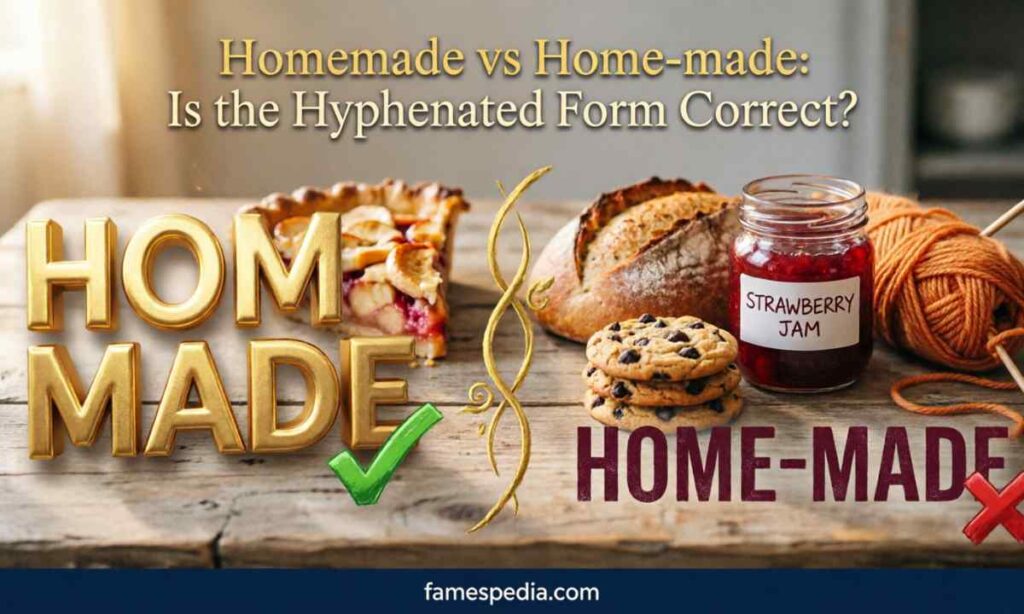
This is where many writers feel uncertain. Is “home-made” with a hyphen acceptable, or should you always drop the hyphen?
“Home-made” is correct when hyphenated, but it is much less common today. It was the original way to spell the adjective form, but the evolution of the language has allowed writers to drop the hyphen in favor of simplicity.
The Cambridge Dictionary lists “homemade” as one word with no hyphen but also lists “home-made” with a hyphen as an alternative spelling form. The grammar rule for the hyphenated version states that it is a compound adjective and should always go directly before the noun it modifies.
Here is when each form applies:
Use “homemade” (one word):
- In all standard modern writing, American and British
- In blog posts, recipes, product descriptions, and social media
- When the modified noun appears before or after the adjective
- In academic and professional writing
Use “home-made” (hyphenated):
- When strictly following the AP Stylebook, which hyphenates compound adjectives placed directly before a noun
- When quoting older texts or brand names that use the hyphenated form
- In some traditional British publications, though this is becoming less common
Modern British publishing has largely moved to the one-word form. You will still encounter “home-made” on older British recipe cards and in classic British texts, but contemporary British newspapers, websites, and books overwhelmingly prefer “homemade.”
The safest and most universally accepted choice is always homemade as one word. It works in every context, follows modern dictionary standards, and requires no additional rules to remember.
Examples of Using “Homemade” in a Sentence
Seeing the word in real sentences is the best way to lock in the correct usage. Here are practical examples across different topics and contexts.
Food and Cooking
- She baked homemade cookies for the school fundraiser.
- Nothing beats a bowl of homemade soup on a cold evening.
- The restaurant claimed their pasta was homemade, and you could taste the difference.
- He spent Sunday morning making homemade pancakes from scratch.
- I prefer homemade salsa over anything sold in a jar.
Crafts and DIY Projects
- The children presented their parents with homemade cards on Mother’s Day.
- She decorated the entire event with homemade paper flowers.
- He built a homemade bookshelf using reclaimed wood from the garage.
- Their homemade costumes were the hit of the Halloween party.
- The market stall sold homemade candles with natural essential oils.
Remedies and Personal Care
- Her grandmother always relied on homemade remedies for minor ailments.
- She made a homemade face mask using honey and oats.
- The lotion was completely homemade and free of any artificial ingredients.
Professional and Business Contexts
- The bakery built its entire brand around the appeal of homemade goods.
- Their menu featured homemade sauces prepared fresh each morning.
- The developer built a homemade automation tool that saved the team hours each week.
Notice that in every sentence above, “homemade” sits directly before the noun it describes or is used as a predicate adjective after the noun. Both placements are correct. When the noun appears before the term, you should write it as one word too. For example: “The tomato sauce was homemade by her mother.”
Homemade vs Handmade: Are They the Same?
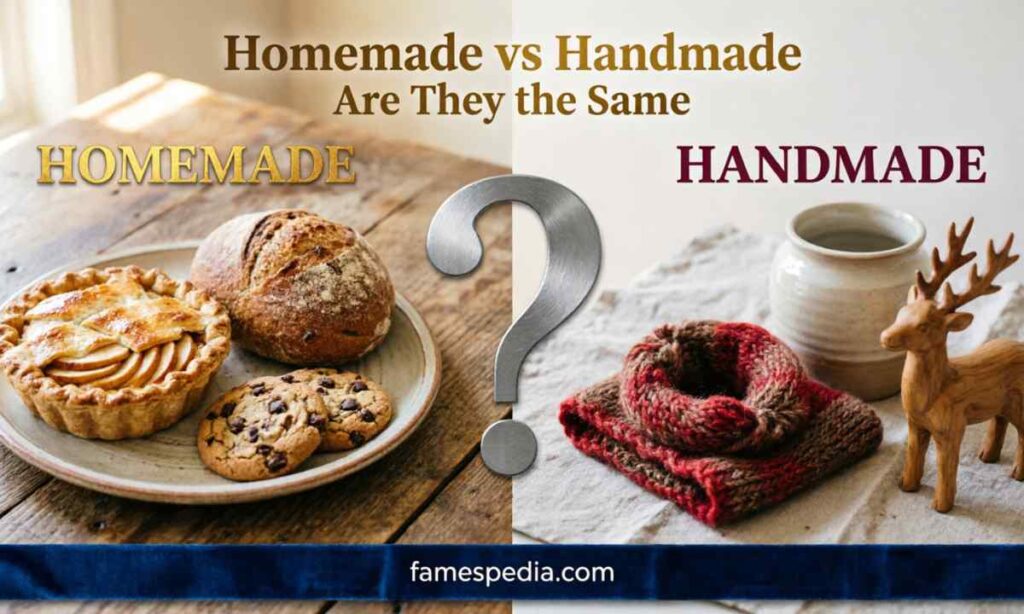
Many people use “homemade” and “handmade” as if they mean the same thing, but they do not.
Homemade and handmade are often confused, but they describe different ideas. Homemade focuses on where something is made, while handmade focuses on how it is made. Homemade refers to items made at home regardless of method, while handmade refers to items crafted by hand, regardless of location.
| Term | Focus | Example |
| Homemade | Where it was made (at home) | Homemade bread baked in your kitchen |
| Handmade | How it was made (by hand, not machine) | Handmade jewelry crafted by an artisan |
A piece of jewelry made by hand in a factory is handmade but not homemade. A loaf of bread baked in your kitchen using a bread machine is homemade but not entirely handmade. Understanding this difference prevents misuse of both words.
Also Read This: Maintained vs Maintenanced: Meaning And Differences
Conclusion
The answer is clear and simple. Homemade is the correct, modern, and universally accepted spelling. “Home made” as two separate words is incorrect and has no place in standard English writing. “Home-made” with a hyphen is an older form that still appears in certain style guides and older British texts, but the one-word version works better in virtually every situation.
Using “homemade” correctly does more than avoid a spelling error. It signals that you understand modern English conventions, pay attention to detail, and write with clarity. Whether you are crafting a recipe post, labeling a product, or writing a professional document, this single word does a great job of communicating warmth, authenticity, and care.
When in doubt, just remember: one word, no hyphen, always homemade.

Arslan is the creator and author behind FamesPedia, a platform focused on grammar, writing skills, and English language learning. Passionate about clear communication and effective writing, Arslan shares practical grammar tips, easy-to-follow language guides, and educational content to help readers improve their English with confidence.