“Well noted” shows up in almost every professional inbox. Someone sends an update, a deadline, or a piece of feedback, and back comes the same two word reply. It works, but it also gets tired fast, and leaning on it in every single email can make your writing sound flat, robotic, or even a little dismissive to the person on the other end.
The good news is that English gives you dozens of ways to say the same thing with more warmth, more precision, or more personality, depending on who you are writing to and what the situation calls for. This guide walks through what “well noted” actually means, when it fits, whether it is considered professional, and more than thirty alternatives you can start using today. Each one comes with a plain explanation and a real world example so you know exactly how to slot it into your own writing without sounding forced.
What Does “Well Noted” Mean?
“Well noted” is a short acknowledgment phrase. It tells the sender that you have received their message, read it carefully, and registered the information inside it. It does not necessarily mean you agree with what was said, only that you have taken it in and are aware of it.
You will most often see this phrase in workplace emails, after instructions, updates, corrections, reminders, or policy changes. It confirms receipt without promising any specific next step, which is exactly why some people find it efficient and others find it a bit cold or vague. For example, if a manager writes, “Please submit your timesheet by Friday,” a reply of “Well noted” simply confirms you saw the deadline, nothing more.
When to Use “Well Noted”
“Well noted” works best in situations where a brief, neutral acknowledgment is all that is needed and a longer reply would feel unnecessary. Common scenarios include:
- Confirming you received new instructions from a manager or client
- Acknowledging a schedule change, deadline, or meeting update
- Responding to a correction on a report, invoice, or document
- Letting a colleague know their feedback has been registered
- Replying to an internal memo, policy update, or announcement that does not require a detailed response
- Confirming receipt of files, attachments, or reference materials
It is less suitable for emotionally sensitive messages, complaints, apologies, or situations where the sender expects a warmer or more detailed reply. In those cases, a fuller response shows more care, builds trust, and reduces the risk of the message sounding indifferent or automated.
Is It Professional or Polite to Say “Well Noted”?
Yes, “well noted” is generally considered professional and polite, particularly in formal or corporate settings. It is concise, respectful, and gets straight to the point, which many senior colleagues, clients, and managers appreciate when time is limited and clarity matters more than elaboration.
That said, tone matters just as much as word choice. Sent on its own with no greeting, no punctuation softeners, or no follow up line, it can read as curt or even passive aggressive, especially in email threads with people you do not know well or in cultures where warmth is expected in written communication. Pairing it with a short line of context, such as thanking the sender or confirming your next action, softens the phrase and keeps the exchange friendly rather than transactional.
Because it can come across as repetitive when used constantly across dozens of emails a week, mixing in the alternatives below keeps your professional communication feeling fresh, genuine, and attentive rather than copy and pasted.
Synonyms For “Well Noted”
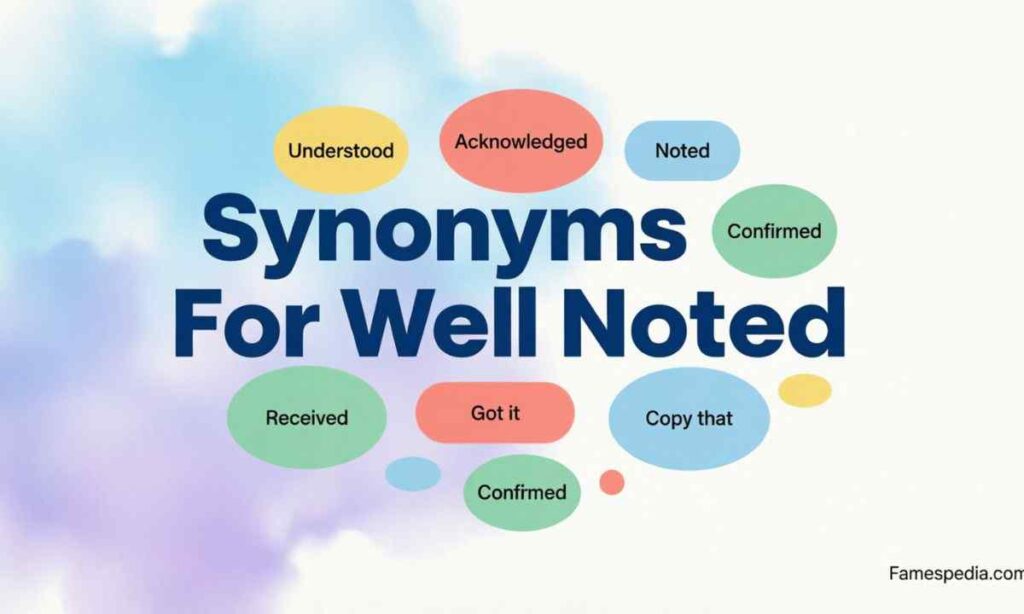
Here is a quick reference table of alternatives, along with the tone each one carries and the setting it fits best. Use it to quickly find the right phrase before reading the full breakdown below, or bookmark it for the next time you are stuck rewriting the same email closing line.
| Alternative | Tone | Best For |
| Acknowledged | Formal | Official emails, senior management |
| Noted With Thanks | Warm professional | Client and team updates |
| Understood | Neutral professional | Instructions, task assignments |
| Got It | Casual | Internal team chats |
| Duly Noted | Formal | Corrections, policy reminders |
| Taken On Board | Warm professional | Feedback and suggestions |
| I Understand | Neutral | Clarifications |
| Received With Thanks | Formal | Document or file submissions |
| Point Taken | Casual professional | Feedback, criticism |
| Message Received | Neutral | Quick confirmations |
| I’ve Noted This | Neutral professional | Meeting notes |
| Thanks for Letting Me Know | Warm | Updates and heads ups |
| I’ll Keep This in Mind | Warm professional | Future planning |
| Noted and Appreciated | Warm | Positive feedback |
| Consider It Noted | Casual | Informal reminders |
| I’ve Taken Note | Formal | Instructions |
| This Is Clear | Neutral | Task clarification |
| I Hear You | Warm, empathetic | Concerns, complaints |
| Understood and Noted | Formal | Compliance messages |
| All Clear | Casual | Status checks |
| I’ve Got This | Casual, confident | Task confirmation |
| Clear on This | Neutral | Instructions |
| I Acknowledge This | Formal | Official correspondence |
| Noted for Future Reference | Neutral professional | Policy or process updates |
| I Appreciate the Update | Warm professional | Status reports |
| All Set | Casual | Confirmations |
| I’m Aware Now | Neutral | New information |
| Thanks for the Heads Up | Warm, friendly | Alerts, warnings |
| I’ve Made a Note | Neutral professional | Reminders |
| Thanks, Noted | Casual professional | Quick replies |
| Confirmed and Understood | Formal | Contracts, official approvals |
| I’ll Take Care of It | Warm, confident | Task ownership |
| Noted, Thank You | Warm professional | General acknowledgment |
Acknowledged
“Acknowledged” is a single word reply that instantly confirms you received and understood a message. It suits formal settings such as corporate updates, official notices, or communication with senior leadership, where brevity signals confidence rather than coldness.
When to use it: choose “acknowledged” when you want a crisp, no frills confirmation and the relationship is already fairly formal.
Example: “Acknowledged. I will forward this to the finance team by end of day.”
Noted With Thanks

This phrase blends acknowledgment with gratitude, making it warmer than a plain “noted.” It works well when someone has gone out of their way to share information, correct an error, or provide helpful context.
When to use it: reach for this when you want to sound appreciative without writing a full paragraph.
Example: “Noted with thanks. I have updated the file accordingly.”
Understood
“Understood” confirms comprehension rather than just receipt. Use it after instructions or explanations when you want the sender to know the message made sense and you are ready to act on it.
When to use it: perfect for confirming task instructions or process explanations from a manager.
Example: “Understood, I’ll have the revised draft ready by Thursday.”
Got It
“Got it” is casual and best suited to internal chats, quick replies, or messages between colleagues who already have a relaxed rapport. It confirms receipt without sounding overly formal or stiff.
When to use it: ideal for Slack messages, texts, or fast paced team threads.
Example: “Got it, I’ll update the spreadsheet now.”
Duly Noted
“Duly noted” carries a formal, almost official tone. It works well for corrections, policy reminders, or situations where you want to show the information has been properly registered and will be respected going forward.
When to use it: strong choice for compliance related messages or formal corrections.
Example: “Duly noted. The revised timeline will be reflected in tomorrow’s report.”
Taken On Board
This phrase is common in feedback situations. It shows that you have not just heard the information but plan to genuinely factor it into future decisions or behavior.
When to use it: use it after receiving constructive criticism or suggestions during a review.
Example: “Thank you, I’ve taken your suggestions on board for the next version.”
I Understand
Similar to “understood,” this option feels slightly more personal because it uses “I.” It works well when responding to explanations, apologies, or detailed instructions that deserve a direct acknowledgment.
When to use it: good for one on one conversations where personal tone matters.
Example: “I understand the new process, and I’ll follow it starting Monday.”
Received With Thanks
Use this when someone sends a document, file, or formal submission. It confirms both receipt and appreciation, which is especially useful in client facing or administrative communication.
When to use it: best for confirming attachments, invoices, or signed paperwork.
Example: “Received with thanks. I will review the contract this afternoon.”
Point Taken
“Point taken” acknowledges an argument, piece of feedback, or criticism, often signaling that you accept the validity of what was said. It fits casual to semi formal professional exchanges.
When to use it: useful when someone corrects you and you want to accept it gracefully.
Example: “Point taken, I’ll rework the proposal with that in mind.”
Message Received
This is a neutral, straightforward way to confirm you saw a message, often used when a fuller response will come later. It sets expectations without committing to immediate action.
When to use it: helpful when you need time before giving a complete answer.
Example: “Message received, I’ll get back to you with details tomorrow.”
I’ve Noted This
This phrase personalizes the acknowledgment while keeping things simple. It suits meeting notes, task lists, or any context where you want to confirm information has been logged for reference.
When to use it: works well during meetings or when tracking action items.
Example: “I’ve noted this and will include it in the meeting minutes.”
Thanks for Letting Me Know
A warmer, more conversational alternative, this phrase works well for updates, heads ups, or anything where the sender took the initiative to inform you of something.
When to use it: choose this when someone proactively shares information you did not ask for.
Example: “Thanks for letting me know, I’ll adjust my schedule accordingly.”
I’ll Keep This in Mind
Use this when the information is relevant to future decisions rather than an immediate task. It signals that you will factor it in later without promising instant action.
When to use it: fits long term planning conversations or advisory feedback.
Example: “I’ll keep this in mind for next quarter’s planning.”
Noted and Appreciated
This phrase pairs acknowledgment with genuine gratitude, making it ideal for positive feedback, compliments, or helpful suggestions from colleagues or clients.
When to use it: great for responding to praise or thoughtful input.
Example: “Noted and appreciated, thank you for taking the time to explain this.”
Consider It Noted
A slightly informal, confident way to confirm receipt, often used among peers or in quick internal replies where a lighter tone fits the relationship.
When to use it: works nicely in friendly team environments.
Example: “Consider it noted, I’ll have the changes ready by Friday.”
I’ve Taken Note
Similar to “I’ve noted this” but slightly more formal, this phrase fits instructions or important updates that require careful attention and a documented response.
When to use it: appropriate for official memos or procedural changes.
Example: “I’ve taken note of the new submission guidelines.”
This Is Clear
Use this when confirming that instructions or explanations make sense, particularly in task based communication where clarity matters most and you want to avoid follow up questions.
When to use it: good after receiving detailed step by step instructions.
Example: “This is clear, I’ll proceed with the updated figures.”
I Hear You
This phrase leans empathetic and works especially well for concerns, complaints, or emotionally charged messages where the sender wants to feel genuinely listened to, not just processed like a routine email.
When to use it: use with care during difficult or sensitive conversations.
Example: “I hear you, and I understand why this delay is frustrating.”
Understood and Noted
Combining two acknowledgment phrases adds emphasis and formality, making it suitable for compliance messages, audits, or official instructions where precision matters and ambiguity is not an option.
When to use it: fits legal, HR, or regulatory communication.
Example: “Understood and noted, the policy will be applied from next week.”
All Clear
A casual, upbeat phrase often used to confirm that a task, plan, or piece of information has been fully understood and there are no outstanding questions left.
When to use it: handy for quick status checks with a team.
Example: “All clear on the new schedule, thanks for confirming.”
I’ve Got This
Confident and casual, this phrase reassures the sender that you have understood the task and are already handling it, without needing further explanation or hand holding.
When to use it: use when you want to project ownership and reliability.
Example: “I’ve got this, I’ll send the report over by lunchtime.”
Clear on This
A short, neutral way to confirm understanding, often used after instructions or clarifications in fast paced team communication where speed matters more than formality.
When to use it: works well in project management tools and quick chats.
Example: “Clear on this, I’ll make the changes right away.”
I Acknowledge This
A formal alternative suited to official correspondence, contracts, or situations where a documented confirmation of receipt is important for accountability purposes.
When to use it: choose this for legal or contractual exchanges.
Example: “I acknowledge this and will respond formally by tomorrow.”
Noted for Future Reference
This phrase signals that the information is being stored for later use rather than acted on immediately, useful for policy updates or process changes that apply going forward.
When to use it: good for onboarding materials or reference documents.
Example: “Noted for future reference, I’ll apply this to upcoming projects.”
I Appreciate the Update
A warm, professional way to acknowledge status reports or progress updates while also expressing gratitude for being kept informed throughout a project.
When to use it: use for recurring progress emails or check ins.
Example: “I appreciate the update, everything looks on track.”
All Set
Casual and efficient, this phrase confirms that everything discussed has been understood and there is nothing further needed from either party at this stage.
When to use it: fits confirming logistics like meetings or bookings.
Example: “All set, thanks for confirming the details.”
I’m Aware Now
This phrase works when someone has informed you of something you did not previously know, and you want to confirm the gap has been closed without overreacting.
When to use it: appropriate for correcting a misunderstanding or oversight.
Example: “I’m aware now, thank you for flagging this issue.”
Also Read This Information: Pentoxide vs Pentaoxide: Differences And Uses For Each One
Thanks for the Heads Up
A friendly, informal acknowledgment often used for warnings, alerts, or advance notice about upcoming changes, delays, or risks.
When to use it: ideal for casual internal warnings between coworkers.
Example: “Thanks for the heads up, I’ll prepare accordingly.”
I’ve Made a Note
A neutral professional phrase confirming that the information has been recorded, commonly used for reminders or details that need tracking over time.
When to use it: use for personal reminders, preferences, or scheduling details.
Example: “I’ve made a note of your availability for next week.”
Thanks, Noted

A quick, casual professional reply that works well for short internal messages where a longer response is not necessary and speed is the priority.
When to use it: great for rapid back and forth email chains.
Example: “Thanks, noted, I’ll circle back once I have an update.”
Confirmed and Understood
This phrase combines confirmation with comprehension, making it useful when you want to leave no room for doubt about whether you accepted and understood the terms of a message.
When to use it: best for approvals, sign offs, or contractual confirmations.
Example: “Confirmed and understood, we will proceed under the new terms.”
I’ll Take Care of It
This alternative shifts the focus from acknowledgment to action, reassuring the sender that the matter is already being handled without needing further prompting.
When to use it: use when you want to demonstrate ownership immediately.
Example: “I’ll take care of it and update you by tomorrow morning.”
Noted, Thank You
A simple, warm variation that adds a touch of courtesy to a plain acknowledgment, making it feel less abrupt in written exchanges.
When to use it: works well for closing out short informational emails politely.
Example: “Noted, thank you, I’ll adjust the report accordingly.”
Conclusion
“Well noted” will always have a place in professional communication, but it does not need to be your only option. Whether you are writing to a client, replying to a manager, or chatting with a teammate, the right acknowledgment phrase can make your message feel more thoughtful, more human, and better suited to the moment.
Keep this list handy the next time you catch yourself reaching for the same two words. A small change in wording can make a noticeable difference in how warm, professional, or engaged your emails come across, and that is a simple upgrade worth making the next time you sit down to reply.

Arslan is the creator and author behind FamesPedia, a platform focused on grammar, writing skills, and English language learning. Passionate about clear communication and effective writing, Arslan shares practical grammar tips, easy-to-follow language guides, and educational content to help readers improve their English with confidence.