
If you’ve ever paused mid-sentence wondering whether to write nonresponsive or unresponsive, you’re not alone. These two words look nearly identical, sound almost the same, and seem to mean the same thing yet writers, medical professionals, and grammar enthusiasts debate them constantly.
So which one is actually correct? The short answer: both are correct, but they aren’t always interchangeable. Context is everything.In this guide, you’ll get a clear breakdown of both words, their origins, meanings, everyday usage, example sentences, and synonyms so you can choose the right word with confidence every time.
Origin of Words: Nonresponsive vs Unresponsive
Understanding where a word comes from often unlocks its true meaning. Both nonresponsive and unresponsive share the same root word responsive which traces back to the Latin responsivus, first recorded around 1375–1425, meaning “capable of replying or reacting to external stimuli.”
What sets these two words apart is their prefix.
The Prefix “Non-“
The prefix non- comes from Latin and simply means “not” or “lacking.” It signals the absence or failure of something. When attached to responsive, it forms nonresponsive literally meaning “not giving a response.” This prefix is typically used in formal, technical, or academic writing and carries a detached, clinical tone.
The Prefix “Un-“
The prefix un- comes from Old English and also means “not” or “opposite of.” However, un- is far more versatile than non-. It can negate adjectives, reverse verb actions (think: dress → undress), and apply to both physical and emotional states. Because English historically favors un- with adjectives, unresponsiveness became the more widely adopted and natural-sounding form.
Quick Tip: The prefix non- carries a sense of absence or omission. The prefix un- often suggests a reversal or a deeper inability to respond.
Nonresponsive vs Unresponsive Meaning
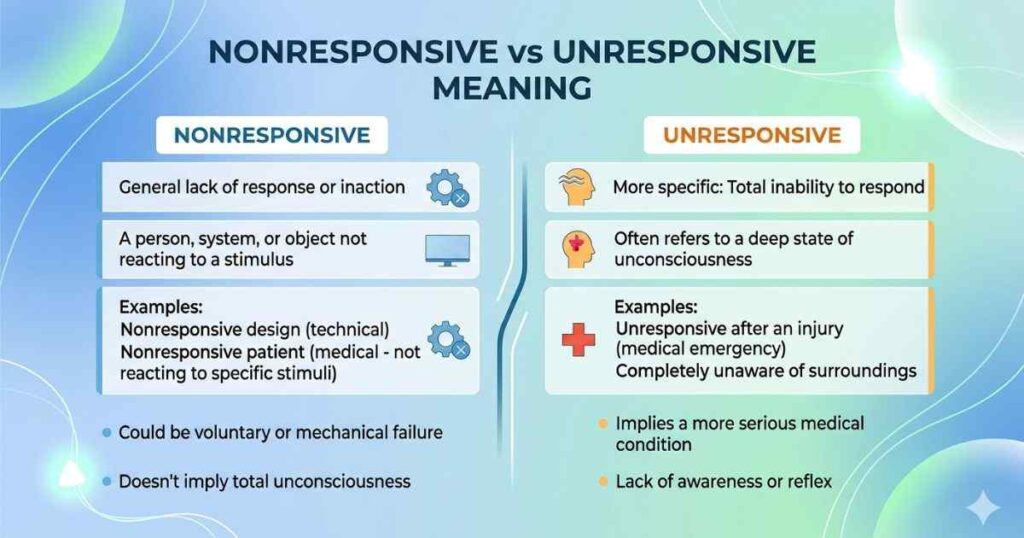
Despite their shared root, these words carry slightly different shades of meaning depending on context.
What Does Nonresponsive Mean?
Nonresponsive is an adjective that describes someone or something that fails to reply or react, particularly in a formal, procedural, or technical setting. The lack of response here is often expected: a reply was due, but it never came.
It’s not necessarily about physical inability; it’s more about the absence of a reply or reaction under circumstances where one is anticipated.
You may also see it written as non-responsive (with a hyphen). Both spellings are accepted. The Cambridge Dictionary uses the hyphenated form, while Merriam-Webster prefers the solid form. Either way, the meaning stays the same.
Key characteristics of nonresponsive:
- More formal and technical in tone
- Common in medical, legal, and research contexts
- Describes a failure to reply, not necessarily an inability to do so
- Often used for systems, treatments, organizations, and procedures
What Does Unresponsive Mean?
Unresponsive is also an adjective, but it covers a broader range of meanings. It describes someone or something that does not react to stimuli, questions, or actions whether due to physical incapacity, emotional detachment, or simple silence.
When a patient is described as unresponsive, it signals a medically serious condition. When a person is emotionally unresponsive, it means they show no feelings or reaction. When a phone is unresponsive, the screen won’t respond to touch.
Key characteristics of unresponsive:
- Broader and more versatile in use
- Common in medical, emotional, technical, and everyday language
- Can imply inability, apathy, indifference, or unconsciousness
- The go-to word in casual and general writing
Read Information about Grammar and words on famespedia
Nonresponsive vs Unresponsive: Side-by-Side Comparison
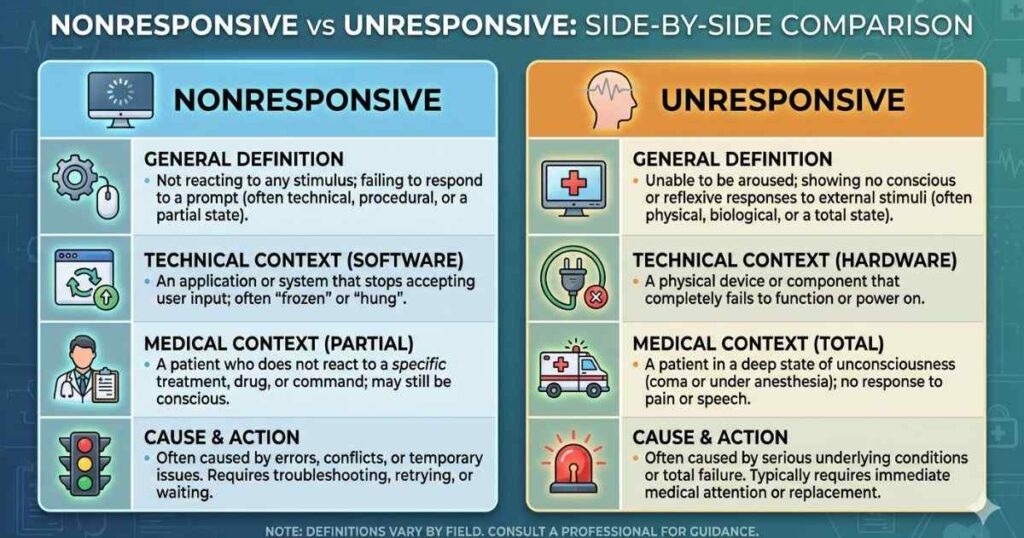
| Feature | Nonresponsive | Unresponsive |
| Prefix Origin | Latin (non-) | Old English (un-) |
| Tone | Formal, clinical, technical | Versatile, general, natural |
| Common Contexts | Medical treatment, legal, research, systems | Medical emergencies, emotions, tech, everyday use |
| Emotional Connotation | Rarely used for emotional states | Can describe apathy, indifference |
| Hyphenated Form | Non-responsive (also accepted) | N/A |
| Frequency of Use | Less common | More common |
| Best For | Professional/academic writing | All writing styles |
How Do People Use Nonresponsive and Unresponsive?
Unresponsive in Everyday Use
Unresponsive is the word you’ll encounter most in daily life. It shows up in news headlines, medical reports, tech troubleshooting guides, and casual conversations. Its flexibility makes it the natural default choice when you need to describe any kind of non-reaction.
Common everyday scenarios:
- Medical: A 911 dispatcher asking whether a patient is breathing or unresponsive
- Technology: A frozen phone or computer screen described as unresponsive
- Emotional: Someone described as cold, detached, or unresponsive to affection
- Social: A friend who seems unresponsive to jokes or feedback
Because unresponsive sounds more human and relatable, it tends to appear in contexts where there’s emotional weight or urgency behind the situation.
Nonresponsive in Everyday Use
Nonresponsive tends to appear in more structured, formal settings. You’re more likely to read it in a research paper, clinical report, legal document, or organizational memo. It communicates the same core meaning no response but does so at a professional distance.
Common formal scenarios:
- A clinical trial report noting that patients were nonresponsive to a new drug
- A customer service log flagging nonresponsive clients who didn’t reply to emails
- A legal deposition where a witness is marked nonresponsive for avoiding direct answers
- A data analysis excluding nonresponsive survey entries
If you’re writing formally and want to signal precision, nonresponsive does that job well. But in everyday writing, unresponsive almost always sounds more natural.
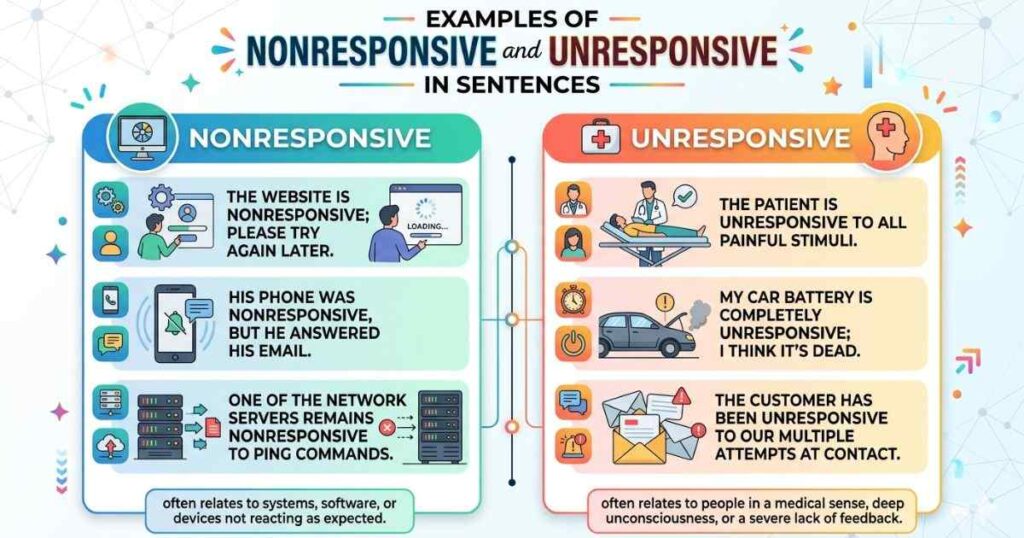
Examples of Nonresponsive and Unresponsive in Sentences
Example Sentences with Unresponsive
- The paramedics arrived to find the elderly man unresponsive on the floor.
- After hours of waiting, she grew frustrated with the unresponsive customer support team.
- No matter what the coach said, the players seemed completely unresponsive to his feedback.
- His phone screen became unresponsive after it got wet in the rain.
- She sat quietly in the corner, unresponsive to every question directed at her.
- The medication was tested on several patients, but the majority remained unresponsive to the treatment.
- The market has been unresponsive to the new policy changes announced last month.
Example Sentences with Nonresponsive
- The committee flagged all nonresponsive vendors who failed to submit their bids on time.
- Clinical notes indicated that the patient was nonresponsive to three rounds of chemotherapy.
- The software became nonresponsive after the latest update was installed.
- Nonresponsive survey entries were removed from the data set before analysis began.
- His legal team was criticized for being nonresponsive during the discovery phase.
- The organization is known for being nonresponsive to public complaints and feedback.
- Doctors confirmed the tumor was nonresponsive to conventional radiation therapy.
Non Responsive or Unresponsive: What About Synonyms?
Whether you’re writing to avoid repetition or simply want the most precise word for your context, here are the best synonyms and related terms for both words.
Synonyms for Unresponsive:
- Inert
- Apathetic
- Indifferent
- Impassive
- Inactive
- Unconscious (in medical contexts)
- Insensible
- Cold
- Detached
- Aloof
Synonyms for Nonresponsive:
- Unresponsive
- Non-reacting
- Inactive
- Uncooperative (in communication contexts)
- Irresponsive (rare and outdated avoid this one)
- Silent
- Unacknowledging
Note on “irresponsive”: Some older texts use irresponsive as a synonym. However, this word is largely obsolete and can make your writing feel awkward. Stick with nonresponsive or unresponsive for clarity.
Which One Should You Use? A Simple Rule
When you’re unsure which word fits better, follow this simple guide:
- Use unresponsive when describing a physical inability to react, an emotional state of apathy, a tech issue, or any general everyday situation.
- Use nonresponsiveness when writing in a formal, clinical, research, or technical context where you’re noting the failure to reply or react in a structured setting.
- When in doubt, choose unresponsive. It’s universally understood, widely accepted, and naturally fits almost every context.
Conclusion
At first glance, nonresponsive and unresponsive look like carbon copies of each other. Once you understand their prefixes, tone, and typical usage, choosing between them becomes simple. Unresponsive is flexible and everyday; nonresponsive is formal and precise.
Both words are correct and context decides the better fit. When in doubt, always default to unresponsiveness. It works in virtually every situation and will never make your writing sound off.

Arslan is the creator and author behind FamesPedia, a platform focused on grammar, writing skills, and English language learning. Passionate about clear communication and effective writing, Arslan shares practical grammar tips, easy-to-follow language guides, and educational content to help readers improve their English with confidence.