
If you’ve ever paused mid-sentence wondering whether to write “how are you faring” or “how are you fairing,” you’re far from alone. These two words sound identical in speech, making them one of the sneakiest mix-ups in everyday English. The good news? The answer is simple and once you understand it, you’ll never second-guess yourself again.
The Quick Answer: “Faring” Is Always Correct
“How are you faring?” is the grammatically correct phrase. It uses faring the present participle of the verb fare to ask about someone’s well-being, progress, or how they’re managing a situation.
“How are you fairing?” is incorrect in this context. Fairing is a noun used in engineering and aerodynamics. It has nothing to do with a person’s health, emotions, or life circumstances.
Think of it this way: you fare through life’s challenges; a motorcycle has a fairing to cut through wind.
What’s the Difference Between “Faring” and “Fairing”?
Despite sounding identical, these two words belong to completely different worlds.
| Feature | Faring | Fairing |
| Part of speech | Verb (present participle) | Noun |
| Root word | Fare (to get along, progress) | Fair (smooth, even) |
| Used for | People, situations, progress | Vehicles, aircraft, aerodynamics |
| Example | How are you faring at your new job? | The motorcycle’s fairing reduces drag. |
| Correct in “How are you ___?” | ✅ Yes | ❌ No |
Read Information About This From Here: Rug vs. Rag: How Are These Different? When To Use Them?
Understanding “Faring”: The Verb
What Does “Faring” Mean?
Faring comes from the Old English verb faran, which originally meant “to journey or travel.” Over centuries, its meaning expanded beyond physical travel to describe how someone moves through life’s circumstances, their condition, progress, or experience in a given situation.
When you ask someone “how are you faring,” you’re essentially asking:
- How are you getting along?
- How are you managing?
- How are things going for you?
It’s a warm, thoughtful phrase often used when someone is navigating a challenge, a new job, a health issue, a difficult project, or a major life change.
Context for the Use of “Faring”
You’ll naturally reach for faring whenever you’re:
- Checking in on someone’s well-being “How are you faring after the surgery?”
- Asking about progress at work or school “How are the new interns faring this week?”
- Discussing how a group or organization is performing “How is the startup faring in the current market?”
- Writing professional emails or formal correspondence adds a polished, attentive tone.
- Expressing care during difficult circumstances, illness, loss, relocation, or major transitions.
The word carries emotional weight that “doing” or “managing” sometimes lacks. It implies genuine interest in someone’s journey, which is why it’s still widely used in journalism, literature, and formal speech.
Examples of “Faring” Used in a Sentence
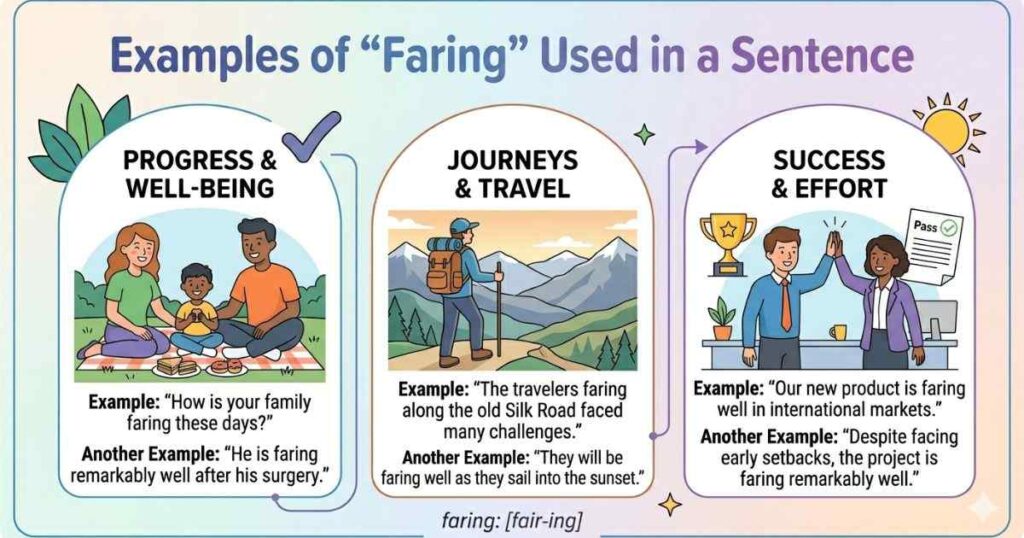
Here are real-world examples across different contexts to show how naturally faring fits:
Personal / Wellbeing:
- “How are you faring after the move? Settling in okay?”
- “She is faring much better since starting her new medication.”
- “I heard the recovery has been tough. How are you faring?”
Professional / Academic:
- “How are the new recruits faring in their first week of training?”
- “The students are faring well ahead of their final exams.”
- “How is your team faring with the project deadline approaching?”
News / Journalism:
- “How is the local economy faring amid rising inflation?”
- “Analysts are watching closely to see how the company fares in Q3.”
- “Smaller businesses are faring worse than larger corporations this quarter.”
Everyday Conversation:
- “Are you faring okay with all the extra responsibilities?”
- “Things are faring better now that the restructuring is complete.”
- “How did the kids fare on their first day of school?”
Understanding “Fairing”: The Noun
What Does “Fairing” Mean?
A fairing is a structural component of a smooth shell or covering added to a vehicle, aircraft, motorcycle, or spacecraft. Its purpose is to reduce aerodynamic drag, improve airflow, and in some cases protect internal components.
You’ll encounter this word almost exclusively in:
- Motorcycle design The front fairing shields the rider from wind.
- Aircraft engineering Nose fairings and wheel fairings streamline airflow.
- Spacecraft Rocket payload fairings protect satellites during launch.
- Automotive design Fairings improve fuel efficiency on certain vehicles.
Context for the Use of “Fairing”
| Context | Example |
| Motorcycles | The sport bike’s fairing was cracked after the fall. |
| Aircraft | The landing gear fairing reduces turbulence during flight. |
| Rockets | The payload fairing separated cleanly after liftoff. |
| Cars | Aerodynamic fairings help reduce fuel consumption at high speed. |
Fairing has a second, older definition: a gift or present purchased at a fair though this usage is largely archaic and rarely seen today.
Why Do People Confuse “Faring” and “Fairing”?
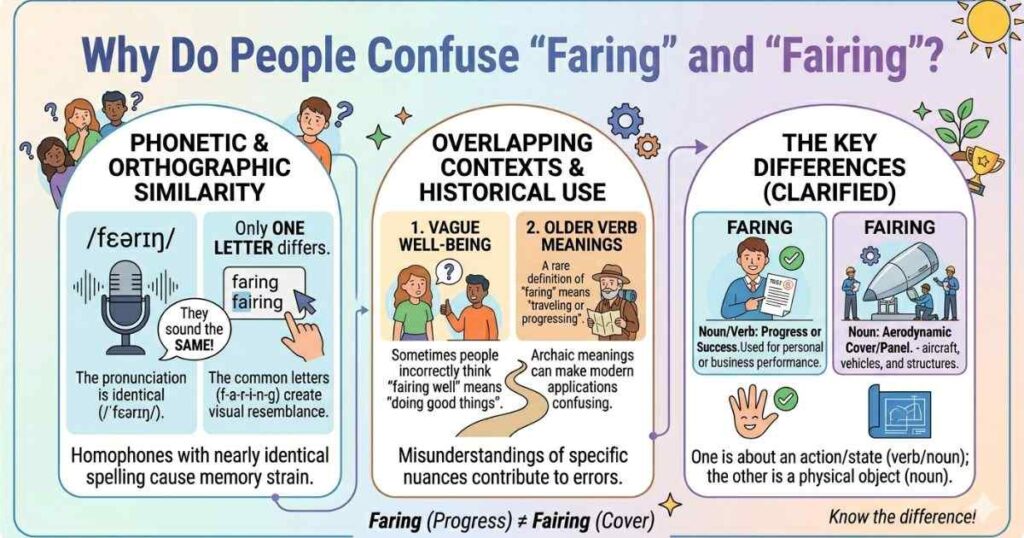
There are three main reasons this mix-up is so common:
- They’re homophones. Both words are pronounced exactly the same way. There’s no audio cue to tell them apart.
- Spell-check won’t save you. Since both are real English words spelled correctly, most grammar tools won’t flag the mistake.
- “Fairing” looks like a verb form. Adding -ing to fair naturally resembles other progressive verbs, which trips up even experienced writers.
A Simple Memory Trick
Not sure which to use? Try this:
Faring → Farewell → Life’s journey Think of faring like farewell both relate to how someone travels through life.
Fairing → Fair + ing → Smooth and streamlined Think of a fairing as something that makes a surface smooth and aerodynamic.
If you’re asking about a person’s experience or progress → use faring.
If you’re talking about a machine or vehicle part → use fairing.
Common Mistakes to Avoid
- ❌ “How are you fairing with your new role?” → ✅ faring
- ❌ “She’s been fairing well since the operation.” → ✅ faring
- ❌ “The team is fairing poorly this season.” → ✅ faring
- ❌ “The plane’s faring was damaged on landing.” → ✅ fairing
Conclusion
“How are you faring” is always the correct phrase, as faring is a verb from Old English meaning to get along or progress through a situation. Fairing, by contrast, is a technical noun used for aerodynamic covers on vehicles and aircraft, never a substitute in everyday conversation.
Remember this simple rule: use faring for people and fairing for machines. Getting this distinction right instantly improves your writing clarity and professional credibility.

Arslan is the creator and author behind FamesPedia, a platform focused on grammar, writing skills, and English language learning. Passionate about clear communication and effective writing, Arslan shares practical grammar tips, easy-to-follow language guides, and educational content to help readers improve their English with confidence.