Have you ever typed out a sentence and paused mid-word because you weren’t sure whether to write “jynx” or “jinx”? You’re not alone. These two words sound identical, look nearly the same, and both orbit the world of bad luck and misfortune. But using the wrong one can make even careful writers look careless.
This guide breaks down the difference between Jynx vs Jinx, explains exactly when to use each one, and walks through real sentence examples, common mistakes, and the contexts where each word actually belongs. By the end, you’ll know which spelling to reach for every single time.
What Is the Difference Between Jynx and Jinx?
| Feature | Jynx | Jinx |
| Part of Speech | Noun only | Noun and Verb |
| Origin | Greek word “iynx” | Middle English “jynxen” |
| Primary Use | Mystical charms, folklore, Pokémon | Everyday bad luck, superstition |
| Standard English? | No (used creatively or as a name) | Yes |
| Verb Form? | No | Yes (“to jinx someone”) |
Define Jynx
Jynx traces its roots back to the Greek word iynx, which referred to a mystical charm or spell used to bring misfortune upon someone. In ancient folklore, it often appeared as a supernatural female figure with enchanting, almost hypnotic powers. The word carried a heavy mythological weight, tied to curses and magic rather than the casual bad luck of everyday life.
In modern writing, Jynx is most commonly recognized as a proper noun. The most famous example is the Psychic/Ice-type Pokémon named Jynx, known for its hypnotic movements and psychic abilities. Millions of fans first encountered the word through gaming culture rather than grammar lessons, which is a big reason so many people assume it functions as a regular English word.
The key thing to remember: Jynx is strictly a noun. It cannot be used as a verb in standard writing, and outside of mythology, Pokémon, and creative branding, it does not belong in formal or professional content.
Define Jinx
Jinx is the word you reach for in everyday writing. It refers to a curse or spell that brings about bad luck, or the act of attributing bad luck to someone or something. Unlike Jynx, which feels mystical and ancient, Jinx slots naturally into casual conversation, sports commentary, social media posts, and storytelling.
What makes Jinx more versatile is its grammatical flexibility. Jinx can serve as both a noun and a verb, describing an event or action that brings misfortune. You can call someone “a jinx” (noun) or say you’re about to “jinx something” (verb). That dual function makes it the dominant choice across nearly all standard writing contexts.
How To Properly Use The Words In A Sentence
How To Use “Jynx” In A Sentence

Since Jynx functions only as a noun and belongs mainly to supernatural, folkloric, or pop culture contexts, keep it tightly within those frames. It should never appear where a standard “bad luck” meaning is intended.
Correct examples:
- The ancient village legend spoke of a Jynx that cursed anyone who entered the forbidden forest.
- She named her black cat Jynx after the Pokémon character.
- In the old mythology texts, a Jynx was a charm crafted specifically to bring ruin to enemies.
Notice how each sentence either references mythology directly or uses Jynx as a name. That’s exactly where it belongs.
How To Use “Jinx” In A Sentence
Jinx works in far more situations. Use it as a noun to name a source of bad luck, or as a verb to describe the act of causing misfortune through words or actions.
Correct examples (noun):
- He had been a jinx on every team he joined, winning zero championships.
- Breaking the mirror was considered a terrible jinx in her household.
Correct examples (verb):
- Don’t talk about the score at halftime or you’ll jinx the whole game.
- She worried that mentioning the deal early would jinx it before the papers were signed.
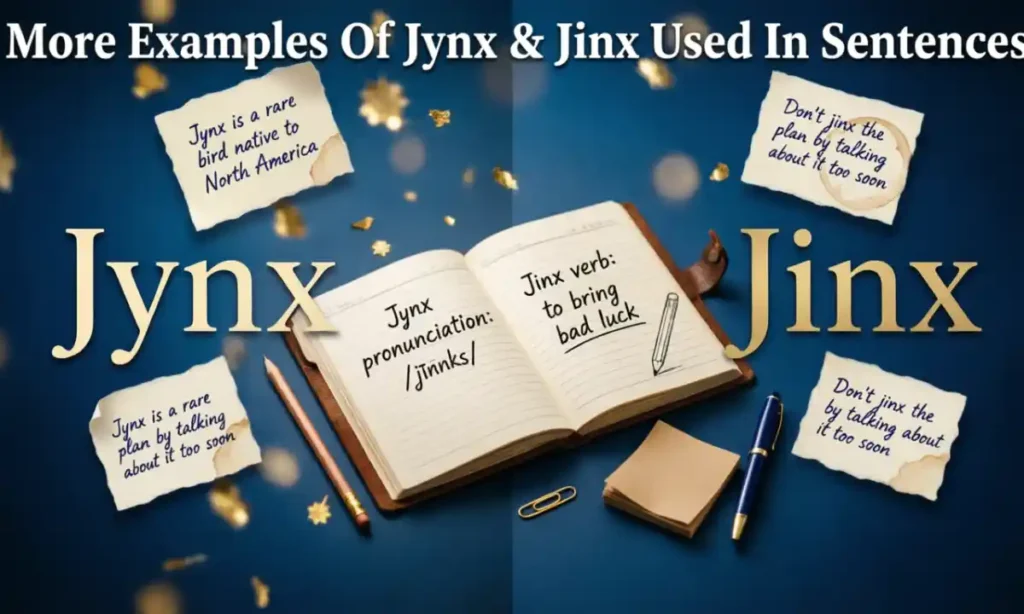
More Examples Of Jynx & Jinx Used In Sentences
Examples Of Using Jynx In A Sentence
- The storyteller described a Jynx placed on the royal bloodline centuries ago.
- His gaming username was Jynx because he loved Pokémon as a kid.
- According to local folklore, the Jynx would only lift if three offerings were made at the old altar.
- The fantasy novel featured a sorceress who cast a powerful Jynx on the hero’s sword.
- She collected figurines, and her favorite was the Jynx from her Pokémon card collection.
Examples Of Using Jinx In A Sentence
- The coach refused to celebrate early, not wanting to jinx the championship run.
- Everyone on the team thought the new mascot was a jinx after three consecutive losses.
- Stop talking about how smoothly the project is going or you’ll jinx it.
- She jokingly called herself a jinx after her third phone broke in two months.
- He knocked on wood to make sure he hadn’t just jinxed his own good fortune.
Common Mistakes To Avoid
1. Using Jynx As A Verb
This is the single most common error writers make. Using “jynx” when you mean the act of causing bad luck is incorrect. The correct form is “jinx.”
- Incorrect: “I hope I don’t jynx our chances of winning.”
- Correct: “I hope I don’t jinx our chances of winning.”
Jynx has no verb form in standard English. If your sentence requires an action word tied to bad luck, jinx is always the right pick. No exceptions.
2. Confusing Jinx With Hex
Both words involve bad luck, but they’re not the same thing. A jinx typically refers to a minor form of bad luck or a temporary spell of misfortune, while a hex is a more potent and long-lasting curse believed to cause serious harm.
If someone “jinxes” a sports game by talking too early, that’s a light, casual superstition. If a witch “hexes” an enemy, that implies something darker and more intentional. Mixing them up changes the tone of your writing significantly.
- Incorrect: “She hexed the exam by saying she was going to ace it.”
- Correct: “She jinxed the exam by saying she was going to ace it.”
3. Using Jinx As A Noun Only
Many writers forget that jinx pulls double duty. It works as both a noun (a jinx, the jinx) and a verb (to jinx, jinxing, jinxed). Limiting it to noun use means missing out on half its power in writing.
- Noun: “That broken clock is a total jinx.”
- Verb: “Don’t jinx us by assuming we’ll win.”
Both forms are grammatically correct and widely used.
Context Matters
1. Superstitions And Bad Luck
In the realm of superstitions and bad luck, both Jynx and Jinx find their place. However, “Jynx” is often associated with mystical or supernatural elements, lending an air of mystery to the concept of bad luck. On the other hand, “jinx” is more widely recognized and commonly used in everyday conversations.
If you’re writing a lighthearted blog post about knocking on wood or avoiding black cats, jinx is your word. If you’re crafting a dark fantasy story involving ancient spells, Jynx fits naturally into the mystical atmosphere.
2. Gaming And Pop Culture
Pop culture massively boosted the popularity of the word “Jinx.” Characters named “Jinx” usually embody chaos, unpredictability, and recklessness. League of Legends players will immediately think of the iconic character Jinx. Pokémon fans, however, will picture the ice-type character Jynx.
When writing gaming content or pop culture commentary, match the spelling to the specific reference. Using “Jynx” for the League of Legends character, or “Jinx” for the Pokémon, would be factually wrong and confuse your audience immediately.
3. Linguistic Nuances
Search engines and grammar systems still prioritize “jinx” as the officially recognized spelling. Using “Jynx” incorrectly can make content appear careless or poorly edited.
For SEO-focused writing, academic work, and professional communication, jinx is always the safer choice. It carries authority and clarity, while Jynx signals either creative intent or an error, depending on the context.
Exceptions To The Rules
1. Regional Variations
This is not a US vs UK difference. Both American English and British English use “jinx” as the standard form. There is no regional dialect or accent where “Jynx” becomes the accepted standard spelling for bad luck. Writers outside the US often assume British English follows different rules here, but it does not.
2. Pop Culture References
The one solid exception where Jynx is entirely correct is when you’re naming or referencing a specific character, brand, or persona using that spelling. The Pokémon Jynx, a streamer named Jynx, a band called Jynx, all of these are proper nouns that require the “y” spelling. Even if a character is called Jynx, the regular English word for bad luck remains jinx.
3. Technical Terminology
In programming or statistics, “jinx” could indicate a bug or error causing unexpected behavior. This is a metaphorical extension of the everyday meaning rather than a technical term with a strict definition. Writers in tech spaces sometimes use it informally to describe frustrating system failures or unpredictable bugs. In those cases, jinx remains the correct spelling.
Also Read This: 30 Simple Email Closings Instead of Sincerely (Updated 2026)
Conclusion
The Jynx vs Jinx debate really comes down to one rule: in standard English, jinx is almost always the word you want. It works as a noun and a verb, it covers everyday superstition and casual bad luck, and it’s recognized by every major dictionary and grammar system in use today.
Jynx belongs in a narrower lane: mythology, folklore, specific pop culture characters, and creative branding. Outside of those spaces, reaching for Jynx instead of Jinx is a spelling error, not a stylistic choice. Master this distinction and your writing will immediately feel more polished, precise, and credible to readers who know the difference.

Arslan is the creator and author behind FamesPedia, a platform focused on grammar, writing skills, and English language learning. Passionate about clear communication and effective writing, Arslan shares practical grammar tips, easy-to-follow language guides, and educational content to help readers improve their English with confidence.