One letter is all it takes to completely change what you mean. Tapping and taping look almost identical on paper, but they describe two entirely different actions. Using the wrong one in a sentence can confuse your reader instantly. Whether you are writing a sports article, a how-to guide, or a quick text message, knowing the difference between tapping vs taping keeps your writing sharp, clear, and professional. This guide covers definitions, examples, common mistakes, and practice exercises so you never mix them up again.
Tapping vs Taping: Quick Comparison Table
| Feature | Tapping | Taping |
| Root Word | Tap | Tape |
| Core Meaning | Light, repeated striking or touching | Securing or recording with tape |
| Used In | Music, therapy, smartphones, sports | Medical, packaging, recording, DIY |
| Requires a Tool? | No (usually fingertips) | Yes (adhesive tape) |
| Can It Be Metaphorical? | Yes (“tapping into resources”) | Rarely |
| Sound Produced | A light knock or click | Usually silent |
Define Tapping

Tapping is the present participle of the verb tap, meaning to lightly strike, touch, or hit something repeatedly, often in a rhythmic pattern. The action is quick, gentle, and usually produces a small sound.
Tapping shows up in a surprisingly wide range of contexts. In music, it refers to a guitar technique where the player strikes the fretboard with their fingers to produce a percussive, melodic sound. In smartphone use, tapping means briefly pressing a touchscreen to select, open, or interact with content.
In Emotional Freedom Technique (EFT), a recognized psychological acupressure method, tapping involves pressing specific meridian points on the body to reduce stress and anxiety. In medical settings, percussion tapping on the back helps patients with respiratory conditions clear their airways. The word can also work figuratively, as in “tapping into a new market” or “tapping a keg of beer.”
Key fact: Over 60% of global web traffic now comes from mobile devices, making tapping a central part of everyday digital interaction.
Define Taping
Taping is the present participle of the verb tape, meaning to attach, secure, support, or wrap something using adhesive tape. It can also mean recording audio or video content, a meaning carried over from the era of magnetic cassette and video tapes.
The most common use today involves physical adhesive tape. In sports medicine and physical therapy, athletic taping and kinesiology taping are widely used techniques that stabilize joints, reduce muscle strain, and prevent injuries during physical activity. In medical settings, taping secures bandages, protects wounds, and supports recovery.
In packaging, taping seals boxes for shipping. In electrical work, electrical tape insulates wires and prevents short circuits. In broadcasting and content production, people still say “taping an episode” or “taping an interview” even when no physical tape is involved.
Key fact: Kinesiology taping has become one of the most popular injury prevention and recovery tools in professional sports worldwide.
How To Properly Use Tapping And Taping In A Sentence
Both words function as present participle verbs or gerunds in a sentence. The key is to identify the action being described before choosing the word.
How To Use “Tapping” In A Sentence
Use tapping when the action involves a light, repeated touch, strike, or contact, including smartphone interaction, rhythmic movement, or accessing a resource.
Sentence structure tips:
- Subject + was/is + tapping + object
- Use it when no adhesive material is involved
- The action should be brief, light, or rhythmic
Examples:
- She was tapping her fingers on the desk impatiently.
- He kept tapping the screen to reload the page.
- The drummer was tapping the snare lightly during the warmup.
- The company is tapping into a new international market this quarter.
How To Use “Taping” In A Sentence
Use taping when the action involves applying adhesive tape to secure, protect, or attach something, or when referring to recording content.
Sentence structure tips:
- Subject + was/is + taping + object
- The action requires tape as a physical or conceptual tool
- Context usually involves securing, supporting, or documenting
Examples:
- She was taping the moving boxes shut before the movers arrived.
- The trainer spent ten minutes taping the runner’s ankle before the race.
- They finished taping the final episode of the season yesterday.
- The nurse was taping the bandage carefully around the wound.
More Examples Of Tapping & Taping Used In Sentences
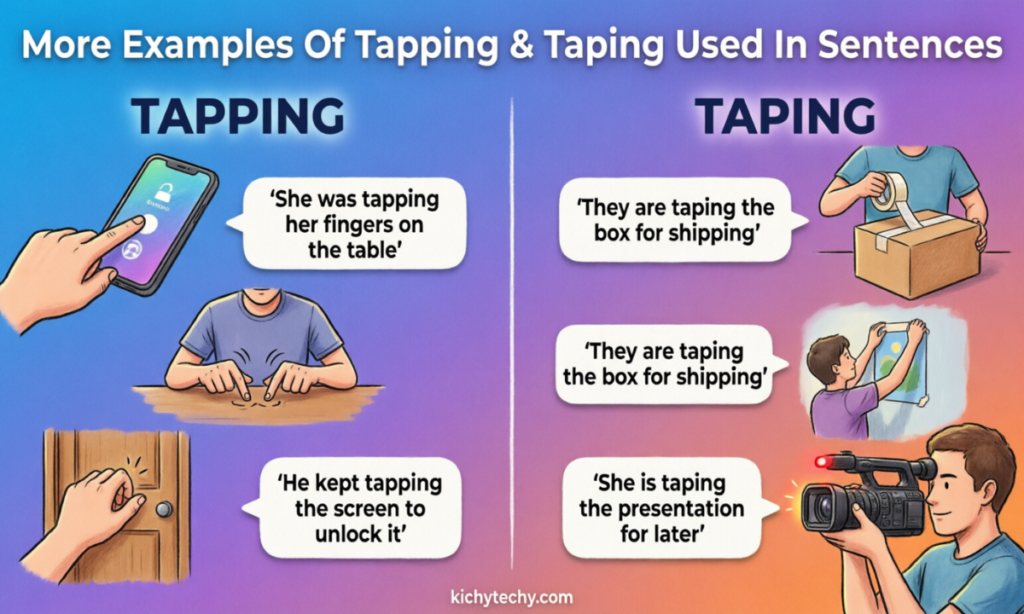
Seeing both words side by side makes the difference even clearer.
Examples of Using “Tapping” in a Sentence
- The therapist was tapping on the patient’s back to loosen tight muscles.
- She kept tapping her pen against the notebook while deep in thought.
- The carpenter was tapping nails gently into the wood frame.
- He was tapping his foot to the beat of the song without even realizing it.
- The plumber was tapping the pipe to locate the blockage by sound.
- The child was tapping the aquarium glass to get the fish’s attention.
- During the EFT session, she practiced tapping on her collarbone point.
Examples of Using “Taping” in a Sentence
- The coach was taping the player’s shoulder before the match.
- He spent the morning taping the edges of the wall before painting.
- The documentary crew was taping their interviews across three continents.
- The physio began taping her knee with rigid sports tape for added support.
- Workers were taping the electrical cables neatly along the baseboard.
- She was taping a birthday banner above the kitchen doorway.
Common Mistakes To Avoid When Using Tapping & Taping
1. Using Tapping and Taping Interchangeably
This is the most frequent error. Because the two words sound nearly identical in natural speech, writers sometimes swap them without thinking. Writing “he was tapping the box shut” creates an odd image of someone knocking on a box rather than sealing it. Always check the action being described before choosing the word.
2. Assuming They Have the Same Purpose
Tapping and taping are not variations of the same idea. They serve completely different functions. Tapping produces motion, sound, or access. Taping produces attachment, support, or documentation. Confusing their purposes in professional or medical writing can reduce credibility and cause real miscommunication.
3. Incorrect Technique
In practical contexts, using the wrong term signals a misunderstanding of the actual process. In sports medicine, for example, kinesiology taping and EFT tapping are two distinct therapeutic approaches. Describing one as the other misleads readers seeking accurate health guidance.
Tips to Avoid Mistakes
- Ask yourself: is the action about touching or about tape?
- If a material (tape, bandage, wrap) is involved, use taping
- If the action is rhythmic, digital, or strike-based, use tapping
- Proofread by reading the sentence aloud and picturing the action
- When in doubt, replace the word with its definition to test the sentence
Context Matters: When to Use Tapping vs Taping
The right word depends entirely on the situation. Here is how each word applies across common settings.
1. Industrial Applications
In manufacturing and engineering, tapping refers to the process of cutting internal threads into a drilled hole using a tool called a tap. This creates a threaded opening for screws or bolts. It ensures a secure mechanical connection, especially in metal components or high-vibration environments where adhesive solutions would not hold. Taping, by contrast, is used in industrial packaging, wire management, and masking surfaces during paint or coating applications.
2. Medical Applications
In physical therapy, rehabilitation, and sports medicine, taping is the dominant term. Techniques such as rigid taping, athletic taping, and kinesiology taping stabilize joints, reduce swelling, and support muscle function. Tapping appears in medical contexts too, specifically in percussion therapy for respiratory conditions and in spinal tap procedures, where a needle accesses cerebrospinal fluid for diagnostic purposes.
3. Electrical Applications
Electrical taping insulates live wires, covers exposed connections, and protects circuits from moisture and short circuits. Tapping in electrical contexts can mean temporarily accessing a circuit or testing a connection, but taping is the more routine and safety-critical action in this field.
4. DIY Projects
For home projects, taping almost always refers to applying masking tape, painter’s tape, or duct tape to surfaces, seams, or repairs. Tapping might describe checking a wall for hollow spots behind plaster or lightly hammering a surface during assembly work.
Exceptions To The Rules: When Tapping and Taping Differ
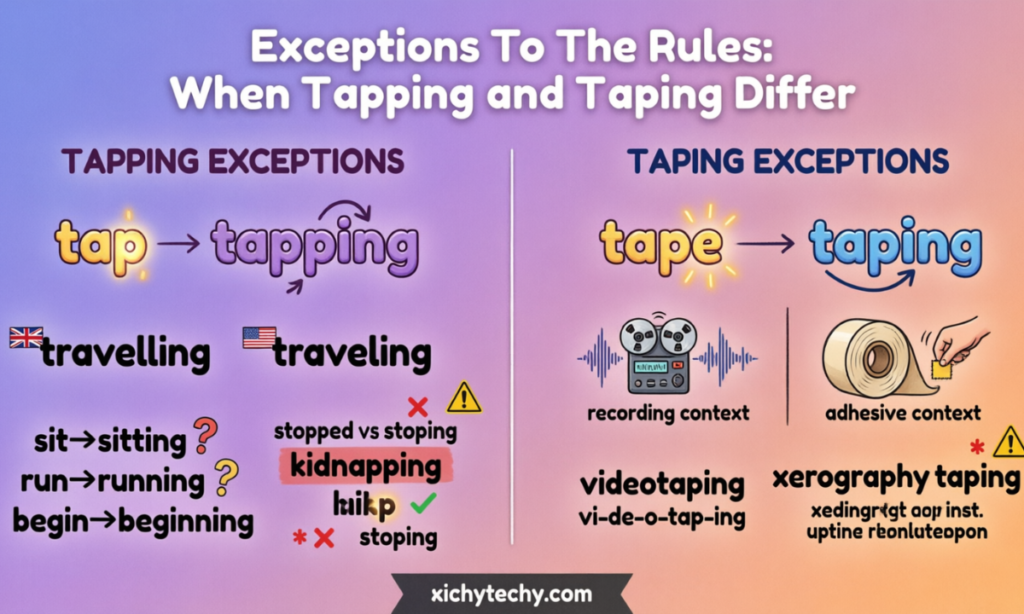
1. Medical Conditions
In healthcare, the same body part might involve both words in different procedures. A doctor might perform percussion tapping on a patient’s chest to assess lung health, while a physiotherapist applies kinesiology taping to the same patient’s shoulder for injury recovery. The procedures are entirely unrelated despite sounding similar.
2. Athletic Performance
Athletes regularly use both. A dancer performs tap dancing, which is rhythmic tapping of the feet on a floor. Meanwhile, the same athlete might have their ankles wrapped with athletic taping before a performance. The sport determines which word applies, and both can appear in the same context without overlap.
3. Personal Preferences
In complementary therapy, some individuals prefer EFT tapping for stress relief, while others rely on kinesiology taping for physical discomfort. Both are valid, evidence-informed practices, but they involve completely different techniques and cannot substitute for each other.
Also Read This: Jynx vs Jinx: When To Use Each One In Writing
Practice Exercises: Test Your Understanding of Tapping vs Taping
Exercise 1: Fill in the Blank
Fill in each blank with either tapping or taping:
- The athlete was __________ his wrist before the game for added support.
- She kept __________ her foot nervously while waiting for the interview.
- The crew finished __________ the final episode last Thursday.
- He was __________ the wall to find a hollow spot behind the plaster.
- The nurse was __________ the bandage firmly around the patient’s arm.
Answer Key: 1. taping, 2. tapping, 3. taping, 4. tapping, 5. taping
Exercise 2: Multiple Choice
Choose the correct word for each sentence:
1. She was __________ the gift wrap neatly over the box.
a) tapping b) taping
2. He was __________ his fingers on the table while thinking.
a) tapping b) taping
3. The studio was __________ the live concert for broadcast.
a) tapping b) taping
4. The physio was __________ the player’s knee before training.
a) tapping b) taping
Answer Key: 1. b, 2. a, 3. b, 4. b
Conclusion
Knowing the difference between tapping vs taping is a small but meaningful step toward cleaner, more professional writing. Tapping describes light, repeated motion or touch, whether that means drumming fingers, interacting with a screen, or using EFT therapy. Taping describes the act of securing with adhesive tape or recording content. These two words cover completely different ground, and choosing the right one every time shows care and accuracy in your communication. Keep this guide handy and your tapping vs taping confusion will stay a thing of the past.

Arslan is the creator and author behind FamesPedia, a platform focused on grammar, writing skills, and English language learning. Passionate about clear communication and effective writing, Arslan shares practical grammar tips, easy-to-follow language guides, and educational content to help readers improve their English with confidence.