Does anybody always trips people up, even seasoned English writers. The confusion between “do” and “does” is one of the most searched grammar questions online, and for good reason. One wrong word can make a professionally written sentence sound instantly off. This article clears up the confusion for good. You will walk away knowing the rule, the logic behind it, and exactly how to use it in any sentence or professional setting.
Does Anybody or Do Anybody: Which is Correct?
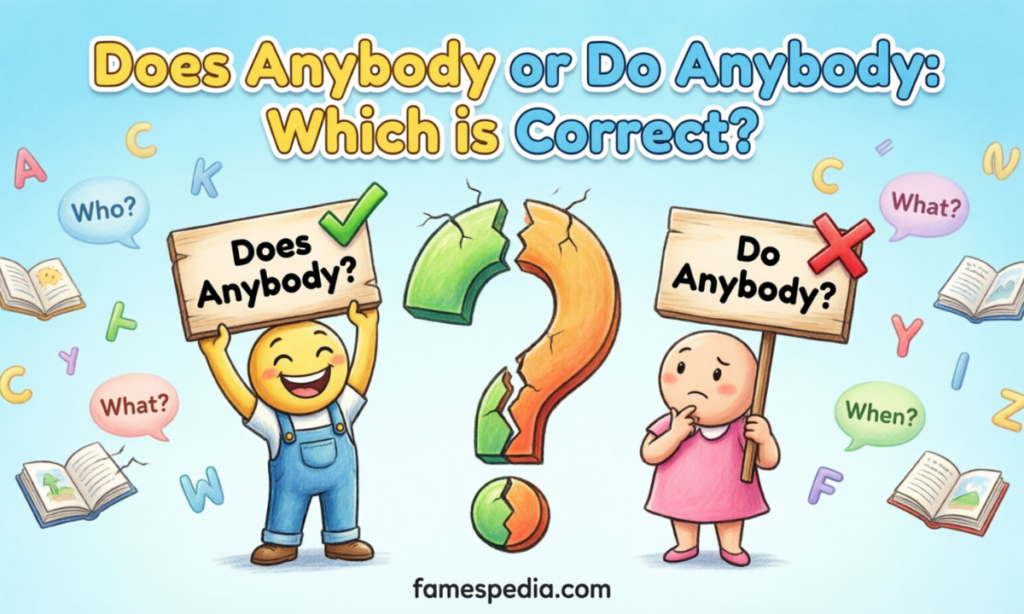
“Does anybody” is correct. “Do anybody” is grammatically incorrect and should be avoided in both speech and writing.
The word “anybody” is a singular indefinite pronoun. In English grammar, singular subjects require singular verb forms. Since “does” is the singular third-person form of the auxiliary verb “do,” it pairs naturally and correctly with “anybody.” This is not a matter of style or regional preference. It is a firm rule of standard English grammar.
The Quick Answer
“Does anybody” is the only grammatically correct form. “Do anybody” breaks the rule of subject-verb agreement and is considered nonstandard in all formal contexts.
Three standalone facts worth knowing:
- “Anybody” is always grammatically singular, just like “he,” “she,” or “it.”
- Indefinite pronouns like “anyone,” “everyone,” and “somebody” are always singular and therefore require singular verbs.
- “Anyone” and “anybody” are grammatically singular and refer to an unspecified single person, so auxiliaries in present simple questions use the third-person singular form: “does” or “doesn’t.”
Understanding Indefinite Pronouns: The Foundation
Indefinite pronouns are words that refer to people or things without naming them specifically. When you say “anybody,” you are not pointing to one particular person. You are speaking about any possible person in general.
Indefinite pronouns are used to refer to someone or something in a general way, without being specific about whom or what you are referring to. Despite this general meaning, they still have a grammatical number, either singular or plural, and that number determines which verb form you must use.
The most important thing to understand is that “anybody” is always grammatically singular, even though it feels like it could mean many people. English grammar treats it the same way it treats “he” or “she.”
Common Examples of Indefinite Pronouns
Here is a quick breakdown of indefinite pronouns grouped by their grammatical number:
| Always Singular | Always Plural | Can Be Either |
| anybody, anyone | both, few | all, some |
| somebody, someone | many, several | any, more |
| everybody, everyone | others | none |
| nobody, no one | most | |
| each, either, neither |
Indefinite pronouns that are always singular include: anyone, everyone, someone, anybody, somebody, nobody, each, one, either, and neither. Always plural indefinite pronouns include: both, few, many, others, and several.
A useful trick from Study.com: indefinite pronouns that end in “one” and “body” are always considered singular indefinite pronouns. That covers “anybody,” “everybody,” “nobody,” “someone,” and all their close relatives.
The Role of Auxiliary Verbs: “Do” vs “Does”
Auxiliary verbs, also called helping verbs, work alongside the main verb in a sentence. They carry grammatical information like tense, number, and person. “Do” and “does” are both present-tense forms of the verb “do,” but they are not interchangeable.
When to Use “Do”
Use “do” with the following subjects:
- I (first person singular): Do I need to bring anything?
- You (second person singular or plural): Do you want coffee?
- We (first person plural): Do we have enough time?
- They (third person plural): Do they know the answer?
When to Use “Does”
Use “does” with third-person singular subjects:
- He: Does he agree?
- She: Does she want to join?
- It: Does it work properly?
- Any singular indefinite pronoun: Does anybody, does someone, does everyone
The rule is clean and consistent. Whenever your subject is third-person singular, “does” is the correct choice.
Why “Anybody” Takes “Does”
Since “anybody” acts like “he” or “she,” you use “does” with it. “Anybody” is treated as singular in English grammar.
Think about how you already speak naturally. You say “Does she know?” without hesitating. You say “Does he want anything?” without thinking twice. Since “anybody” sits in the same grammatical category as “he” and “she,” the same rule applies automatically. The moment you see “anybody” as the subject of a present-tense question, “does” is your verb.
The Logic Behind “Does Anybody”
Here is the full grammatical chain that makes “does anybody” correct:
- “Anybody” is an indefinite pronoun.
- It is always grammatically singular.
- Singular third-person subjects require the singular auxiliary verb “does.”
- Therefore: Does anybody is the only correct form.
“Anybody” is a third-person singular form, so it takes “-s” in the present simple tense. That is why “does anybody” is correct.
One thing that confuses learners is this: since “does” already carries the singular marker, the main verb that follows stays in its base form. You say “Does anybody know?” not “Does anybody know?” The “-s” belongs on the auxiliary, not the main verb.
Examples of Using ‘Does Anybody’ in a Sentence
Here are natural, ready-to-use examples:
- Does anybody have a charger I can borrow?
- Does anybody know what time the meeting starts?
- Does anybody want the last slice of pizza?
- Does anybody need help with this project?
- Does anybody remember where we parked?
- Does anybody here speak Spanish?
- Does anybody object to this plan?
Notice how the main verb in each sentence stays in its bare base form. “Know,” “want,” “need,” and “remember” do not take an “-s” because “does” has already handled the singular agreement.
Common Mistakes and How to Avoid Them
These are the most frequent errors people make with “anybody” and auxiliary verbs:
| Incorrect | Correct | Why |
| Does anybody know? | Does anybody know? | “Anybody” is singular |
| Does anybody know? | Does anybody know? | Double marking: “does” already carries “-s” |
| Does anyone have a pen? | Does anyone have a pen? | “Anyone” is also singular |
| Does anybody want to? | Does anybody want to? | Base verb follows “does” |
The second mistake in the table, saying “does anybody knows,” is surprisingly common. People hear the singular rule and try to apply it twice. You only need to apply it once, on the auxiliary verb “does.”
Similar Grammar Mistakes with Indefinite Pronouns
The same singular rule applies across the entire family of indefinite pronouns. These mistakes follow the same pattern:
- Incorrect: Does everyone agree with this? / Correct: Does everyone agree with this?
- Incorrect: Does somebody need help? / Correct: Does somebody need help?
- Incorrect: Does nobody care? / Correct: Does nobody care?
All of the “-any,” “-every,” “-no,” and “-some” pronouns are singular even if they refer to more than one person. That is the unified rule covering this entire group.
Also Read This: Dysregulated vs Disregulated: How Are These Words Connected?
Tips for Remembering the Correct Form
Here are three practical memory tricks:
- The substitution trick: Replace “anybody” with “he” or “she” in your sentence. If it sounds right with “does he” or “does she,” then “does anybody” is correct.
- The ending trick: If the pronoun ends in “-body” or “-one,” use “does,” never “do.”
- The double-S check: If you already have “does,” the main verb should NOT get an “-s.” Avoid “does anybody knows.”
Does Anyone Have or Do Anyone Have?
“Does anyone have” is correct. “Do anyone have” is incorrect for exactly the same reason. “Anyone” is a third-person singular form and takes “-s” in the present simple tense, so “does anyone have” is the correct choice. A correct example is: “Does anyone have a pen I can borrow?”
“Anyone” and “anybody” mean the same thing and follow the same grammar rules. You can use either one in most contexts. “Anyone” tends to appear more in formal writing, while “anybody” is slightly more common in spoken conversation, but neither one changes the verb rule.
Should I Use ‘Wants’ or ‘Want’ After ‘Does Anyone’?
Use “want” without the “-s.” The correct form is “Does anyone want?” not “Does anyone want it?”
Since “anyone” is a singular pronoun, you should use “want” without “-s” when using “does anyone” in a question. The word “does” already carries the singular marker for the whole sentence. Adding “-s” to the main verb creates a grammatical double-up that is always wrong.
Can “Anybody” Ever Be Used with “Do”?
In standard written and spoken English, no. You may hear nonstandard “do anyone” in casual regional speech, but in writing and careful speech, “does anyone” is always the correct form.
In the past tense, the question changes completely. Both “do” and “does” are replaced by “did,” which works for all subjects regardless of person or number. So “Did anybody call?” is correct for the past tense. The “do vs. does” confusion only applies to the present tense.
What About “Does Anybody Else”?
Adding the word “else” after “anybody” changes nothing about the grammar. Adding the word “else” does not change anything. You still say “Does anybody else need help?” The word “else” just adds extra meaning but does not affect the grammar rule.
“Else” is simply a modifier that signals you are asking about people other than those already mentioned. The subject is still “anybody,” which is still singular, so “does” is still required.
Past Tense: “Did Anybody”
In the past tense, the rule becomes even simpler. “Did” replaces both “do” and “does” for all subjects. There is no singular or plural distinction:
- Did anybody call while I was out?
- Did anybody see what happened?
- Did anybody remember to lock the door?
Talking about the past makes things easier. You always use “did” for everyone and everything. The confusion between “do” and “does” only happens in the present tense.
Why Correct Grammar Matters in Professional Settings
Using “does anybody” correctly in emails, reports, and meetings signals attention to detail. It builds credibility with colleagues, managers, and clients. A small error like “do anybody” may seem minor, but it can quietly undermine your professional image in high-stakes situations.
Grammar accuracy is especially important in written communication, where there is no tone of voice to smooth over rough edges. The words on the page represent you directly.
Building Strong Language Skills
Every grammar rule you master makes the next one easier. Subject-verb agreement with indefinite pronouns is one of those foundational rules that shows up constantly in everyday English. Once you understand why “anybody” is singular, you immediately understand why “everybody,” “somebody,” and “nobody” follow the same pattern.
Good grammar is not just about sounding educated. It is about communicating clearly so your message reaches people without friction or distraction.
Quick Reference Guide
| Question | Correct Form | Incorrect Form |
| Present tense question | Does anybody know? | Does anybody know? |
| With “have” | Does anybody have one? | Does anybody have one? |
| With “want” | Does anybody want to? | Does anybody want to? |
| With “else” | Does anybody else need help? | Does anybody else need help? |
| Past tense | Did anybody call? | Has anybody called? |
| With “anyone” | Does anyone know? | Does anyone know? |
Conclusion
Getting “does anybody” right is simpler than it looks once you understand the logic. “Anybody” is always a singular indefinite pronoun, just like “he” or “she,” and singular subjects always take the singular auxiliary “does” in present-tense questions.
Skip “do anybody” entirely in your writing and speaking. Whether you are sending a professional email, writing an essay, or asking a quick question in a meeting, “does anybody” is always the correct, confident, and polished choice.

Arslan is the creator and author behind Healthy Leeks, a platform focused on grammar, writing skills, and English language learning. Passionate about clear communication and effective writing, Arslan shares practical grammar tips, easy-to-follow language guides, and educational content to help readers improve their English with confidence.