Have you ever typed “disregulated” and wondered if it was even a real word? You are not alone. Thousands of writers, students, and healthcare professionals search this question every month. The confusion makes sense because both words look almost identical. But only one of them belongs in your writing.
This guide breaks down the real difference between dysregulated vs disregulated, shows you how to use each correctly, and helps you avoid the most common spelling trap in modern English.
Define Dysregulated
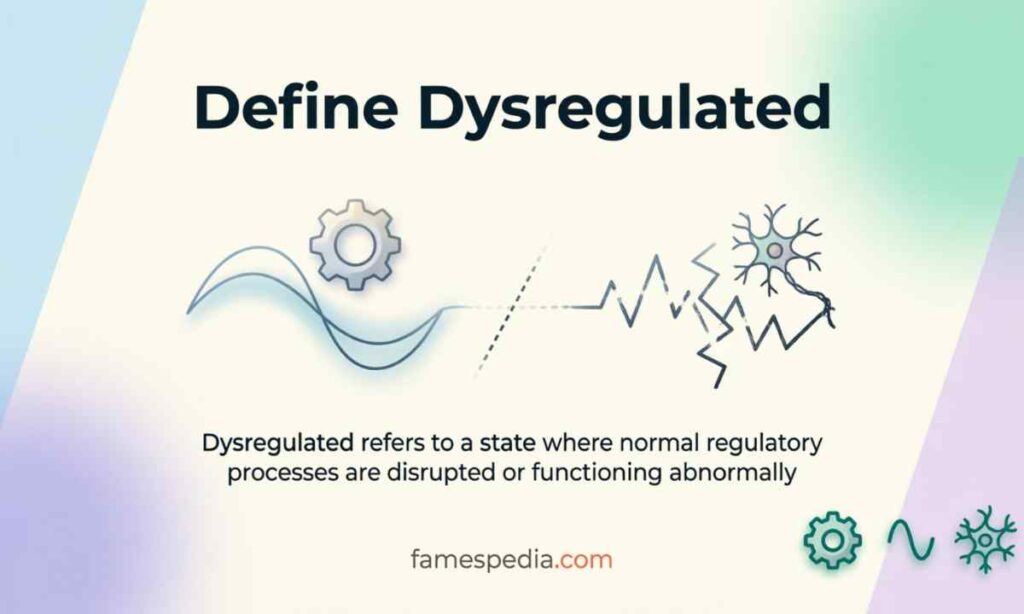
Dysregulated is the correct and widely accepted spelling in standard English. It combines the Greek prefix dys, meaning “abnormal,” “impaired,” or “difficult,” with the word “regulated,” which comes from the Latin regulare, meaning “to control or direct.”
Together, dysregulated describes a system, whether biological, emotional, behavioral, or neurological, that is still functioning but not functioning as it should. The regulatory mechanism is present; it is simply working improperly.
The word appears most often in psychology, neuroscience, medicine, and mental health discussions. A dysregulated nervous system, for example, may cause anxiety, hypervigilance, or emotional outbursts. A dysregulated immune system may attack the body’s own healthy tissue. These are precise, clinical uses that require an equally precise word.
Key fact: “Dysregulated” does not appear in Merriam-Webster or Oxford as a simple variant. It is the primary, accepted spelling rooted in Greek etymology and used by clinical professionals worldwide.
Define Disregulated
Disregulated is not a recognized word in standard English dictionaries, including Merriam-Webster and Oxford. It does not appear in major medical or academic publications as a valid term.
The word appears to use the Latin prefix dis, meaning “opposite of,” “not,” or “removal,” which is common in words like disconnect, disagree, and disorder. Technically, “disregulated” could suggest that regulation has been entirely removed, which is a different concept from impaired regulation.
In practice, most people who write “disregulated” are simply misspelling “dysregulated.” The two prefixes sound similar when spoken quickly, which is exactly why this spelling error is so widespread online, especially on social media platforms like Reddit and TikTok.
Key fact: If your spellcheck flags “disregulated,” that flag is correct. Modern grammar tools recognize it as a non-standard construction.
| Feature | Dysregulated | Disregulated |
| Recognized in dictionaries | Yes | No |
| Prefix origin | Greek (dys) | Latin (dis) |
| Meaning | Impaired regulation | Not a standard word |
| Used in medical writing | Yes | No |
| Recommended for formal use | Yes | No |
How To Properly Use Dysregulated & Disregulated In A Sentence
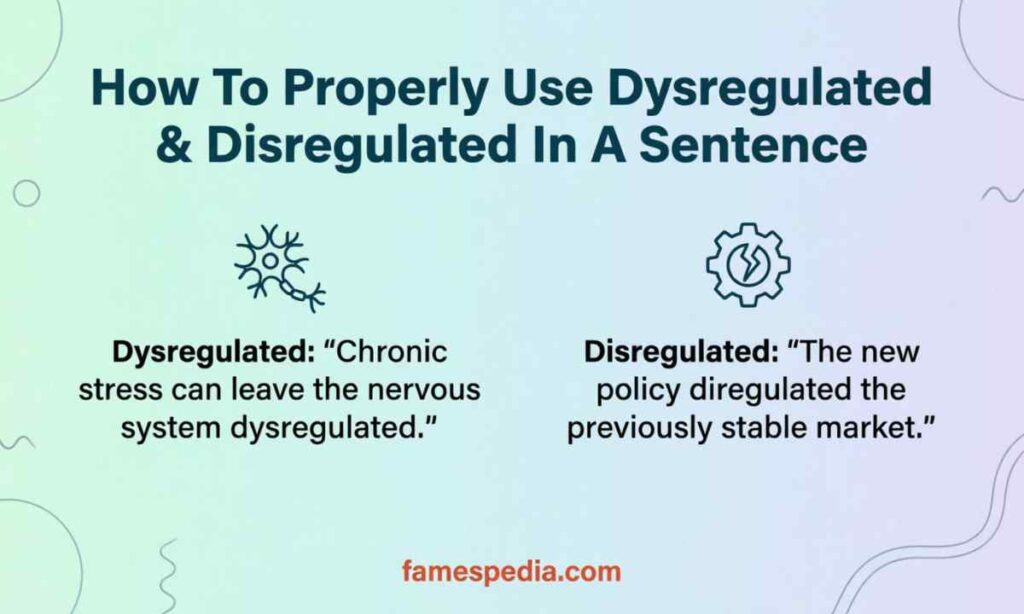
The rule here is straightforward. Dysregulated belongs in formal, professional, and everyday writing. Disregulated does not belong in writing at all. However, understanding how each one appears in context helps you catch the error before it reaches your reader.
How To Use Dysregulated In A Sentence
Use dysregulated whenever you want to describe a system, process, emotion, or biological function that is not working properly. It fits naturally in medical reports, mental health discussions, academic papers, and even casual conversations about stress or emotional health.
The word can describe:
- Emotional states: feeling overwhelmed, reactive, or unable to calm down
- Biological processes: hormone imbalance, immune system malfunction, or sleep disruption
- Behavioral patterns: impulsive responses, aggression, or emotional shutdown
- Neurological functioning: a nervous system stuck in fight-or-flight mode
Always pair it with a noun that can logically be regulated, such as nervous system, immune response, emotional reaction, behavior, or hormone levels.
How To Use Disregulated In A Sentence
In most cases, you simply should not use “disregulated” in a sentence. It is widely considered a misspelling, not an alternate form.
If you encounter it in older texts or informal writing, treat it as a spelling error. Replace it with dysregulated in any context involving impaired function. If you mean that regulation has been formally removed (as in a policy context), consider using “deregulated” or “unregulated” instead, both of which are recognized terms with specific meanings.
More Examples Of Dysregulated & Disregulated Used In Sentences
Examples Of Using Dysregulated In A Sentence
- After months of chronic stress, her nervous system became dysregulated and she struggled to sleep.
- Children with ADHD often show dysregulated emotional responses that can be misread as defiance.
- The patient’s immune system was dysregulated, causing it to attack healthy tissue.
- His dysregulated behavior during the meeting alarmed his colleagues.
- Trauma survivors frequently experience a dysregulated stress response long after the original event.
- The lab results confirmed that her hormone levels were dysregulated after the surgery.
- A dysregulated nervous system can make even minor challenges feel overwhelming.
Examples Of Using Disregulated In A Sentence
The examples below show how “disregulated” appears in real writing and why it should be corrected:
- Incorrect: The child seemed disregulated after the loud noise.
Correct: The child seemed dysregulated after the loud noise. - Incorrect: Her disregulated emotions made it hard to focus at work.
Correct: Her dysregulated emotions made it hard to focus at work. - Incorrect: Trauma can leave the nervous system disregulated for years.
Correct: Trauma can leave the nervous system dysregulated for years.
Common Mistakes To Avoid
Highlighting Common Mistakes
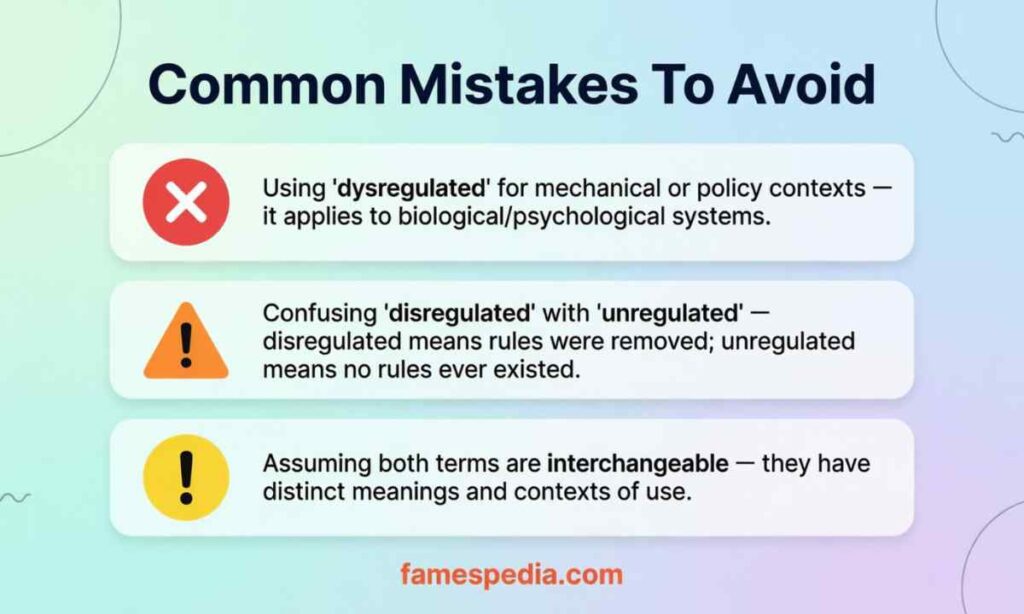
The single most common mistake is substituting dis for dys when spelling the word. This happens because:
- The prefix “dis” appears far more frequently in everyday English words
- Both prefixes sound almost identical when spoken at normal speed
- Spellcheck tools sometimes fail to catch the error in medical or psychological contexts
- Social media platforms spread the misspelling by repetition, making it appear correct
Another common error is confusing dysregulated with unregulated or deregulated. These three words carry very different meanings and are not interchangeable.
Tips To Avoid These Mistakes
- Memorize the prefix rule: Dys means impaired or abnormal. Dis means removed or reversed. If a system is still working but working badly, you need dys.
- Use a mental anchor: Think of other “dys” words you already know, such as dysfunction, dyslexia, and dystopia. These all describe conditions that exist but are impaired.
- Run a quick spellcheck: Most updated grammar tools will flag “disregulated” as an error.
- Ask yourself the right question: Is the system broken but still present? Use dysregulated. Has regulation been entirely removed? Use unregulated or deregulated.
Context Matters
Dependent On Context
The word dysregulated shows up across many different fields, and the exact meaning shifts slightly depending on where you use it. Understanding the context helps you use the word with confidence and precision.
In mental health settings, dysregulated typically refers to emotional dysregulation, which means difficulty managing the intensity, timing, or expression of emotions. In medicine, it describes a biological process that has fallen outside normal parameters. In neuroscience, it often refers to nervous system states tied to trauma, burnout, or anxiety disorders.
Examples Of Different Contexts
| Context | Example Sentence |
| Psychology | She was emotionally dysregulated after the argument. |
| Medicine | The patient had a dysregulated immune response. |
| Neuroscience | Chronic stress left his nervous system dysregulated. |
| Education | The dysregulated student needed a calm environment to reset. |
| Parenting | Her child’s dysregulated behavior improved with consistent routines. |
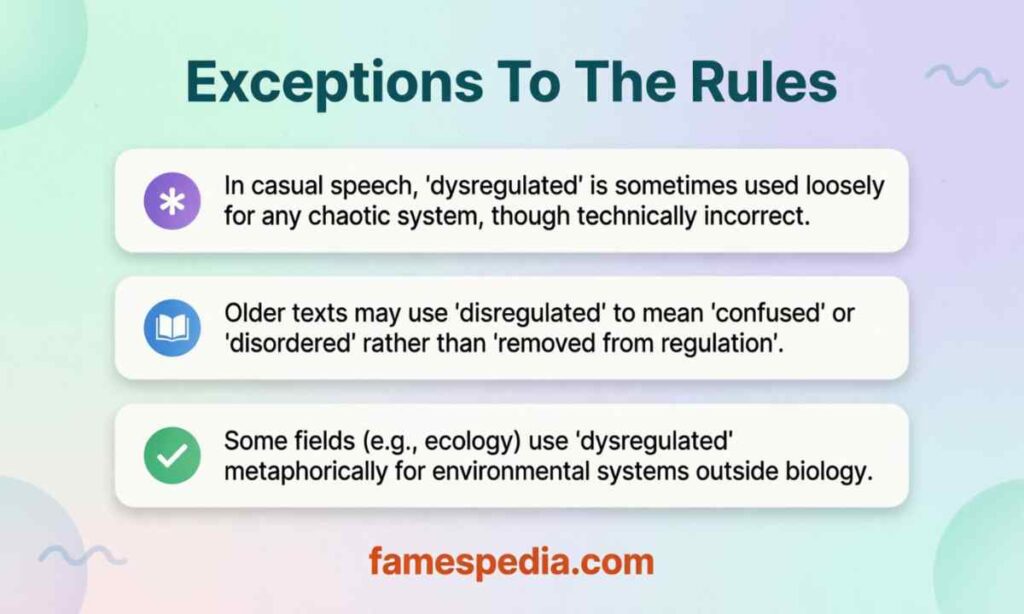
Exceptions To The Rules
1. Medical Terminology
In clinical and academic writing, dysregulated is always the preferred form. There are no accepted medical exceptions that allow “disregulated.” Professionals in fields like psychiatry, endocrinology, and neurology use “dysregulated” exclusively when describing impaired biological or psychological function.
2. Regional Variations
Both British English and American English agree on this spelling. Unlike some word pairs where regional differences lead to two valid spellings, dysregulated vs disregulated is not a regional issue. Neither the UK nor the US recognizes “disregulated” as a correct alternative.
3. Contextual Use
In rare non-clinical contexts, someone might argue that “disregulated” could technically mean “stripped of regulation,” similar to how “deregulated” is used in policy discussions. However, this use is so uncommon that it creates more confusion than clarity. Stick with precise alternatives like deregulated or unregulated when that meaning is intended.
4. Exceptions in Literature or Creative Writing
Creative writers occasionally bend grammatical rules for stylistic effect. A poet or fiction author might use “disregulated” deliberately to create a sense of unfamiliarity or clinical detachment. In those rare cases, the choice is artistic, not grammatical. For all other writing, including blogs, essays, healthcare content, and academic papers, dysregulated is the only acceptable form.
You May Also Like This: Jynx vs Jinx: When To Use Each One In Writing
Practice Exercises
Exercise 1: Fill in the Blank
Fill in each blank with either dysregulated or disregulated:
- After the accident, her nervous system remained ______ for several weeks.
- The child’s ______ behavior was a signal that he needed additional support.
- Chronic sleep deprivation can leave your immune system ______.
- The therapist explained that trauma often leaves the body’s stress response ______.
Answers: All four blanks should be filled with dysregulated.
Exercise 2: Sentence Correction
Identify and correct the error in each sentence below:
- “His disregulated emotions caused problems at work.” → dysregulated
- “The disregulated hormone levels were confirmed by blood tests.” → dysregulated
- “Anxiety can leave children feeling disregulated and overwhelmed.” → dysregulated
Exercise 3: Match the Context
Match each use of “dysregulated” to the correct field:
| Sentence | Field |
| “Her dysregulated cortisol levels were affecting her sleep.” | Medicine |
| “The student appeared dysregulated after the fire drill.” | Education |
| “He described feeling emotionally dysregulated since the breakup.” | Psychology |
| “A dysregulated nervous system can trigger panic attacks.” | Neuroscience |
Final Thoughts
Dysregulated vs disregulated is one of those spelling debates that feels confusing until you understand the prefixes behind each word. The Greek prefix dys points to impaired function, making dysregulated the only correct choice in professional, academic, and everyday writing. Once you know that, the answer becomes automatic.
Next time you write about emotional health, nervous system responses, or biological imbalance, reach for dysregulation with confidence. This single word carries clinical precision, dictionary recognition, and real authority. Keep dysregulated in your vocabulary and leave disregulated out of your writing for good.

Arslan is the creator and author behind Healthy Leeks, a platform focused on grammar, writing skills, and English language learning. Passionate about clear communication and effective writing, Arslan shares practical grammar tips, easy-to-follow language guides, and educational content to help readers improve their English with confidence.