
Have you ever typed a sentence and suddenly second-guessed yourself is it “manual” or “manual”? You are not alone. This one-letter difference trips up students, professionals, and even seasoned writers every day. One word belongs in instruction booklets and automotive conversations; the other belongs on a birth certificate.
Mix them up, and your sentence instantly loses credibility.This guide breaks down everything you need to know about Manuel vs. Manual, their definitions, proper usage, grammar rules, real-life examples, and even the viral meme that made this confusion internet-famous. By the end, you will never confuse these two words again.
Definitions Of Manuel And Manual
Before diving into usage rules, it helps to understand what each word actually means. These two terms look nearly identical but belong to completely different grammatical categories.
Definition Of Manuel
Manuel is a proper noun. It is a masculine given name of Spanish and Portuguese origin, derived from the Hebrew name Emmanuel, which translates to “God is with us.” The name is widely used across Spain, Latin America, and Hispanic communities around the world. A common nickname for Manuel is Manny.
Beyond being a personal name, Manuel is also the name of a municipality in the Valencia province of Spain, a popular destination among Spanish tourists and travelers.
Because Manuel is a proper noun, it must always be capitalized, regardless of where it appears in a sentence. It is never used to describe objects, machines, or instruction books. In English, “manuel” written in lowercase is simply a spelling error; it does not exist as a standard English word.
Quick fact: The Cambridge Dictionary does not list “manuel” as an English word. Its only correct written form is “Manuel” capitalized, as a name.
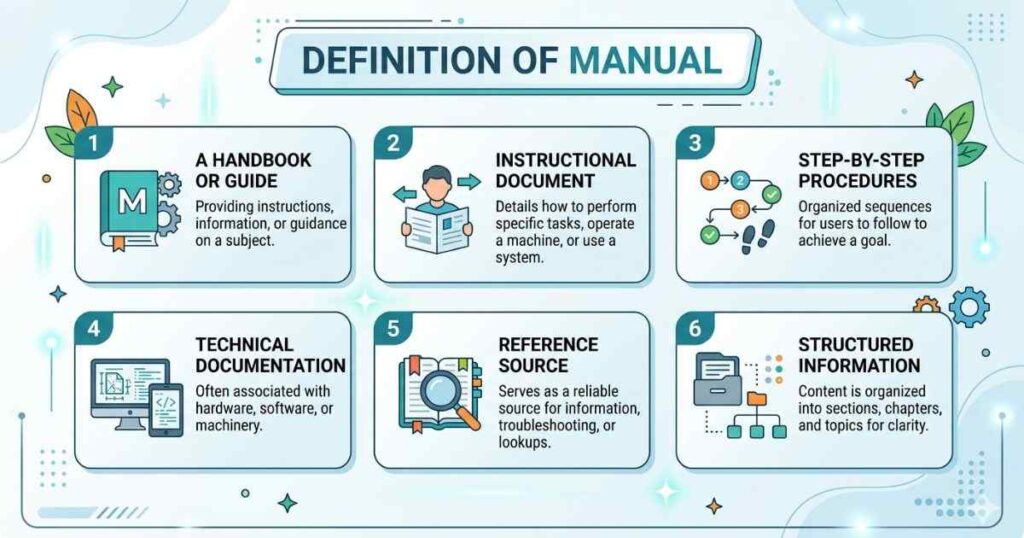
Definition Of Manual
Manual is a common English word with several meanings depending on how it is used in a sentence. It functions as both a noun and an adjective.
According to Merriam-Webster, the word traces back to the Latin manuālis, derived from manus, meaning “hand.” It entered Middle English through Old French before settling into its modern form.
Here are its main definitions:
| Usage | Meaning | Example |
| Noun | A book of instructions for operating something | “Read the manual before using the appliance.” |
| Adjective | Done by hand, not by machine | “This is a manual process.” |
| Automotive | A vehicle with manual transmission (stick shift) | “She prefers driving a manual.” |
| Music | A keyboard played by hand on an organ or harpsichord | “The organist practiced the manual section.” |
| Cycling | A trick where the rider lifts the front wheel without pedaling | “He landed the manual perfectly.” |
As a common noun or adjective, manual is never capitalized unless it appears at the very beginning of a sentence.
Manuel Or Manual How To Tell Them Apart At A Glance
The core rule is simple:
Manuel = a person’s name or a place (proper noun, always capitalized) Manual = an instruction guide, a hand-operated process, or an automotive term (common noun/adjective, lowercase)
One practical memory trick that works well: Manuel ends in “el” like “he” it refers to a person. Manual ends in “al” like “all” the instructions you will find in a guidebook.
Another tip: ask yourself one question before writing “Am I talking about a person or a thing?” If it is a person, write Manuel. If it is a thing, process, or document, write a manual.
How To Properly Use Manuel And Manual In A Sentence?
Understanding the definitions is just half the battle. Knowing how and when to place each word correctly in a sentence is where real writing confidence comes from.
How And When To Use Manuel
Since Manuel is a proper noun, it follows the same grammatical rules as any other name like David, Sofia, or Liam.
As a subject (beginning of a sentence): Manuel leads with the action or is the focus of the sentence.
As a direct object (middle of a sentence): Manuel receives the action performed by someone else.
As an indirect object (end of a sentence in passive voice): Manuel is the recipient of something.
Pluralizing Manuel: When referring to a family or group sharing the name, you can write “the Manuels” to indicate the family unit.
Key rules for using Manuel:
- Always capitalize the first letter no exceptions
- Never use it to describe objects, tools, or documents
- It can appear at the beginning, middle, or end of a sentence
- It can be possessive: Manuel’s car, Manuel’s report
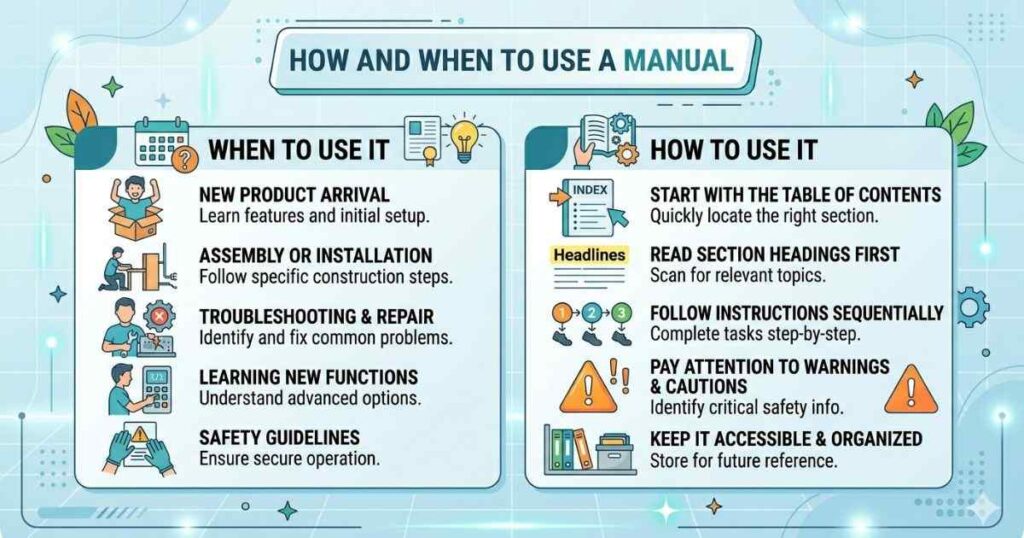
How And When To Use Manual
Manuals are far more versatile. It works as a noun describing a handbook, as an adjective describing hand-operated actions, and even as shorthand for a transmission type or a cycling trick.
As a noun: Use it when referring to an instruction booklet, guide, or handbook.
As an adjective: Use it before a noun to describe something operated by human hands rather than a machine.
In automotive contexts: Use it as a noun or adjective to describe a stick-shift vehicle.
Key rules for using manual:
- Always keep it lowercase (unless it starts a sentence)
- It can be used in technical, mechanical, musical, and everyday writing
- It is never a person’s name or a place name
- It pairs naturally with words like instruction, transmission, operation, and labor
Also Read Information From This: Nonresponsive vs Unresponsive: Which One Is the Correct One?
Manuel Vs. Manual Meme The Internet’s Favorite Grammar Joke
The confusion between these two words became so widespread that it inspired a popular internet meme. The joke typically goes something like:
“Read the manuel before using the device.”
The humor lands because the reader instantly pictures a man named Manuel being asked to personally guide users through a product setup instead of an instruction booklet doing the job. The meme perfectly captures why confusing these words can make your writing look unintentionally funny.
It also highlights a real-world problem. Spellcheck tools often miss this mistake because “Manuel” is a real word (a proper name), so the software does not flag it as incorrect. That means the error slips through unnoticed until a reader catches it and chuckles.
Manual Vs. Manuel Side-By-Side Comparison Table
| Feature | Manuel | Manual |
| Part of speech | Proper noun | Noun / Adjective |
| Capitalization | Always capitalized | Lowercase (unless starting a sentence) |
| Origin | Hebrew/Spanish (Emmanuel) | Latin (manus = hand) |
| Refers to | A person or a place | Instructions, hand-operated tasks, or vehicles |
| Used in English? | Only as a name | Yes, as a standard English word |
| Can you describe objects? | No | Yes |
| Pronunciation | man-uh-wel | man-yə-wəl |
Examples Of Manuel And Manual Use In Sentences
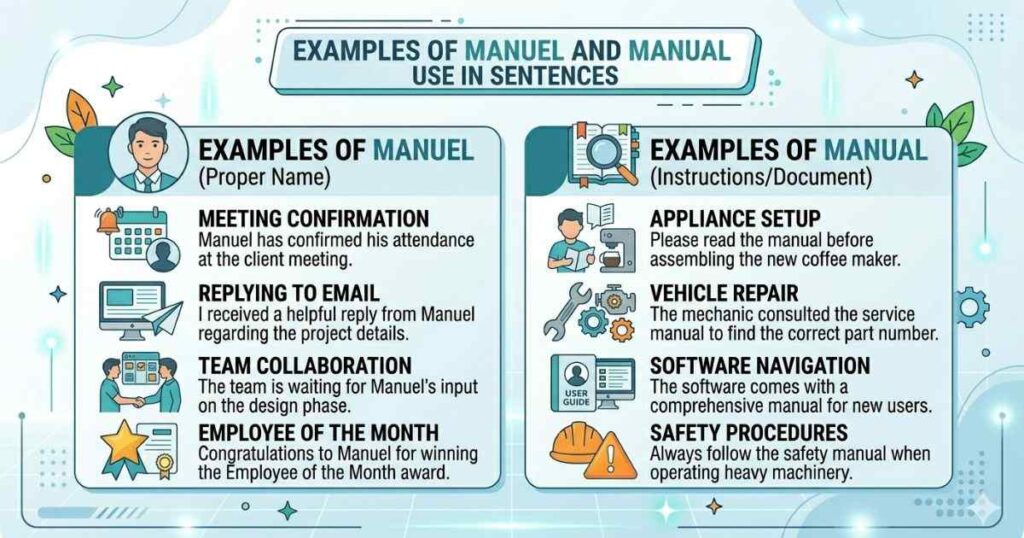
Seeing both words in context is the fastest way to internalize the difference. Study the following examples carefully.
Example Sentences of Manuel
- Manuel arrived at the office early and prepared the presentation before anyone else.
- We plan to visit Manuel in Valencia next summer during the annual festival.
- The scholarship was awarded to Manuel because of his exceptional academic performance.
- Doctor Manuel guided the medical students through the entire procedure with patience.
- Please pass my warmest regards to Mr. Manuel when you arrive in the city.
- We spent the entire holiday at Manuel’s house, surrounded by family and good food.
- The Manuels are well-respected in the neighborhood for their generosity and warmth.
- Our tour begins at Manuel, Valencia, and ends three days later in Barcelona.
Example Sentences of Manual
- Please read the instruction manual carefully before attempting to install the new appliance.
- She prefers driving a manual car because it gives her greater control on mountain roads.
- The factory relies on manual labor for the final inspection stage of production.
- Here is the training manual for all new content managers joining the team this quarter.
- The organ’s manual section requires a great deal of hand coordination and practice.
- Manual operations tend to cost the company more than fully automated alternatives.
- The technician could not fix the device without first consulting the product manual.
- Learning to ride a manual bicycle and master a manual trick takes weeks of daily practice.
Conclusion
Manuel is a proper name for a person, while manual is a common word meaning a handbook or something done by hand. Knowing the difference between Manuel vs. manual keeps your writing clear, correct, and professional. One small spelling change completely shifts the meaning.
Using the right word manual or manual matters more than most people think. Always double-check before hitting publish, because context is everything in English writing. When it’s a name, write Manuel; when it’s a task or a guide, write a manual.

Arslan is the creator and author behind FamesPedia, a platform focused on grammar, writing skills, and English language learning. Passionate about clear communication and effective writing, Arslan shares practical grammar tips, easy-to-follow language guides, and educational content to help readers improve their English with confidence.