Have you ever stared at a form or button and wondered whether to write “unenroll” or “disenroll”? You are not alone. These two words look similar, sound related, and both deal with leaving a course, program, or membership. Yet using the wrong one in the wrong place can make your writing look sloppy or even unprofessional.
The key difference is simple. Unenroll is what you do when you choose to leave. Disenroll is what happens to you when an institution removes you. That one distinction clears up most of the confusion right away.
In this guide, you will get clear definitions, real sentence examples, common mistakes to avoid, and practice exercises to lock in your understanding of unenroll vs disenroll for good.
What Is the Difference Between Unenroll and Disenroll?
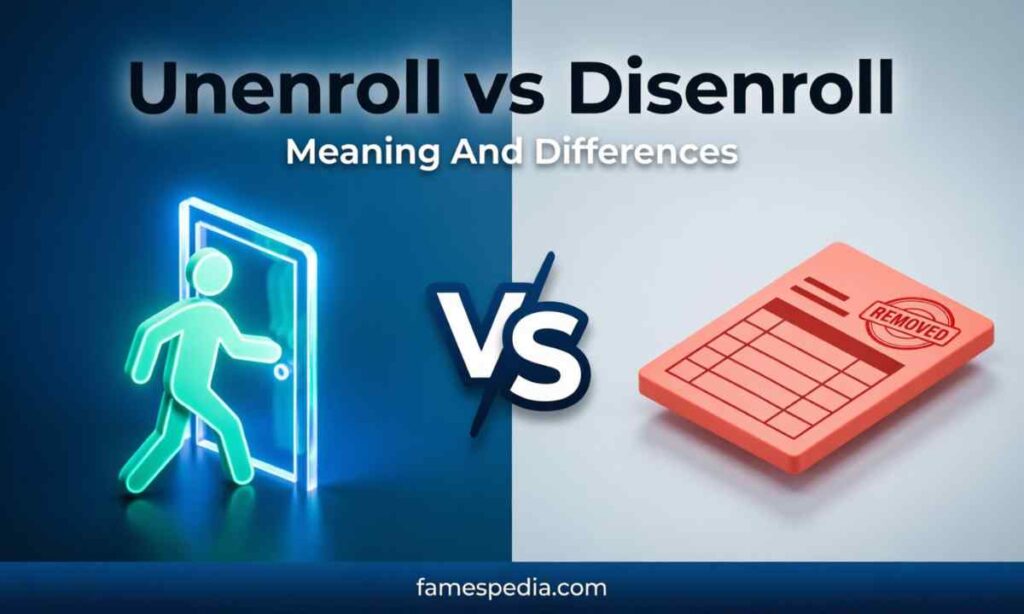
Both words come from the base word enroll, which means to register or sign up for something. The prefixes tell the full story.
The prefix un signals a reversal of something you did yourself. Think of undo, unpack, or unlock. These are all actions you take on your own terms.
The prefix signals formal removal or separation, often by an outside authority. Think of disconnect, disengage, or disqualify. These words carry a sense of something being taken away.
That prefix difference is the key to using both words correctly every single time.
| Feature | Unenroll | Disenroll |
| Who initiates it | The individual | The institution or authority |
| Tone | Casual, user-friendly | Formal, administrative |
| Common settings | Online courses, schools, apps | Healthcare, insurance, government |
| Action type | Voluntary | Often involuntary or system-driven |
| Reversibility | Usually reversible | Often permanent |
Defining Each Word
Define Unenroll
Unenroll means to voluntarily withdraw from a course, program, membership, or subscription. The person makes the decision themselves. No outside force pushes them out.
You will see this word on online learning platforms, student portals, app settings, and school registration systems. It fits anywhere the user is in control of their own participation.
The unenroll meaning centers on personal choice. When you unenroll, you are saying, “I have decided this is not for me right now,” and you act on that decision yourself. It reflects individual control over voluntary withdrawal from a course or program.
Common settings where unenroll appears:
- Online course platforms like Coursera, Udemy, or school LMS dashboards
- App subscription settings where users manage their own access
- School or university student portals
- Email newsletter or membership opt-out pages
The noun form is unenrollment, meaning the act or process of voluntarily leaving a program.
Define Disenroll
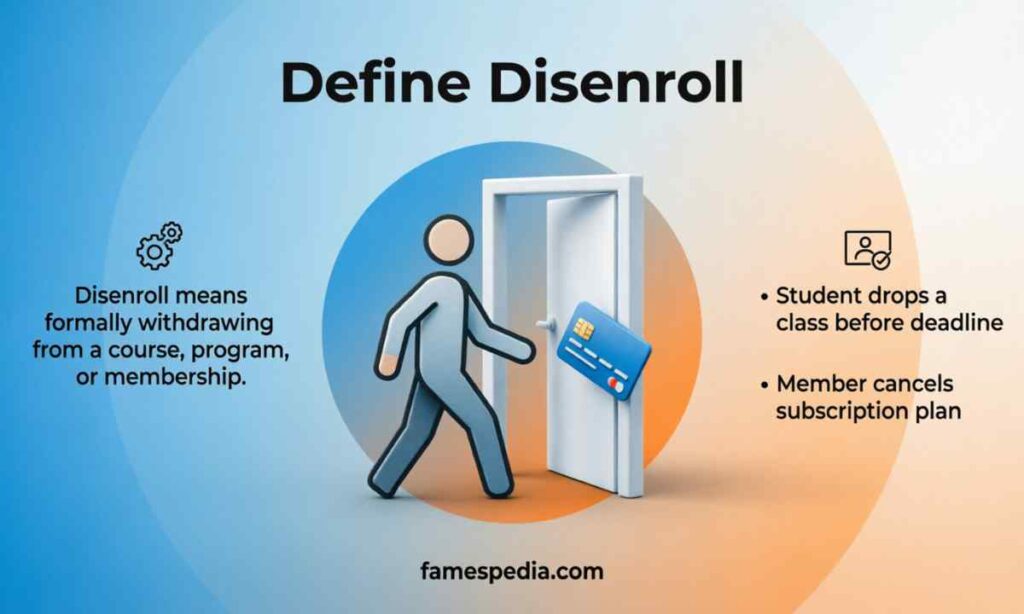
Disenroll means to formally remove someone from enrolled status, usually by an institution, authority, or automated system. Unlike unenroll, this action is performed on the participant, not by them.
The disenroll meaning leans toward official and procedural language. You will find it in healthcare plans, government benefit programs, insurance policies, military systems, and compliance-driven environments. These are places where eligibility, documentation, and regulations shape how people leave a program.
The noun form is disenrollment, which refers to the official process of being removed from enrollment by an organization.
Common settings where disenroll appears:
- Medicare Advantage and Medicaid programs
- Health insurance plan terminations
- Military benefit systems
- Government assistance programs
- Institutional records involving compliance rules
A person does not always choose to be disenrolled. It can happen because their eligibility changed, they violated program rules, or an administrative review removed them from the system.
How to Properly Use Unenroll and Disenroll in a Sentence
The right word depends on who is taking the action and the setting in which it happens.
Use unenroll when the person is making the decision on their own. The tone is conversational and the setting is typically informal or digital.
Use disenroll when an authority, system, or institution is removing someone. The tone is formal and the setting involves rules, policies, or eligibility criteria.
A quick mental test: ask yourself, “Is the person leaving by choice, or are they being removed?” If it is by choice, unenroll fits. If something or someone else is forcing the exit, disenroll is the better word.
Another way to remember it: unenroll for users, disenroll for institutions.
More Examples Of Unenroll and Disenroll Used In Sentences
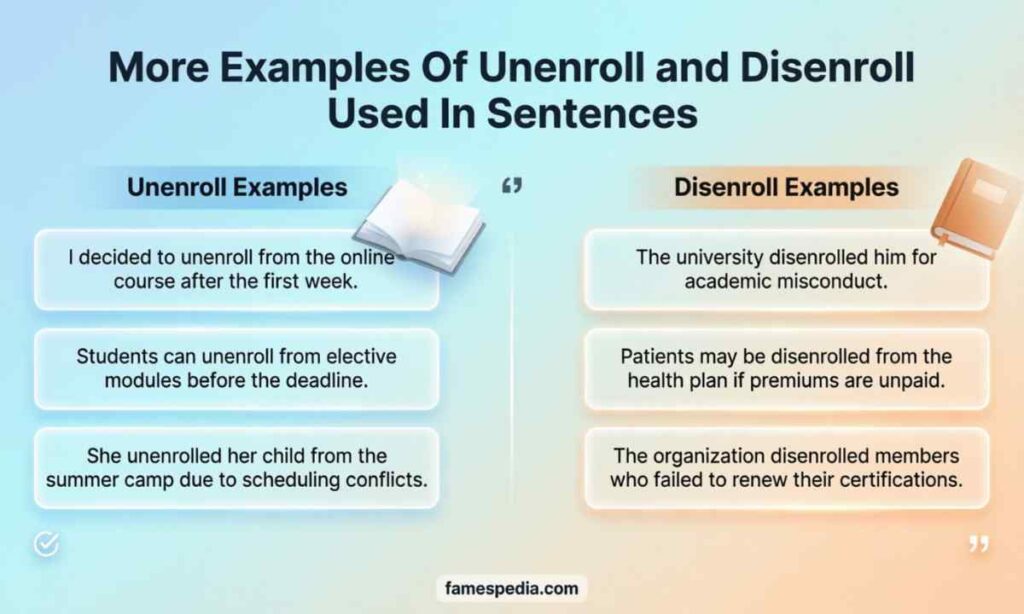
Here are clear, real-world examples of both words in action across different contexts.
Unenroll in sentences:
- She decided to unenroll from the yoga class because the timing no longer worked with her schedule.
- You can unenroll from the subscription at any time through your account settings.
- He chose to unenroll from the advanced math course before the semester deadline.
- Students who want to unenroll must submit a request form at least two weeks before the term ends.
- After finishing three modules early, she unenrolled from the remaining sessions.
Disenroll in sentences:
- The insurance company may disenroll members who no longer meet the eligibility requirements.
- He was disenrolled from the Medicare Advantage plan after failing to pay his premiums.
- The agency decided to disenroll participants who did not complete the required documentation.
- Students can be disenrolled from the program if they miss more than five sessions without notice.
- The system automatically disenrolled inactive users after 90 days of no activity.
Notice how the tone shifts between the two sets of examples. The unenroll examples feel personal and self-directed. The disenroll examples feel administrative and institution-driven.
Common Mistakes To Avoid
Knowing what not to do is just as useful as knowing what to do. Here are the most frequent errors people make with these two words.
Mistake 1: Treating unenroll and disenroll as exact synonyms
They both involve leaving a program, but they are not interchangeable in every situation. Using disenroll in a casual app instruction sounds stiff and confusing. Using unenroll in a healthcare policy document sounds imprecise and unprofessional.
Fix: Match the word to who is acting. Individual leaving = unenroll. Institution removing = disenroll.
Mistake 2: Ignoring context entirely
Some people pick one word and use it everywhere. This leads to mismatches, especially in formal writing or official documentation.
Fix: Always check the setting. Academic and digital platforms lean toward unenroll. Healthcare, insurance, and government systems prefer disenroll.
Mistake 3: Skipping proper procedures
Some writers use unenroll informally when the actual process requires a formal disenrollment request. This can cause confusion in legal, medical, or administrative documents.
Fix: Follow the terminology used by the platform or organization. If their policy says disenroll, match that language in your writing.
Mistake 4: Assuming disenroll is always involuntary
While disenrollment usually happens to someone rather than by them, there are cases where a person voluntarily disenrolls from a healthcare or insurance plan. The word does not always mean the action was forced.
Fix: Look at the context carefully before deciding which word fits best.
Also Read This: Goodmorning or Good Morning: Which is Correct?
Context Matters
The same action can be described with different words depending entirely on the situation. Context is what separates a correct word choice from a confusing one.
Academic settings: Schools and universities typically use unenroll when students choose to withdraw from a class. If a student is removed for academic or disciplinary reasons, some institutions may use disenroll in their formal communications.
Online learning platforms: Platforms like Coursera, Udemy, and corporate LMS systems almost always use unenroll. It fits the user-friendly, self-service nature of these environments.
Healthcare and insurance: This is the strongest territory for disenroll. Plans, policies, and government programs use it consistently. The Centers for Medicare and Medicaid Services (CMS) references disenrollment in their official transaction standards. Patients may be disenrolled when their income changes, their eligibility expires, or they switch providers.
Government and military programs: These systems rely on disenroll because the language must align with compliance standards and legal documentation.
Subscription services and apps: Unenroll is the preferred choice here. It feels natural and user-focused, matching the tone of modern digital platforms.
Exceptions To The Rules
Language is not always perfectly logical, and these two words come with a few exceptions worth knowing.
Exception 1: Voluntary disenrollment in healthcare
Even though disenroll often implies institutional removal, a person can voluntarily disenroll from a Medicare or health insurance plan during an open enrollment period. In this case, the action is the person’s own choice, but the formal terminology still uses disenroll because of industry standards.
Exception 2: Different programs use different rules
Medicare Advantage uses disenroll to describe leaving outside open enrollment. The Health Insurance Marketplace may use unenroll when a member voluntarily leaves during the enrollment window. The same industry can use both words depending on the specific program.
Exception 3: Some contracts do not allow unenrollment
Certain agreements lock participants in for a set period. Trying to leave early may not be called unenrolling at all. It may trigger a formal withdrawal request, a contract termination, or a penalty clause instead.
Exception 4: Regional variation
Some institutions or regions use these words loosely and treat them as interchangeable. In those cases, the context and official policies of that specific system take priority over general grammar rules.
Practice Exercises

Test your understanding with these exercises. Choose the correct word for each blank.
Exercise 1: Fill in the blank
- After missing too many sessions, the student was __________ from the program by the school.
- She decided to __________ from the online cooking class because she found a local option she preferred.
- The insurance company will __________ members who fail to submit updated eligibility documents.
- He chose to __________ from the email course before the third module started.
- Participants who do not renew their credentials may be __________ from the certification program.
Answers: 1. disenrolled, 2. unenroll, 3. disenroll, 4. unenroll, 5. disenrolled
Exercise 2: Correct the sentence
Identify the word that does not fit and replace it.
- “You can disenroll from the app at any time from your account settings.” (Too formal for an app interface.)
- “The government agency unenrolled the applicant after reviewing their eligibility status.” (Too casual for a government process.)
Corrected answers: 1. unenroll, 2. disenrolled
Conclusion
Understanding the difference between unenroll vs disenroll makes your writing clearer and more professional. Unenroll is the right word when someone chooses to leave a course, program, or membership on their own terms. Disenroll fits when an institution, authority, or system removes someone through a formal process.
The easiest rule to remember is this: unenroll for users, disenroll for institutions. When you keep that distinction in mind, choosing between these two words becomes quick and confident every time you write.

Arslan is the creator and author behind FamesPedia, a platform focused on grammar, writing skills, and English language learning. Passionate about clear communication and effective writing, Arslan shares practical grammar tips, easy-to-follow language guides, and educational content to help readers improve their English with confidence.