Do you ever stop mid-sentence wondering whether to write “realist” or “realest”? You are not alone. These two words look almost identical, come from the same root word “real,” and yet they mean completely different things. Using the wrong one can make your writing sound off, whether you are drafting a formal essay or sending a quick caption on social media.
A realist is a person who sees life as it truly is, grounded in facts and practical thinking. Realest, on the other hand, is an informal superlative that means “most genuine” or “most authentic.” One belongs in academic writing and philosophy. The other thrives in hip-hop lyrics and Instagram captions. Knowing which word fits where will sharpen your grammar and make your communication much stronger.
Realist
Meanings Of The Word Realist

The word realist has been part of the English language for centuries. It carries several distinct meanings depending on the subject and context. Below are the main definitions.
As A Noun (Thought)
In everyday thinking and general conversation, a realist is someone who accepts situations exactly as they are. They do not chase impossible outcomes or rely on wishful thinking. Instead, they focus on what is achievable and make decisions based on facts and logic.
A realist looks at a problem and asks, “What can actually be done here?” rather than, “What do I wish would happen?” This mindset is often seen as a strength in leadership, business, and personal decision-making. People who are practical thinkers and problem solvers are frequently described using this term.
Realist As A Noun (Arts, Literature)
In art and literature, a realist is someone who creates work that depicts everyday life truthfully and without idealization. The realism movement in the 19th century rejected romanticism and fantasy. Instead, realist writers and artists portrayed ordinary people, working-class struggles, and real-world conditions with honesty and accuracy.
Famous realist writers include Gustave Flaubert, Charles Dickens, and Mark Twain. Their work focused on authentic representation of society rather than dramatized or romanticized versions of life. In visual art, realist painters captured scenes exactly as they appeared, with no embellishment.
Philosophy. An Adherent Of Realism.
In philosophy, a realist holds the belief that objects and the external world exist independently of the human mind. This school of thought is known as philosophical realism. Realists argue that reality does not depend on what we perceive or believe.
This position directly opposes idealism, which suggests that the mind shapes or creates reality. A philosophical realist would say that a tree in the forest exists whether or not anyone sees it. This concept has influenced major areas of thought including metaphysics, epistemology, and political philosophy.
As A Noun, In The American Dictionary
The American English definition of realist, as found in major dictionaries like Merriam-Webster and the American Heritage Dictionary, is:
A person who accepts and deals with situations as they truly are, rather than hoping for something unlikely or ideal.
This definition emphasizes the practical and grounded nature of a realist. In American usage, the word often appears in political discussions, economic planning, and career advice. It carries a neutral to positive tone, suggesting maturity and clear thinking.
As An Adjective
While realist is primarily used as a noun, it can also function as an adjective in certain contexts. When used this way, it describes something connected to the philosophy or style of realism.
| Usage | Example |
| As a noun | “She is a realist who plans carefully.” |
| As an adjective | “He took a realist approach to the budget.” |
In both cases, the word signals a grounded, fact-based perspective.
Origin Of The Word Realist
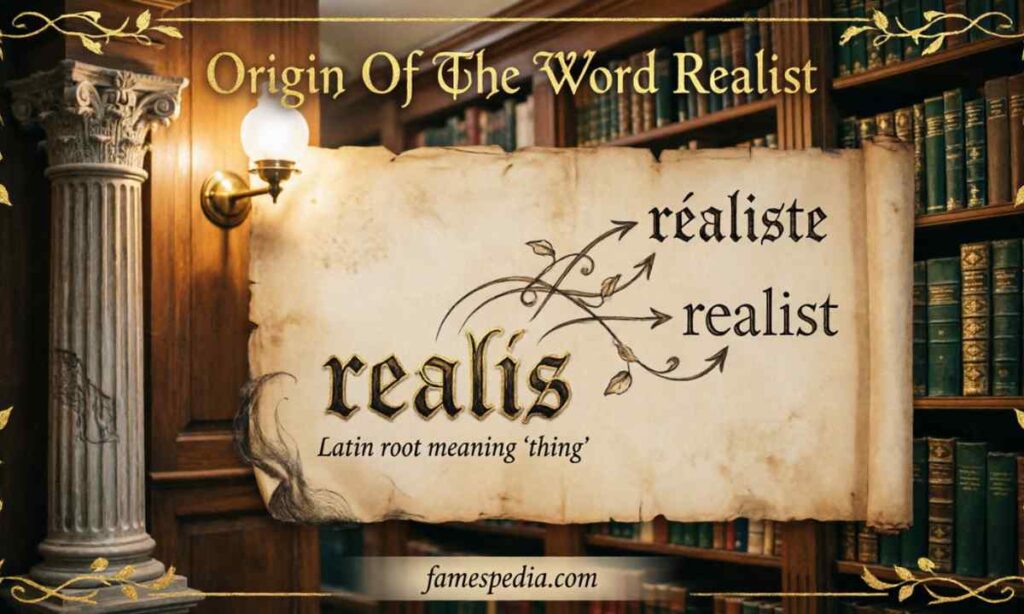
The word realist dates back to between 1595 and 1605. It was formed by combining the word “real” with the suffix “-ist,” which typically denotes a person who practices or believes in something.
The root word “real” itself traces back to the Latin “realis,” meaning “relating to things.” Over time, the word evolved through philosophy to describe thinkers who believed in the independent existence of the material world. By the 19th century, its meaning expanded into art and everyday language to describe anyone with a fact-based, no-nonsense worldview.
Other Words Derived From Realist
Several related words share the same root as “realist.” Understanding them can help you use the right term in the right situation.
| Word | Part of Speech | Meaning |
| Realism | Noun | The practice or philosophy of representing life accurately |
| Realistic | Adjective | Sensible and practical; likely to succeed |
| Reality | Noun | The state of things as they actually exist |
| Realize | Verb | To become fully aware of something |
| Really | Adverb | In actual fact; very much |
Realest
Meanings Of The Word Realest
Realest As An Adjective
Realest is the superlative form of the adjective “real.” In standard grammar, superlatives express the highest degree of a quality. Think of “kindest” from “kind,” or “strongest” from “strong.” Realest follows the same pattern, meaning “most real.”
In modern usage, especially in informal and slang contexts, realest has taken on a deeper, more personal meaning. It describes someone who is the most genuine, most loyal, and most authentic person in a given group or situation.
What Does ‘Realest’ Mean?
In casual everyday speech and popular culture, realest means someone who is completely genuine, honest, and true to themselves and others. When someone calls you “the realest,” they are paying you a high compliment. They are saying you do not fake your emotions, you do not put on a show, and you stay loyal no matter what.
The word captures a feeling that “most genuine” or “most authentic” cannot always match in tone. It carries warmth, respect, and cultural weight that makes it more expressive in casual settings. People use it to recognize someone who keeps it honest, stays grounded, and shows up for others without pretending.
Origin Of The Word Realest
The word “real” goes all the way back to the 14th century, meaning “existing” or “true.” The superlative form “realest” followed naturally from English grammar rules.
However, the slang meaning of realest emerged much later. In the early 20th century, the phrase appeared in print. Marco Frascari and Federica Goffi used it in a 1923 issue of House and Garden, writing about one’s “innermost and therefore realest longings.”
By the late 19th century, related slang expressions like “for real,” “keep it real,” and “get real” were already gaining ground. These all pointed toward ideas of authenticity and being grounded in truth. By 1994, realest had entered hip-hop slang as a term for someone exceptional, honest, and trustworthy. It grew alongside slang expressions like “illest” and “chillest,” all using the “-est” suffix to signal the highest level of a quality.
How Do People Use The Word Realest?
Realest In Hip Hop Culture
Hip-hop culture has played the biggest role in spreading the word realest into mainstream language. In a genre that values authenticity, street credibility, and raw honesty, calling someone “the realest” became one of the highest compliments possible.
Rapper Tupac Shakur used the word in song titles during the 1990s, cementing its place in the genre. Iggy Azalea opened her hit song “Fancy” with the line that made “realest” instantly recognizable to a massive audience. Drake, Kendrick Lamar, and countless other artists have used the word in lyrics to celebrate loyalty, rawness, and staying true to one’s roots.
The idea behind it connects directly to a core hip-hop value: “keeping it 100” or being fully transparent and genuine in everything you do.
Who Uses The Word ‘Realest’?
Realest is widely used across several groups and platforms:
- Gen Z and millennials on social media platforms like Instagram, TikTok, and X (formerly Twitter)
- Hip-hop fans and artists in lyrics, interviews, and fan culture
- Influencers and content creators who want to signal authenticity to their audience
- Friends paying each other genuine compliments in everyday conversation
- Pop culture writers commenting on celebrities who show their true personality in public
The word remains informal. It does not belong in academic papers, business emails, or formal reports. In those contexts, phrases like “most genuine,” “most authentic,” or “most sincere” work better.
You May Also Like This: Challenge or Challange: Which Is Actually Right?
Examples Of Realist And Realest In Sentences
Realist
Below are clear examples showing how to use realist correctly in sentences:
- She is a realist who knows that success takes years of consistent effort.
- As a realist, he avoided making promises he could not keep.
- The general took a realist approach to the conflict, focusing only on what was achievable.
- From a realist perspective, the project timeline needed serious adjustments.
- Being a realist does not mean giving up on dreams. It means building a real plan to reach them.
- The philosopher was a realist who believed the world existed independently of human perception.
- Within a realist framework, international politics is driven by power, not ideals.
Realest
Here are natural examples of realest used correctly in sentences:
- You are the realest friend I have ever had. You never pretend.
- That documentary gave the realest look at poverty I have seen in years.
- She kept it honest when no one else would. She is the realest one in the room.
- His interview was the realest moment of the entire press tour.
- Among everyone in that group, he stayed the realest through every hardship.
- They always show up for each other. That is the realest kind of friendship.
- Her song lyrics captured the realest emotions of growing up in a tough neighborhood.
Quick Comparison: Realist Vs. Realest
| Feature | Realist | Realest |
| Part of speech | Noun / Adjective | Adjective (superlative) |
| Meaning | A practical, grounded person | Most genuine or authentic |
| Tone | Formal and neutral | Informal and expressive |
| Context | Philosophy, literature, academia | Social media, music, casual speech |
| Example | “She is a realist.” | “She is the realest.” |
Conclusion
Realist and realist look similar but serve very different purposes. A realist is a practical person who deals with life as it truly is, rooted in philosophy, literature, and formal thought. Realest is the superlative form of real, used informally to celebrate the highest level of authenticity, honesty, and loyalty.
The rule is simple. Use realism when you are describing a practical mindset or a formal concept. Use realest when you are praising someone’s genuine character in casual conversation, a caption, or song lyrics. Getting this right keeps your writing sharp, your tone appropriate, and your message clear every single time.

Arslan is the creator and author behind FamesPedia, a platform focused on grammar, writing skills, and English language learning. Passionate about clear communication and effective writing, Arslan shares practical grammar tips, easy-to-follow language guides, and educational content to help readers improve their English with confidence.