
Two words. Nearly identical sounds. Completely opposite meanings. If you have ever typed a sentence and paused wondering whether to write “immerse” or “emerse,” you are not alone. This confusion is remarkably common, even among experienced writers, because both words trace back to the same Latin root and deal with the same general concept of liquid and movement.
Here is the short answer: immerse means to plunge something fully into a liquid or to become deeply absorbed in an activity. Emerse, on the other hand, describes something rising above a water surface, and it is mostly confined to scientific and botanical writing. Using one in place of the other does not just look wrong; it changes your meaning entirely.
What Is The Meaning Of The Word “Immerse”?
Immerse is a verb. At its most basic level, it means to place something completely under a liquid so that no part of it remains above the surface. Think of lowering a tea bag into a cup of hot water. The bag goes fully under. That physical picture captures the core of what immerse means.
Beyond the literal sense, immerse carries a powerful figurative meaning that has become far more common in everyday speech and writing. When you immerse yourself in something, you give it your complete focus and attention, leaving the outside world behind. You are not just involved; you are fully absorbed.
Both senses of the word share the same core idea: total engagement, full submersion, nothing held back.
Key meanings at a glance:
| Sense | Meaning | Example |
| Literal | To place completely under a liquid | Immerse the cloth in the dye |
| Figurative | To become deeply absorbed in something | She immersed herself in the novel |
| Educational | To surround oneself with a subject for accelerated learning | Language immersion programs |
| Therapeutic | To expose oneself to a fear in a controlled setting | Immersion therapy for phobias |
What Is The Origin Of The Word “Immerse”?
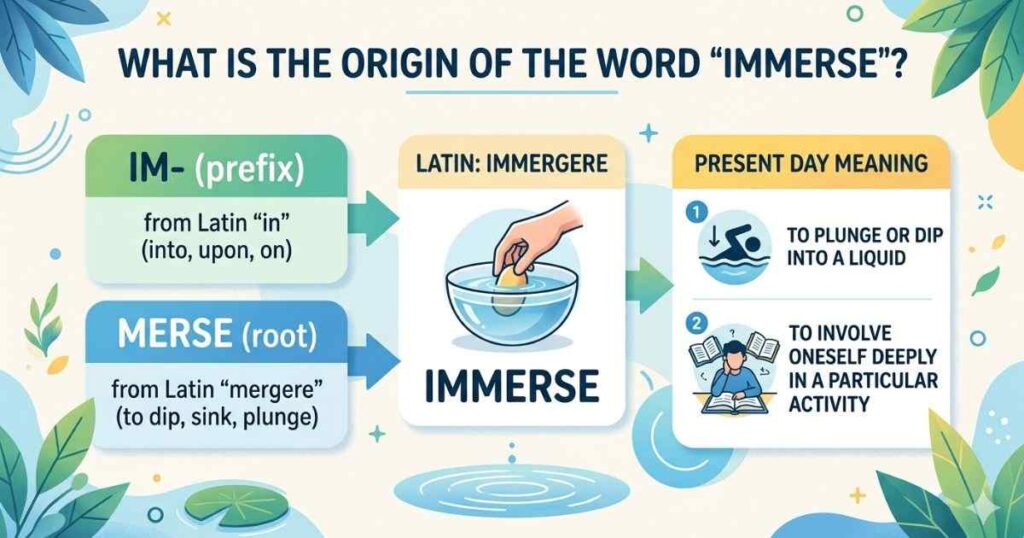
The word immerse has Latin roots that make its meaning feel inevitable once you understand them. It comes from the Latin verb immergere, built from two parts:
im (a form of “in,” meaning “into”) and mergere (meaning “to dip” or “to plunge”).
So at the root level, immerse literally means “to plunge into.” English borrowed this word and has used it since the early 17th century to describe physical submersion. By 1660, the word had expanded its reach. Writers and thinkers began using it to describe deep mental and emotional engagement, calling someone “immersed in study” or “immersed in work.” That figurative leap gave immerse the versatility it has today.
The noun form, immersion, followed naturally and is now widely used across education, medicine, technology, and daily conversation.
What Is The Meaning Of The Word “Emerse”? Immerse vs Emerse Meaning
Here is where the contrast becomes clear. Emerse describes the opposite movement. While immerse means going fully under, emerse refers to rising above the surface of water or existing partially above it.
You will most often encounter emerse (sometimes spelled emersed) in scientific and botanical contexts. In botany, an emerse plant is an aquatic plant whose roots remain submerged while its stems or leaves protrude above the waterline. Cattails and water lilies are classic examples of emerse or immersed vegetation.
In general usage outside science, emerse can describe anything that rises or emerges from a liquid, though most everyday writers reach for the more familiar word “emerge” to express this idea.
Key meanings of emerse:
- In botany: aquatic plants with parts growing above the water surface
- In general use: to rise or come above a liquid surface
- As an adjective (emersed): describing something positioned above water
- As a noun (rare): something that is emergent or rising upward
One important note: emerse is not a common everyday verb. In most writing contexts, if you mean “to come out of” something, the word you probably want is emerge, not emerse.
The Relationship Of The Word “Emerse” With “Emersion”
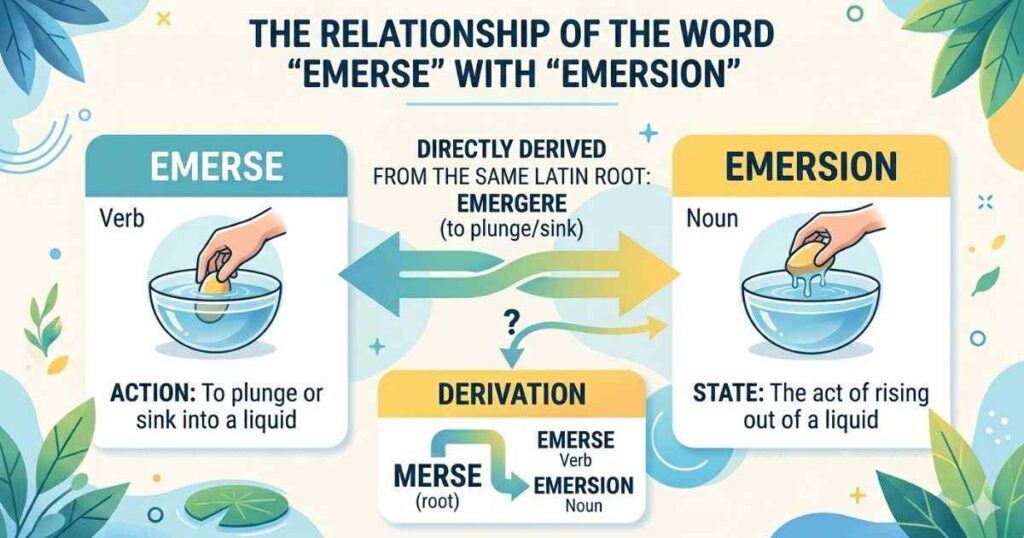
Emerse and emersion are directly connected. Understanding one helps you use the other correctly.
Emersion is the noun form that names the act or process of rising above a surface. The relationship works exactly like immerse and immersion:
- Emerse describes the state or action (the plant is emerse above the water)
- Emersion names the process itself (the emersion of the plant above the waterline)
This parallel structure is a useful memory tool. If you know that immersion is the noun of immerse, then emersion is the noun of emerse.
Emersion also carries a specific meaning in astronomy. When a star, moon, or planet disappears behind another celestial body during an eclipse, astronomers call that event an immersion. When the same body reappears on the other side and comes back into view, that moment is called an emersion. Astronomers track both events with great precision, and the vocabulary reflects the directional logic: going behind is immersion, coming back out is emersion.
What Is The Origin Of The Word “Emerse”?
Emerse arrived in English toward the end of the 17th century. It comes from the Latin word emersus, which is the past participle of emergere.
Breaking that apart: e (a form of “ex,” meaning “out of”) and mergere (to dip or plunge). So emergere, and by extension emerse, means “to rise out of” or “to come up from.”
Notice the direct contrast with immerse. Both words come from the same root mergere, but the prefixes send them in opposite directions. Im drives something in; e brings it out. That single prefix difference is the entire story of immerse vs emerse in one clear picture.
The noun emersion appeared in English around 1630, slightly before emerse itself, and was first used to describe the reappearance of something that had been hidden or submerged. The verb form emerse followed later and has always remained more specialized and less common than its counterpart immerse.
The Difference Between “Immersion” Vs “Emersion” (Immerse Vs Emerse)
Now that you understand each word individually, here is a direct side-by-side comparison:
| Feature | Immersion (Immerse) | Emersion (Emerse) |
| Direction | Inward, going under | Outward, rising above |
| Latin prefix | Im (into) | E/Ex (out of) |
| Common usage | Everyday language, education, technology, therapy | Scientific, botanical, astronomical contexts |
| Figurative use | Very common (immersed in work, learning, culture) | Rare in figurative writing |
| Frequency | Extremely common | Uncommon, mostly specialized |
| Opposite of | Emersion | Immersion |
The simplest way to remember the difference: immersion pulls inward, emersion pushes outward. Immersion is the process of entering, absorbing, or submerging. Emersion is the process of exiting, rising, or surfacing.
Another helpful memory cue: the prefix im sounds like “in” because it means going in. The prefix e sounds like the start of “exit” or “escape” because it signals coming out. Once that connection clicks, you will not mix them up again.
How Do People Use The Word “Immersion” (Immerse)
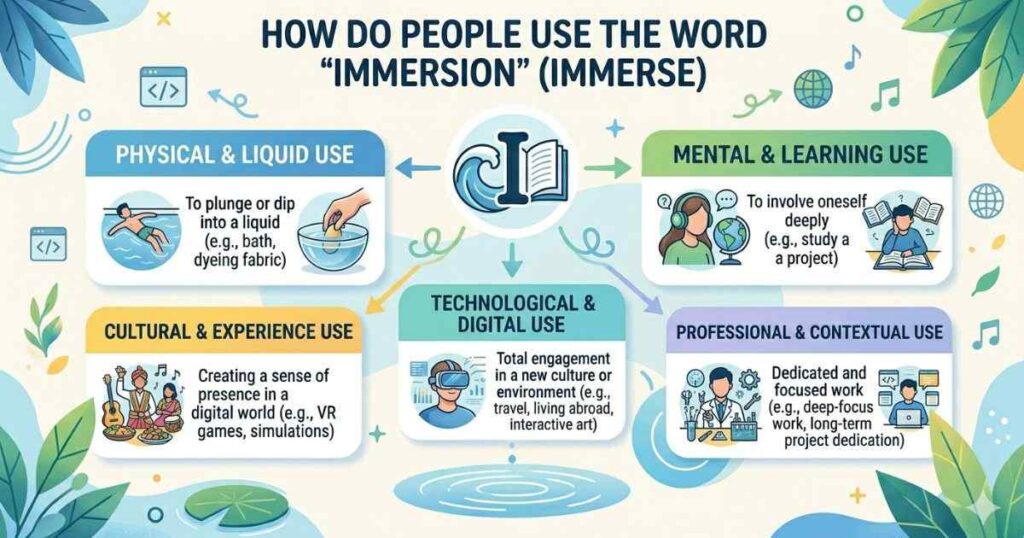
Immerse and its noun form immersion appear constantly across many fields and everyday conversations. Here are the most common contexts where you will encounter them:
1. Language Learning Language immersion programs place students inside an environment where the target language surrounds them completely. Every lesson, every conversation, and every instruction happens in that language. Research consistently shows this total-immersion approach accelerates fluency faster than traditional classroom instruction.
2. Virtual Reality (VR) The technology industry uses immersion heavily. When a VR headset convinces your brain that you are inside a game or simulated world, that experience is described as full immersion. The term “immersive experience” is now standard vocabulary in gaming, entertainment, and design.
3. Therapy and Psychology Immersion therapy, sometimes called exposure therapy or flooding, is a psychological technique where patients face their fears directly and repeatedly in a safe, controlled environment. Therapists use it to treat phobias, anxiety disorders, and post-traumatic stress. The idea is that immersing a patient in the source of their fear, gradually and carefully, breaks the fear response over time.
4. Cultural Engagement Travelers, students, and writers often describe deep engagement with another culture as cultural immersion. Moving to a foreign country, living with a local family, or participating in traditional customs are all forms of cultural immersion.
5. Religious Practice Full immersion baptism, practiced in many Christian traditions, involves submerging a person completely in water as a spiritual act. The word immersion here carries both its literal and symbolic meaning simultaneously.
6. Reading and Creative Work Writers, readers, and artists frequently describe being immersed in a project. This figurative use captures the feeling of losing track of time because your attention is completely committed to one thing.
How Do People Use The Word “Emersion” (Emerse)
Emersion and emerse appear far less frequently, and almost always in specialized writing. Here are the main contexts where these words do their proper work:
1. Botany Aquatic plant science relies on emerse and emersed regularly. A plant described as having emerse leaves is one whose leaves break through the water surface and grow in the air above. This matters in ecosystem studies because emerse plants access sunlight differently than fully submerged species and support different kinds of wildlife.
2. Astronomy As mentioned earlier, emersion describes the exact moment a celestial body reappears after being hidden during an eclipse or occultation. Astronomers note the precise time of emersion to gather data about the size, shape, and position of celestial objects.
3. General Scientific Writing In marine biology, hydrology, and environmental science, emersion sometimes describes the exposure of surfaces that were previously underwater, such as tidal zones that become exposed when water levels fall.
4. Rare Figurative Use A small number of writers use emerse figuratively to describe ideas, feelings, or realities surfacing into awareness. For example, a breakthrough idea might emerse from long discussion. However, this figurative use is uncommon and in everyday writing, emerge remains the more natural and universally understood choice.
You May Like This: Well Deserved or Well-Deserved? Which Is Correct?
Examples Of The Use Of The Word “Immerse” In Everyday Sentences
Seeing immerse used correctly across different contexts makes its range clear. Here are examples that cover both its literal and figurative meanings:
Literal examples:
- Immerse the vegetables in salted boiling water for three minutes before draining.
- The diver immersed himself beneath the surface and descended toward the reef.
- The manufacturer recommends immersing the component in a cleaning solution for thirty seconds.
Figurative examples:
- She immersed herself in the research for weeks before writing a single word.
- After the difficult year, he immersed himself in music and found comfort in it.
- The best way to learn a language quickly is to immerse yourself completely in it.
- The novel immerses readers in a world so vivid that hours pass without notice.
- They immersed themselves in the local culture, trying foods, learning customs, and attending festivals.
Professional and educational contexts:
- The training program immerses new employees in real projects from day one.
- Immersive storytelling techniques allow audiences to feel like participants, not just observers.
- The school’s language program is built entirely around full immersion.
Notice how immerse works smoothly in all of these sentences. It never feels forced or out of place because it is a flexible, widely understood word.
A Final Thought On The Words “Immerse” And “Emerse”
These two words are genuine antonyms built from the same Latin root but sent in opposite directions by their prefixes. That relationship makes the difference between them logical and, once you see it, easy to remember.
Immerse is the word you will use almost every time. It is common, flexible, and comfortable in formal writing, casual conversation, educational content, and creative work. Whether you are describing a cooking technique, a language program, a therapy method, or a moment of deep creative focus, immerse is the right word.
Emerse belongs in specialized writing. If you are a botanist describing aquatic plant life, an astronomer discussing an eclipse event, or a marine biologist documenting tidal exposure, emerse and emersion are precise and appropriate. Everywhere else, if you mean something coming out of water, reach for emerge instead.
The takeaway is simple:
- Going in, fully submerged, deeply absorbed? Use immerse.
- Rising above water in a scientific context? Use emerse.
- Coming out or becoming visible in everyday writing? Use emerge.
Good word choice is one of the clearest signs of strong writing. Now that you know the difference between immerse and emerse, you have one fewer reason to pause mid-sentence, and one more reason to write with confidence.

Arslan is the creator and author behind FamesPedia, a platform focused on grammar, writing skills, and English language learning. Passionate about clear communication and effective writing, Arslan shares practical grammar tips, easy-to-follow language guides, and educational content to help readers improve their English with confidence.