Have you ever paused mid-sentence, wondering whether to write “all-time favorite” or “all times favorite”? You are not alone. This is one of the most common grammar questions people search for online, and the answer is simpler than you might think.
Getting it right matters, whether you are crafting a social media post, writing a professional email, or composing a blog article. One version is grammatically correct, and the other is a widespread mistake that can make your writing look unprofessional. Let us clear this up once and for all.
Why is “All-Time Favorite” the Correct Usage?
The correct phrase is my all-time favorite, written with a hyphen between “all” and “time.”
The reason comes down to a fundamental English grammar rule: when two or more words work together to modify a noun, they form what is called a compound adjective, and a hyphen is required to connect them. In this phrase, “all-time” functions as a single compound adjective that modifies the noun “favorite.” Without the hyphen, the phrase loses its grammatical structure and becomes ambiguous.
Here is why “all times favorite” fails:
- “Time” should remain singular in this construction. Compound adjectives use the singular form of a noun, not the plural.
- “All times favorite” removes the necessary hyphen, breaking the compound adjective apart.
- The phrase becomes grammatically nonsensical, similar to saying “a high quality product” instead of “a high-quality product.”
All-Time Favorite Meaning
The phrase “all-time favorite” describes something or someone that holds the top spot above everything else across any period. It is not limited to a single moment or trend. It is an enduring, timeless preference that supersedes everything before or after it.
When you call something your all-time favorite, you are saying it is the number one pick, the perennial favorite, and the best of the best in your personal ranking, no matter when it was made or experienced.
Think of it this way: your all-time favorite song is not just your current obsession. It is the one track that has consistently moved you more than any other song, through every phase of your life.
Why “All Times Favorite” is Wrong
“All times favorite” is grammatically incorrect for two reasons. First, it uses the plural “times” where the singular “time” is required. Second, it omits the hyphen that is essential for forming a proper compound adjective. Writing “all times favorite” is similar to saying “a long time friend” instead of “a long-time friend.” The meaning collapses, and native English readers will immediately recognize the error.
Using “All-Time Favorite” in Different Situations

One of the great things about this phrase is its versatility. You can use “all-time favorite” in virtually any context to express a strong, lasting preference. Below are practical examples across different everyday situations.
All-Time Favorite Examples
Movies and Entertainment
- “The Shawshank Redemption is my all-time favorite movie because its story never loses its power.”
- “She considers The Godfather her all-time favorite film for its masterful direction and storytelling.”
Music
- “Bohemian Rhapsody by Queen remains his all-time favorite song, no matter how many times he hears it.”
- “That old jazz record is her all-time favorite album, and she has owned three copies over the years.”
Food and Dining
- “Chocolate chip cookies are my all-time favorite dessert, simple as that.”
- “Pizza Margherita is their all-time favorite meal when they visit Italy.”
Books
- “To Kill a Mockingbird is widely considered an all-time favorite novel in American literature.”
- “She handed me her all-time favorite book and said I had to read it before the weekend.”
Sports and Athletes
- “Michael Jordan is regarded as the all-time favorite basketball player by many sports analysts.”
- “The 1986 World Cup final remains his all-time favorite sporting event.”
Travel
- “Rome is their all-time favorite city, and they return every summer without fail.”
Hobbies
- “Watercolor painting has always been her all-time favorite creative outlet.”
Quick Comparison Table: Correct vs. Incorrect Usage
| Incorrect | Correct |
| all times favorite movie | all-time favorite movie |
| all time favorite song (no hyphen) | all-time favorite song |
| all times favourite book | all-time favourite book |
| my all times favorite place | my all-time favorite place |
| her all time favorite food | her all-time favorite food |
Notice that even “all time favorite” without a hyphen, while closer to correct, is still missing the essential hyphen. The complete and proper form always includes the hyphen: all-time favorite.
American vs British English: Usage of All-Time Favorite
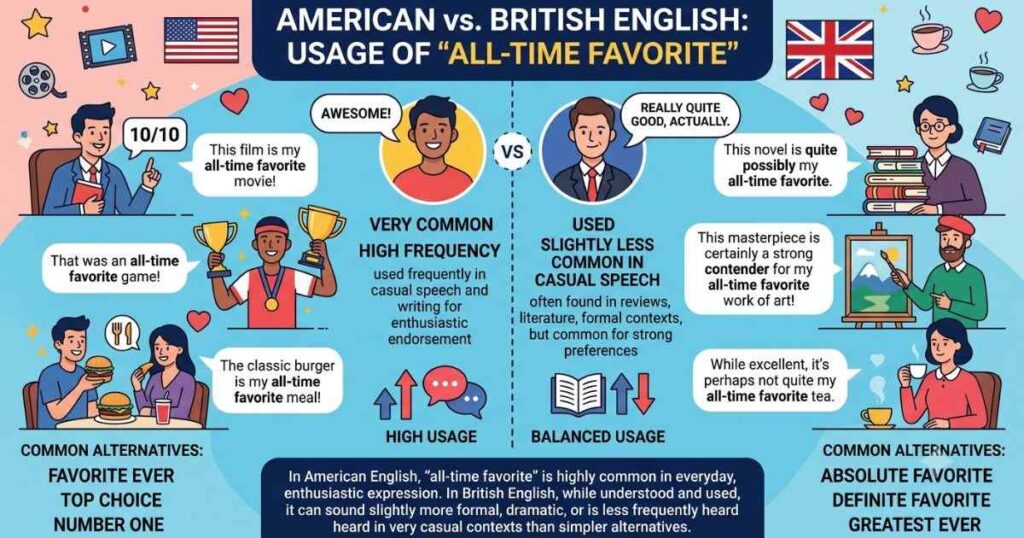
Here is where things get slightly interesting. The phrase “all-time favorite” is used in both American and British English, but there is one spelling difference worth knowing.
The Spelling Difference: Favorite vs. Favourite
In American English, the word is spelled favorite (without the “u”).
In British English, the word is spelled favourite (with the “u”).
This difference follows a broader pattern in English spelling. British English retained the “our” ending from French-influenced spellings, giving words like “colour,” “honour,” and “favourite.” American English simplified these spellings in the 18th and 19th centuries, largely through the language reforms of Noah Webster, dropping the “u” to produce “color,” “honor,” and “favorite.”
The Hyphen Rule Stays the Same
Regardless of which variety of English you use, the hyphen in “all-time” never changes. Whether you write:
- American English: all-time favorite
- British English: all-time favourite
…the hyphen is always present. This is one grammar rule that crosses the Atlantic without exception.
Usage Across English-Speaking Countries
| Region | Correct Spelling |
| United States | all-time favorite |
| United Kingdom | all-time favourite |
| Canada | all-time favourite (most common) |
| Australia | all-time favourite |
| Ireland | all-time favourite |
Both spellings are entirely acceptable in their respective regions. What matters most is that you stay consistent throughout your writing. If you begin with American English spellings, use them throughout. If you choose British English, do the same.
Alternative Ways to Say “All-Time Favorite”

Sometimes you want to express the same strong preference without repeating the exact phrase. Fortunately, English offers several great alternatives that carry the same meaning. Here are the most natural and widely used options:
Formal Alternatives
Perennial Favorite Something described as a perennial favorite has been loved consistently over a long period. “The Sound of Music is a perennial favorite at holiday screenings across the country.” This term is commonly used in journalism and literary writing.
Unequivocal Favorite This phrase adds a layer of certainty. It means there is absolutely no doubt about the top choice. “She is the unequivocal favorite to win the championship this season.”
Enduring Classic Used to describe something that has stood the test of time. “Casablanca remains an enduring classic that new generations continue to discover.”
Top Pick A straightforward, conversational way to say something is the best choice. “This book is my top pick for anyone interested in personal development.”
Also Get Information About These At: Immerse Vs Emerse: When To Use Each One In Writing
Casual and Conversational Alternatives
Number One Pick Perfect for informal conversations. “The beach has always been my number one pick for a vacation destination.”
Go-To Choice Implies reliability and consistent preference. “Thai food is my go-to choice whenever I cannot decide what to eat.”
All-Time Fav A shortened, social media friendly version used in casual writing and posts. While informal, it is widely understood online.
Timeless Classic Especially useful when describing music, film, or literature. “Abbey Road by The Beatles is a timeless classic that no one can argue with.”
Quick Reference: Alternatives at a Glance
| Phrase | Best Used For |
| Perennial favorite | Formal writing, journalism |
| Unequivocal favorite | Emphasizing certainty |
| Enduring classic | Art, music, film, literature |
| Go-to choice | Casual, everyday conversation |
| Number one pick | Rankings, personal preferences |
| Timeless classic | Cultural or historical references |
| Top pick | Product reviews, recommendations |
Conclusion
The answer is clear: all-time favorite is the only correct form. The hyphen is not optional, “times” should never be plural, and the phrase functions as a compound adjective that modifies a noun. Whether you follow American or British spelling conventions, the hyphen in “all-time” is a constant that never changes.
Getting this phrase right is a small but meaningful detail that reflects well on your writing. It shows attention to grammar and a command of the English language. So the next time you want to express your deepest, most enduring love for a movie, a song, a place, or a person, reach confidently for “all-time favorite” and know you are using it correctly.

Arslan is the creator and author behind FamesPedia, a platform focused on grammar, writing skills, and English language learning. Passionate about clear communication and effective writing, Arslan shares practical grammar tips, easy-to-follow language guides, and educational content to help readers improve their English with confidence.