
Have you ever typed “curtesy” when you meant “courtesy” and wondered if anyone would notice? You are not alone. These two words look nearly identical, but they belong to entirely different worlds. One shows up in everyday conversations, professional emails, and social etiquette. The other belongs to old English common law and dusty legal textbooks.
Getting them mixed up can make your writing look careless, especially in formal or professional settings.This guide breaks down the difference between courtesy and curtesy in plain language. You will learn what each word means, how to use them correctly in a sentence, common mistakes to avoid, and some helpful practice exercises to lock in your understanding.
Define Courtesy
Courtesy is a noun that refers to the act of showing politeness, respect, and consideration toward other people. It describes those small but meaningful gestures that make social and professional interactions smoother and more pleasant. When you hold a door open for someone, thank a colleague for their help, or let another driver merge into your lane, you are practicing courtesy.
The word comes from Old French “courtoisie,” which referred to the polished manners expected of people in royal courts. Over centuries, it evolved into the broader concept of good behavior in everyday life.
Courtesy can also function as an adjective, as in “a courtesy call” or “a courtesy vehicle.” In this form, it describes something provided as a polite gesture rather than out of obligation.
Key characteristics of courtesy include:
- It reflects good manners and social etiquette
- It is used in both casual and professional settings
- It appears in common phrases like “out of courtesy,” “as a courtesy,” and “common courtesy”
- It can describe a noun (courtesy shuttle, courtesy copy) or stand alone as a concept
Define Curtesy
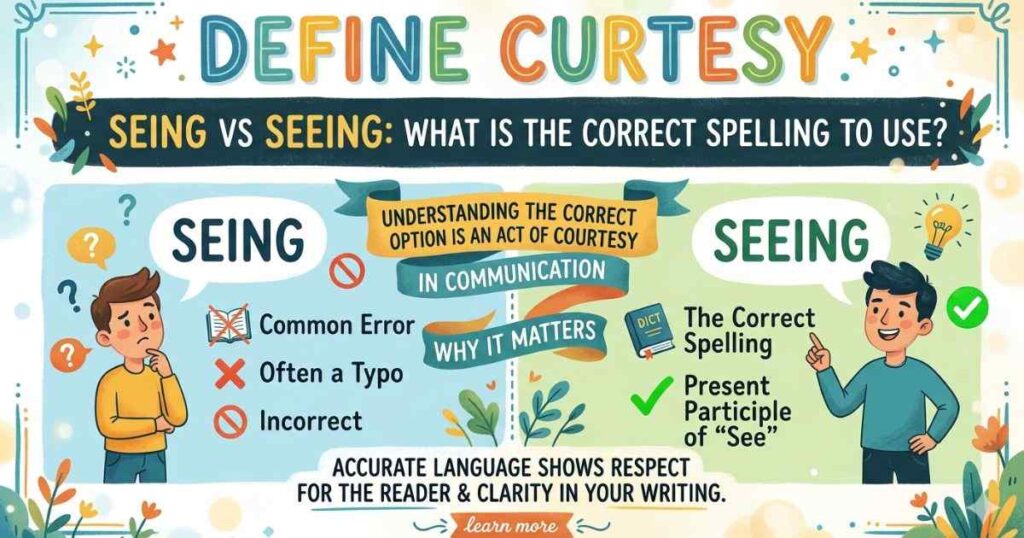
Curtesy is a historical legal term rooted in English common law. It refers to a surviving husband’s right to a life estate in the real property owned by his deceased wife, provided the couple had a child born alive during the marriage who was capable of inheriting the land.
Under this old doctrine, a widower could continue to live on and benefit from his late wife’s property for the remainder of his life. This right was known as “curtesy initiate” before the wife’s death and “curtesy consummate” after her death. The female equivalent of this right was called “dower,” which granted widows a one-third life interest in their husband’s real estate.
Today, curtesy has been largely abolished in most jurisdictions and replaced by modern statutory protections such as the elective share, which gives a surviving spouse the right to claim a percentage of the deceased spouse’s estate regardless of what the will says.
In short, curtesy is a rare, specialized term that you will almost never encounter outside of legal documents, estate law discussions, or historical texts.
Courtesy vs Curtesy Meaning at a Glance
| Feature | Courtesy | Curtesy |
| Part of Speech | Noun, Adjective | Noun (legal term) |
| Meaning | Politeness, respect, good manners | Husband’s legal right to deceased wife’s property |
| Usage Frequency | Extremely common | Very rare |
| Context | Everyday life, professional settings | Historical law, estate documents |
| Origin | Old French “courtoisie” | English common law |
| Modern Relevance | Universal | Largely abolished |
How To Properly Use The Words In A Sentence
How To Use “Courtesy” In A Sentence
Since courtesy is a noun and adjective, it fits naturally into sentences that describe polite behavior, thoughtful gestures, or professional conduct. Always pair it with action verbs like “show,” “extend,” “offer,” or “practice” when you want to describe the act itself.
Here are some clear usage patterns:
As a noun: “He showed great courtesy when he waited for the elderly man to finish speaking before responding.”
As an adjective: “The hotel provides a courtesy shuttle that runs every thirty minutes between the airport and the lobby.”
In a prepositional phrase: “As a courtesy, please silence your phone before the meeting begins.”
In a professional context: “The customer service team extended the courtesy of a full refund, even though the return window had passed.”
One important rule: courtesy is never used as a verb. You cannot say “I will courtesy him.” Instead, you say “I will show him courtesy” or “I will extend the courtesy of a phone call.”
How To Use “Curtesy” In A Sentence
Because curtesy is a technical legal term, it belongs almost exclusively in legal writing, historical analysis, or estate law discussions. Here is how it appears correctly in context:
“Under the old doctrine of curtesy, the widower retained the right to live on his late wife’s estate for the duration of his natural life.”
“The court found that curtesy rights had been extinguished by the state’s Married Women’s Act.”
“Before modern probate laws replaced it, curtesy gave husbands significant control over their deceased wives’ real property.”
If you are not writing about historical property law or estate inheritance, you almost certainly do not need this word.
More Examples Of Courtesy & Curtesy Used In Sentences
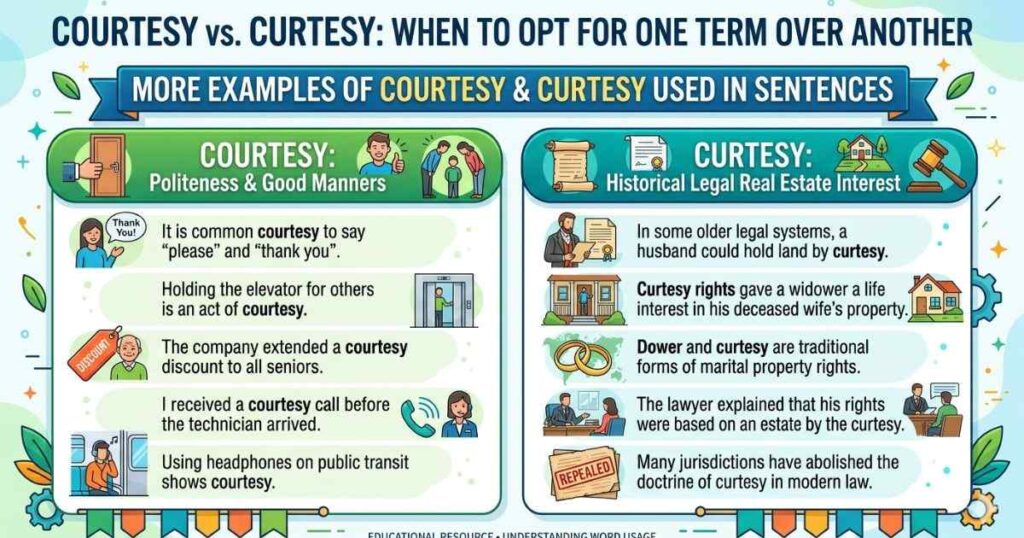
Examples of Using Courtesy in a Sentence
- As a courtesy, the airline upgraded her to business class at no additional charge.
- It is common courtesy to reply to an email within 24 hours in a professional setting.
- He called ahead as a courtesy to let them know he would be running late.
- The company offered a courtesy inspection to all new clients during the first month.
- Showing courtesy in difficult conversations builds trust and keeps communication open.
- She received the gift as a professional courtesy from a longtime business partner.
- Drivers who use turn signals are practicing basic courtesy on the road.
- Please extend the courtesy of knocking before entering a closed office.
Examples of Using Curtesy in a Sentence
- The attorney explained that curtesy once allowed a widower to claim a life estate in his wife’s farmland.
- Several American states have abolished curtesy entirely through modern inheritance statutes.
- The old legal record referenced curtesy as the basis for the widower’s continued occupation of the estate.
- Curtesy and dower were mirror-image doctrines designed to protect surviving spouses under early English law.
- Legal historians note that curtesy reflected the patriarchal structure of medieval property ownership.
Common Mistakes To Avoid
1. Using “Curtesy” Instead of “Courtesy”
This is by far the most frequent error. Writers sometimes type “curtesy” when they mean “courtesy,” especially when typing quickly or relying on autocorrect.
Incorrect: “He showed great curtesy by holding the door open for her.” Correct: “He showed great courtesy by holding the door open for her.”
The fix is simple: if you are talking about polite behavior, good manners, social etiquette, or respectful gestures, use courtesy. Curtesy belongs only in legal or historical contexts.
2. Using “Courtesy” as a Verb
Courtesy is a noun and an adjective, not a verb. Treating it like one is a grammatical error.
Incorrect: “I will courtesy him with a proper introduction.” Correct: “I will show him the courtesy of a proper introduction.”
When you want to describe the act of being courteous, reach for a verb like “show,” “offer,” “extend,” or “practice” and pair it with courtesy as the object.
3. Confusing Courtesy With Respect
While courtesy and respect are related concepts, they are not interchangeable. Respect is a broader attitude of admiration or esteem for someone. Courtesy refers specifically to the outward behaviors and actions that express that attitude. You can show courtesy to a stranger without necessarily respecting them deeply. Respect tends to be earned over time, while courtesy is something you can offer in any interaction.
Tips To Avoid These Mistakes
- When in doubt, ask yourself: “Am I describing polite behavior?” If yes, use courtesy.
- Before using “curtesy,” confirm you are writing about historical property law or a legal estate matter.
- Never use courtesy as a verb. Pair it with action verbs like show, extend, or offer instead.
- Read your sentence aloud. If it sounds natural and refers to good manners, courtesy is the right word.
- Keep a mental shortcut: “courtesy” contains the letter “u” just like “manners” contains good behavior. Both belong together.
Context Matters
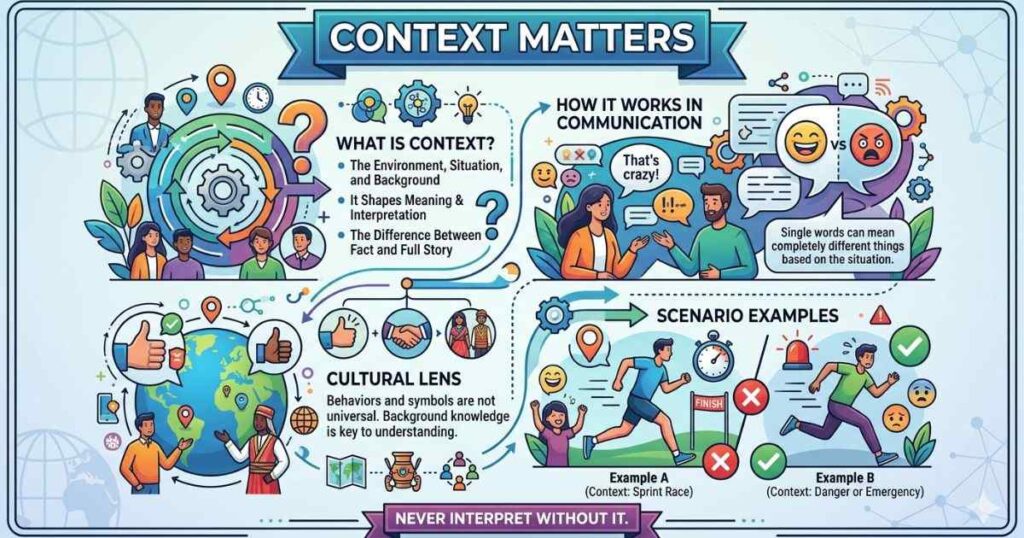
The context in which you are writing plays a huge role in determining which word belongs in your sentence.
In everyday conversation, professional emails, customer service scripts, social media posts, and academic writing, courtesy is always the correct choice. It captures the full range of polite, considerate human behavior that most writers are trying to describe.
In legal documents, historical analyses of English common law, estate planning discussions, or law school textbooks, curtesy may appear when the writer is specifically referencing the historical doctrine of a widower’s property rights.
The safest rule: if you are not writing for a legal or historical audience, forget curtesy exists. Stick with courtesy, and your writing will be clear, accurate, and professional every time.
Exceptions To The Rules
1. Legal Terminology
In legal writing, curtesy must be used precisely and only in the correct context. Misusing it in a legal document could create confusion about property rights or inheritance claims. If you are drafting estate documents, wills, or historical legal analyses, confirm whether curtesy applies under the relevant jurisdiction’s laws. Many states have abolished it entirely.
2. Heraldry
In heraldry and some historical texts related to medieval titles, the term “courtesy title” refers to a title given to members of a noble family who are not themselves peers. For example, the children of a duke may hold courtesy titles. This is a specialized use of “courtesy” that extends slightly beyond everyday politeness, but it still uses “courtesy,” not “curtesy.”
3. Everyday Communication
In modern everyday communication, including business emails, social conversations, text messages, and online writing, curtesy has no place whatsoever. Only courtesy belongs here. No matter how formal or casual the setting, when you are describing polite or considerate behavior, courtesy is the word you need.
Practice Exercises
Test your understanding with these exercises. Try to complete them without looking back at the article.
Exercise 1: Fill in the Blank
Fill in each blank with either “courtesy” or “curtesy.”
- The flight attendant offered passengers a ________ bag containing snacks and a blanket.
- Under old English common law, ________ gave the widower the right to stay on his late wife’s land.
- As a ________, the manager personally called each customer who experienced a delay.
- The legal historian explained how ________ and dower once balanced inheritance rights between spouses.
- Showing ________ in the workplace builds stronger professional relationships.
Answers: 1. courtesy, 2. curtesy, 3. courtesy, 4. curtesy, 5. courtesy
Exercise 2: Sentence Completion
Complete each sentence using the correct word and your own words to finish the thought.
- As a courtesy, the receptionist _______________________________.
- The attorney cited curtesy to explain why _______________________________.
- Common courtesy in a meeting means _______________________________.
- The doctrine of curtesy was abolished because _______________________________.
- He showed remarkable courtesy when _______________________________.
Sample answers: 1. greeted each visitor by name and offered them a seat / 2. the widower still had a legal right to occupy the family estate / 3. silencing your phone and letting others finish speaking / 4. modern inheritance laws provide more equitable protections for surviving spouses / 5. he took the time to personally thank every member of the team
You May Also Like These: All-Time Favorite or All Times Favorite: Which is Correct?
Conclusion
The difference between courtesy and curtesy comes down to context and meaning. Courtesy is the word you will use nearly every day. It describes the polite, considerate behavior that holds communities and professional relationships together. Curtesy, on the other hand, is a narrow legal term from a long-ago era of English property law that most writers will never need.
When you understand this distinction, your writing becomes cleaner, more precise, and more credible. Good communication is itself a form of courtesy, and knowing which word to use is a small but meaningful part of that. Choose your words with care, practice the examples above, and you will never mix up these two again.

Arslan is the creator and author behind FamesPedia, a platform focused on grammar, writing skills, and English language learning. Passionate about clear communication and effective writing, Arslan shares practical grammar tips, easy-to-follow language guides, and educational content to help readers improve their English with confidence.