Have you ever typed “grately” and wondered if it was the right spelling? You are not the only one. This is one of the most searched spelling confusions in English grammar, and it trips up students, professionals, and everyday writers alike. The words look almost identical, they sound the same when spoken out loud, and autocorrect does not always catch the error.
So what is the real difference between grately vs greatly? The short answer is that only one of them is a real word. This article will break down exactly what each term means, show you how to use them correctly in sentences, and help you avoid the spelling mistake for good.
Define Grately
Grately is not a recognized word in standard English. It does not appear in major dictionaries like Merriam Webster, Oxford, or Cambridge. In most cases, it is simply a misspelling of “greatly” caused by fast typing, habit-based spelling errors, or pronunciation confusion.
Some informal sources have attempted to define grately as an adverb meaning “in a great manner,” but this usage is not accepted in formal or professional writing. If you use grately in an essay, email, or article, it will likely be flagged as an error. The correct and standard spelling is always greatly.
Define Greatly
Greatly is a real English adverb that has been in use since around 1150 to 1200 AD. It is formed by adding the suffix “ly” to the adjective “great,” following one of the most common rules in English grammar.
According to the Oxford Learner’s Dictionary, greatly means “very much” and is typically placed before a verb or participle to show a high degree or extent. Merriam Webster defines it as “to a great extent or degree.” It is widely used in both formal and academic writing to emphasize the magnitude of an action, quality, or change.
Synonyms for greatly include enormously, significantly, considerably, vastly, immensely, and markedly.
How To Properly Use The Words In A Sentence
How To Use “Grately” In A Sentence
Because grately is not a standard English word, it should generally be avoided in all writing. There are very limited situations where a writer might use it intentionally, such as for stylistic, humorous, or creative purposes, but even then it risks confusing readers.
If you come across grately in any sentence, the safest and most professional move is to replace it with greatly. For example:
Incorrect: “I am grately thankful for your support.” Corrected: “I am greatly thankful for your support.”
The intended meaning in any such sentence is always better served by greatly.
How To Use “Greatly” In A Sentence
Greatly works as an intensifying adverb, most commonly placed before or after a verb, and sometimes before a past participle. It tells the reader that something happened to a large or significant extent.
Here are the most common sentence patterns:
Subject + greatly + verb: “She greatly admires his dedication.” Subject + verb + greatly: “His confidence improved greatly over time.” Subject + verb + greatly + past participle: “The project was greatly delayed by funding issues.”
A quick tip from grammar experts: if you can substitute “greatly” with “very much” or “significantly” and the sentence still makes sense, then greatly is the right word to use.
More Examples Of Grately and Greatly Used In Sentences
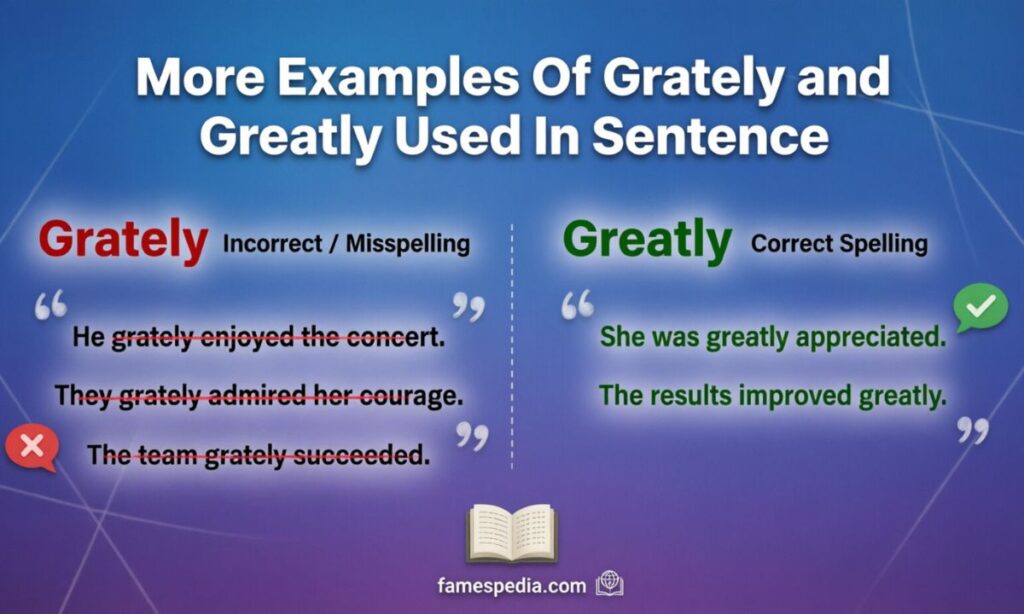
Examples Of Using Grately In A Sentence
These examples show how grately might appear in writing, along with the correct version:
Incorrect: “The team’s performance was grately improved after extra training.” Correct: “The team’s performance was greatly improved after extra training.”
Incorrect: “Her confidence was grately boosted by the positive feedback.” Correct: “Her confidence was greatly boosted by the positive feedback.”
Incorrect: “The new policy grately affects small business owners.” Correct: “The new policy greatly affects small business owners.”
Incorrect: “We are grately honored to receive this award.” Correct: “We are greatly honored to receive this award.”
The pattern is consistent. Every time grately appears in a sentence, greatly is the correct replacement.
Examples Of Using Greatly In A Sentence
Here are strong, natural examples of greatly used correctly:
“I greatly appreciate your help with this project.” “The company’s profits greatly increased after the rebrand.” “Her anxiety was greatly reduced after she started meditating.” “The reports were greatly exaggerated by the media.” “People’s reactions to the film varied greatly.” “This new technology greatly reduces recovery time for patients.” “He greatly regrets not telling the truth sooner.” “The number of preparation steps can vary greatly by restaurant.” “Her piano playing has greatly improved over the past year.” “Employees contribute greatly to moving the company forward.”
Common Mistakes To Avoid
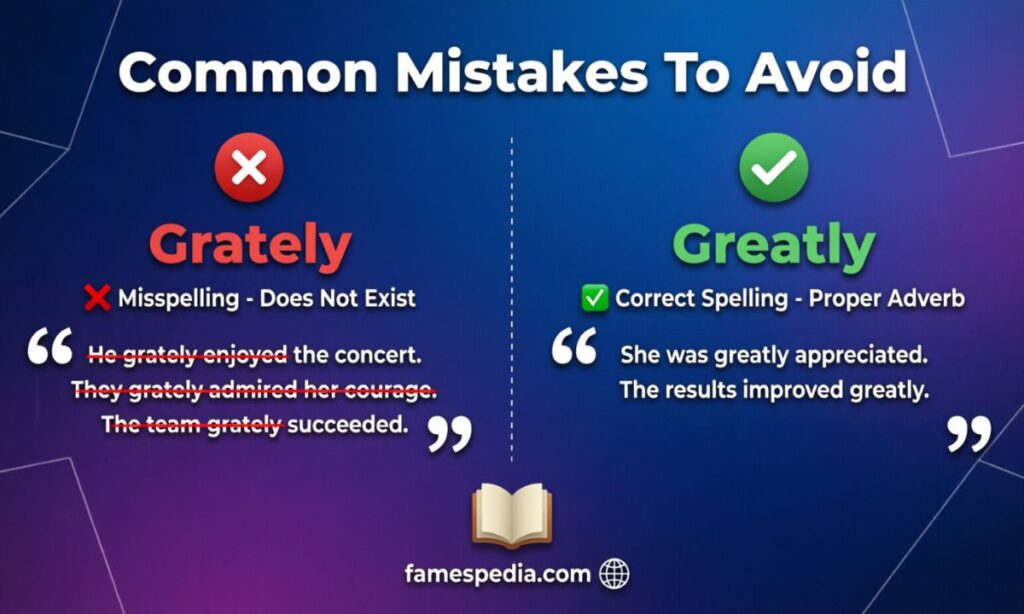
Mistakes To Avoid
Even skilled writers fall into a few common traps with greatly vs grately. Here are the most frequent errors:
Using grately in formal writing. This immediately signals a spelling error and reduces the credibility of your content.
Confusing grate with great. The word grate refers to a metal frame or the action of shredding food. Great means impressive or large in size or degree. Greatly comes from great, not grate.
Overusing greatly in casual writing. While greatly is a correct word, using it too often in informal conversations or social media posts can make your writing sound stiff or unnatural. In casual settings, “a lot” or “very much” often works better.
Relying on autocorrect. Some devices and platforms do not automatically correct grately to greatly. Always proofread manually.
How To Avoid These Mistakes
Follow these simple strategies to keep your spelling accurate:
Break the word down: great + ly = greatly. The root word is great, not grate.
Use the replacement test: swap greatly with “very much” or “significantly.” If the sentence still makes sense, you are using the right word.
Proofread with a grammar checker like Grammarly or Hemingway Editor to catch spelling errors before publishing.
Build the habit of reading widely. The more you see greatly used correctly in published writing, the more natural the correct spelling becomes.
Context Matters
The word greatly is versatile and works across a wide range of writing contexts. However, the formality level of your content should guide how often you use it.
Examples Of Different Contexts
| Context | Example Sentence | Appropriate? |
| Academic writing | “The study greatly supports the original hypothesis.” | Yes, very appropriate |
| Professional email | “I would greatly appreciate your prompt response.” | Yes, very appropriate |
| News article | “The new policy greatly affects low-income households.” | Yes, appropriate |
| Casual conversation | “I liked the movie greatly.” | Possible but sounds stiff |
| Social media post | “Greatly enjoyed the concert last night!” | Acceptable but informal |
| Creative fiction | “He had greatly misjudged her strength.” | Yes, works well |
As a general rule, greatly fits best in professional, academic, and formal writing. In casual or conversational contexts, words like “a lot,” “so much,” or “really” often feel more natural.
Exceptions To The Rules
When “Grately” Might Be Used
There is a very narrow set of situations where grately might appear intentionally. A comedy writer might use it to mock a character who spells poorly. A children’s book author might use creative spelling for stylistic effect. A social media user might use it sarcastically.
Outside of these rare creative scenarios, grately has no place in standard writing. If you are writing anything professional, academic, or public-facing, always use greatly.
When “Greatly” Might Not Be Used
Even though “greatly” is the correct word, there are moments when it may not be the best choice.In very casual speech or texting: “Thanks so much!” sounds more natural than “I greatly appreciate it.” When simpler alternatives are clearer:
“The prices went up a lot” is easier to read than “The prices increased greatly.” When the sentence already contains a strong intensifier: Avoid doubling up with phrases like “very greatly” or “so greatly,” as this creates awkward redundancy.Using greatly wisely means knowing when a simpler word fits better, not just when greatly is technically correct.
Practice Exercises
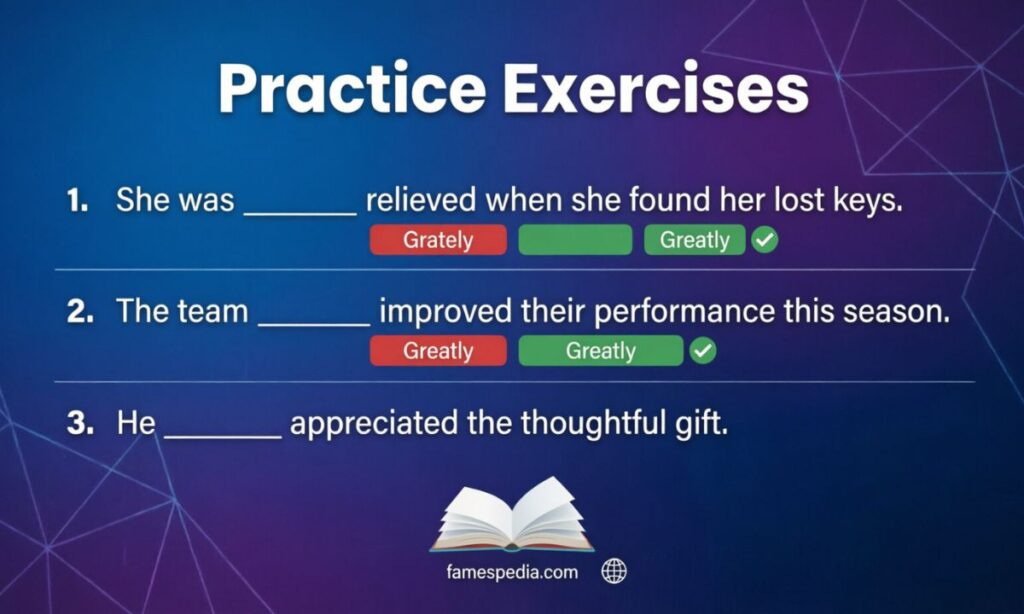
Test your understanding of grately vs greatly with these two exercises.
Exercise 1: Fill In The Blank
Choose either grately or greatly to complete each sentence correctly.
- “I would _______ appreciate it if you could reply by Friday.”
- “Her skills have _______ improved since last year.”
- “The new safety measures _______ reduced workplace accidents.”
- “We are _______ honored to welcome you to our team.”
- “The storm _______ disrupted travel across the region.”
Answers: 1. greatly 2. greatly 3. greatly 4. greatly 5. greatly
Exercise 2: Identify The Correct Word
Read each sentence and choose whether it is correct or incorrect. If incorrect, write the right version.
- “He was grately surprised by the award.” (Correct / Incorrect)
- “The project was greatly delayed due to budget cuts.” (Correct / Incorrect)
- “She grately admires her mentor’s patience.” (Correct / Incorrect)
- “Public opinion varied greatly on the new law.” (Correct / Incorrect)
- “The event was grately enjoyed by all attendees.” (Correct / Incorrect)
Answers: 1. Incorrect (greatly) 2. Correct 3. Incorrect (greatly) 4. Correct 5. Incorrect (greatly)
You May Also Like These: What Do You Call Someone Who Loves Music? 10+ Simple Terms
Conclusion
The grately vs greatly debate has one clear winner: greatly. It is the only correct spelling recognized by every major English dictionary, and it serves as a powerful adverb for adding emphasis and intensity to your writing.
Grately is nothing more than a common spelling mistake, most likely caused by fast typing or the way the word sounds when spoken. While it occasionally shows up in informal or creative contexts, it should never appear in professional or formal writing.
The next time you reach for that word to express appreciation, describe an improvement, or show the extent of a change, spell it the right way: G-R-E-A-T-L-Y. Your writing will be better for it, and your readers will notice the difference.

Arslan is the creator and author behind Healthy Leeks, a platform focused on grammar, writing skills, and English language learning. Passionate about clear communication and effective writing, Arslan shares practical grammar tips, easy-to-follow language guides, and educational content to help readers improve their English with confidence.