Every writer has been there. You are halfway through an email, a blog post, or a professional report and you pause over a single word. Is it “comprable” or “comparable”? They look so similar that it is easy to second-guess yourself. But here is the straightforward truth: only one of these is a real English word, and knowing which one can make a big difference in how your writing comes across.
This guide breaks down the difference between comprable and comparable, walks you through proper usage with clear sentence examples, and covers the most common mistakes writers make. By the end, you will never confuse the two again.
Define Comprable
“Comprable” is not a recognized word in the English language. You will not find it in any standard dictionary, whether that is Merriam-Webster, Oxford, or Cambridge. It is simply a misspelling of the word “comparable.”
The mix-up happens more often than you would think. On a standard QWERTY keyboard, the letters “a” and “o” sit close together. When writers type quickly, they sometimes drop the first “a” in “comparable,” producing “comprable” instead. The result is a spelling error that looks almost right but is entirely wrong.
If you have been using “comprable” in your writing, the fix is simple: replace it with “comparable” every single time.
Define Comparable
“Comparable” is the correct and accepted English word. It functions as an adjective and carries two closely related meanings:
- Similar in nature, quality, or quantity to something else
- Capable of being compared because of shared features or circumstances
The word traces its roots to the Latin “comparabilis,” which comes from “comparare,” meaning “to compare.” It entered Middle English around 1375 to 1425. Today, it appears across everyday conversation, business writing, legal documents, and scientific research.
When you say two things are comparable, you are telling your reader that those two things share enough common ground to be placed side by side and evaluated together.
How To Properly Use The Words In A Sentence
How To Use “Comprable” In A Sentence
You should not use “comprable” in a sentence at all. Since it is not a real word, inserting it into your writing creates a spelling error that weakens your credibility. No grammar guide, style manual, or dictionary supports its use.
The only reason to ever write “comprable” is to point out that it is incorrect, as this article does.
Incorrect: The two laptops offer comprable performance for the price.
Correct: The two laptops offer comparable performance for the price.
Every time you are tempted to write “comprable,” check yourself and type “comparable” instead.
How To Use “Comparable” In A Sentence
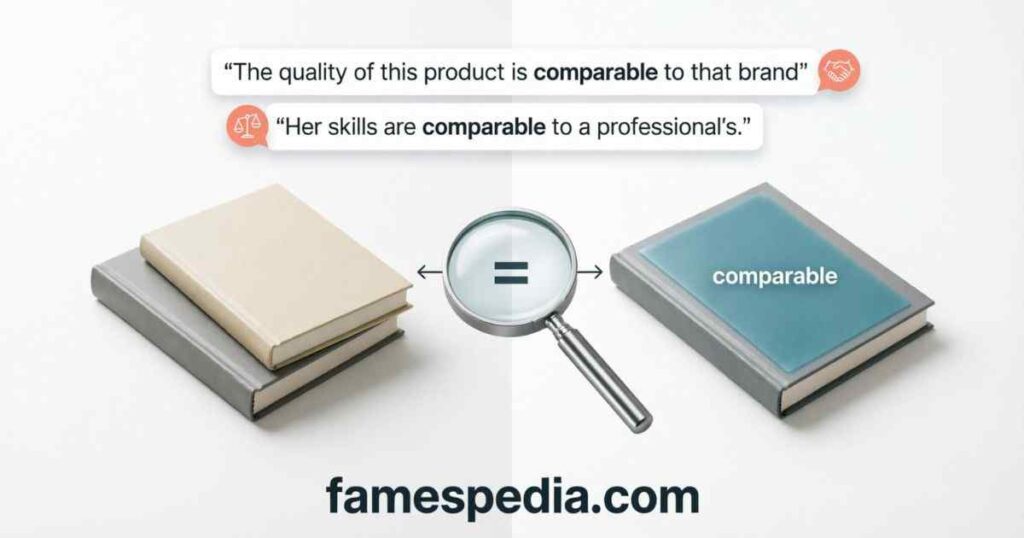
“Comparable” works as an adjective and typically appears before a noun or after a linking verb. It commonly pairs with the prepositions “to” and “with.”
Standard structures:
- Subject + verb + comparable + to/with + noun
- Comparable + noun + verb phrase
Examples:
- Her salary is comparable to what her colleagues earn in the same role.
- The researchers found comparable results across all three test groups.
- This smartphone offers comparable features to models that cost twice as much.
- No other coffee shop in town has a comparable atmosphere.
Keep the subject clear and the comparison specific. “Comparable” does its best work when the reader knows exactly what two things are being placed side by side.
More Examples Of Comprable and Comparable Used In Sentences
Examples Of Using “Comprable” In A Sentence
Remember: these are examples of incorrect usage. “Comprable” should never appear in polished writing.
| Incorrect (Comprable) | Correct (Comparable) |
| The two cars have comprable fuel efficiency. | The two cars have comparable fuel efficiency. |
| We need comprable data from last year. | We need comparable data from last year. |
| Her work quality is comprable to a senior designer. | Her work quality is comparable to a senior designer. |
| The benefits are comprable across both plans. | The benefits are comparable across both plans. |
| There is no comprable product on the market. | There is no comparable product on the market. |
Examples Of Using “Comparable” In A Sentence
Here are strong, natural examples showing how “comparable” is used in real writing contexts:
- The price of this apartment is comparable to others in the same neighborhood.
- Scientists found that the drug produced comparable outcomes in both age groups.
- A comparable house in the suburbs would cost significantly less.
- His arm strength is comparable to that of a top NFL quarterback.
- The two candidates have comparable levels of experience and education.
- Inflation in this region is now at a rate comparable with that of neighboring countries.
- There is simply no other dish on the menu comparable in flavor.
- The company’s quarterly earnings were comparable to the same period last year.
Common Mistakes To Avoid
Using “Comprable” Instead Of “Comparable”
This is the most straightforward mistake on this list. “Comprable” is a typo, plain and simple. It sneaks into emails, blog posts, and professional documents when writers type quickly and skip proofreading. The solution is equally straightforward: slow down and spell-check. Most word processors will flag “comprable” automatically, but do not rely on that alone.
Using “Comparable” When “Similar” Or “Related” Would Be More Appropriate
“Comparable” suggests that two things can be directly measured or evaluated side by side. If the connection between two things is looser, a word like “similar,” “related,” or “alike” often fits better.
- Not ideal: Cooking and painting are comparable hobbies.
- Better: Cooking and painting are similar in their creative demands.
Use “comparable” when the comparison is specific, measurable, or meaningful in context.
Not Understanding The Difference Between “Comparable” And “Complementary”
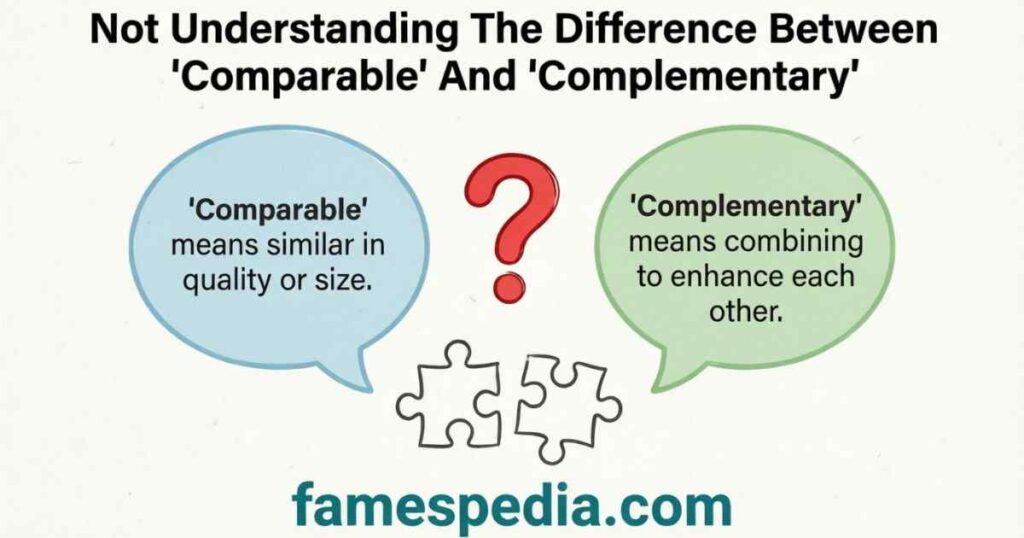
These two words are not interchangeable. “Comparable” means similar or of equal quality. “Complementary” means that two things work well together because they complete or enhance each other. A sock and a shoe are complementary. Two pairs of shoes of the same quality are comparable.
Mixing them up leads to sentences that confuse readers and undercut your point.
Using “Comparable” Too Frequently
Repeating any word too often makes writing feel flat and mechanical. If “comparable” appears three times in one paragraph, your writing loses energy. Vary your vocabulary with phrases like “of equal value,” “equivalent in quality,” “on par with,” or “similar in scope.”
Tips To Avoid These Mistakes
- Always proofread your work before publishing or sending
- Run a spell-check, but do not treat it as a final check
- Read your content aloud to catch awkward phrasing
- Keep a short personal style guide of words you commonly confuse
- When in doubt about a word choice, look it up in a trusted dictionary
You May Also Like This: Grately vs Greatly: When To Use Each One In Writing
Context Matters
Comparing Products Or Services
In product reviews, marketing copy, and buyer guides, “comparable” is one of the most useful words in the English language. It helps readers understand value by placing two items side by side.
Example: This budget-friendly blender delivers performance that is comparable to models priced far higher.
When writing product comparisons, pair “comparable” with specific features like price, speed, quality, or durability for maximum clarity.
Legal Or Financial Contexts
In legal documents, contracts, and financial reporting, precision matters enormously. “Comparable” is widely used to establish equivalency in wages, property values, penalties, and market conditions.
Example: The plaintiff sought damages comparable to those awarded in similar cases.
In these settings, vague use of “comparable” can create ambiguity, so always define what you are comparing and on what basis.
Scientific Comparisons
Researchers use “comparable” to describe study groups, data sets, and experimental results. For a comparison to be scientifically meaningful, the conditions being compared must be controlled and consistent.
Example: The treatment group showed comparable recovery rates to the control group under the same clinical conditions.
In research writing, pair “comparable” with specific metrics and avoid using it loosely to describe things that were not tested under the same conditions.
Exceptions To The Rules
1. Adjective-Noun Combinations
In certain fixed phrases, “comparable” functions as a pre-modifier directly in front of a noun. Expressions like “comparable worth,” “comparable sales,” and “comparable data” are standard in business and academic writing and do not require the prepositions “to” or “with.”
Example: The analyst reviewed comparable sales from the previous quarter.
This is entirely correct and does not violate any grammar rule.
2. Regional Differences
In some informal regional dialects or non-native English writing communities, “comprable” occasionally appears in text. However, no regional dialect formally recognizes it as standard. It remains a spelling error regardless of geography. If you are writing for an international audience or a professional setting, always use “comparable.”
3. Typos And Misspellings
Sometimes “comprable” shows up in published content that simply was not proofread carefully enough. Finding it in a blog post or online forum does not make it correct. The presence of an error in print does not give it legitimacy. Always verify your spelling against a standard dictionary.
Practice Exercises
Exercise 1: Fill In The Blank
Fill in each blank with either “comprable” or “comparable.” Then check your answers at the bottom.
- The quality of this fabric is ________ to that of far more expensive brands.
- She made a ________ mistake in her first draft that her editor caught immediately.
- Researchers discovered ________ patterns in both data sets.
- This restaurant offers a dining experience ________ to any five-star venue in the city.
- The teacher pointed out that “comprable” is a ________ word, not a real one.
Answers: 1. comparable 2. comparable (correct spelling of the word “comparable”) 3. comparable 4. comparable 5. misspelled (or “not a real”)
Exercise 2: Multiple Choice
Choose the correct word for each sentence.
1. The new model offers ________ battery life to the previous version.
- A) comprable
- B) comparable
- C) Both are correct
Answer: B
2. There is no ________ product currently available at this price point.
- A) comprable
- B) comparable
- C) Neither
Answer: B
3. “Comprable” is ________.
- A) a valid alternative spelling
- B) a regional dialect word
- C) a misspelling of “comparable”
Answer: C
4. The two athletes delivered ________ performances in terms of speed and endurance.
- A) comprable
- B) complementary
- C) comparable
Answer: C
Conclusion
The comprable vs comparable debate is really no debate at all. “Comprable” is a misspelling with no place in correct English writing. “Comparable” is the real word, meaning similar in nature, value, or quality, and it earns its place in everything from everyday conversation to legal contracts and scientific papers.
The key takeaways are simple. Always spell it “comparable.” Know when a softer word like “similar” or “related” does a better job. Do not confuse “comparable” with “complementary.” And never let one word carry too much weight in a single piece of writing.
Master these points and your writing will feel sharper, more credible, and far more professional.

Arslan is the creator and author behind Healthy Leeks, a platform focused on grammar, writing skills, and English language learning. Passionate about clear communication and effective writing, Arslan shares practical grammar tips, easy-to-follow language guides, and educational content to help readers improve their English with confidence.