
You typed it out, hit send, and then immediately felt that creeping doubt. Was it “bachelor” or “batchelor”? They sound completely identical out loud. They look almost the same on the page. And yet, only one of them belongs in your email, resume, or academic paper.
This guide gives you a straight, no-fluff answer to the bachelor vs batchelor debate. You will walk away knowing exactly which spelling is correct, what each term actually means, when either one is technically acceptable, and how to avoid the most common mistakes writers make with these two words. Let us get into it.
Quick Answer: Bachelor or Batchelor?
| Term | Status | Meaning |
| Bachelor | Correct modern English spelling | Unmarried man or holder of an undergraduate degree |
| Batchelor | Archaic spelling or surname | Historically used; now considered incorrect in standard writing |
Bachelor is always the right choice in everyday modern English. Batchelor only belongs in one of two situations: as a family surname or in a historical document where the older spelling was originally used.
Define Bachelor

Bachelor is a widely recognized English word with two core meanings.
First, it describes a man who has never been married or is not currently in a committed relationship.
Second, it refers to someone who has completed an undergraduate degree at a college or university, such as a Bachelor of Arts or a Bachelor of Science.
The word traces its roots to Middle English and Latin, where it originally referred to a young knight who had not yet earned his own feudal estate. Over time, it evolved into the broader meanings we use today. In modern contexts, bachelor is used in academic writing, professional bios, everyday conversation, and even reality TV show titles.
It is worth noting that the word can also describe a young male animal, typically a fur seal or elephant, that lives without a mate. While this usage is less common, it is still considered standard English.
Key uses of the word “bachelor” include:
- Referring to an unmarried man in a social or cultural context
- Describing an academic degree earned at a four-year college
- Appearing in formal titles such as Bachelor of Arts (B.A.) or Bachelor of Science (B.S.)
- Used in compound nouns like bachelor party or bachelor pad
The correct spelling is B-A-C-H-E-L-O-R. There is no “t” after the “a.” That is the one rule worth memorizing.
Define Batchelor
Batchelor is the older, archaic version of the word “bachelor.” It was used in earlier periods of the English language but has since fallen out of standard usage.
In contemporary English, batchelor is not recognized as a correct spelling in any major dictionary. It carries no independent meaning separate from “bachelor.” If you encounter it in a modern piece of writing, it is almost certainly a typographical error or a spelling mistake.
There is one important exception. Batchelor functions as a proper noun when used as a surname. Notable figures such as John Batchelor, the British broadcaster and author, carry this spelling as part of their family name. In that context, the spelling is entirely correct and should be respected.
Outside of surnames and historical documents, however, using “batchelor” weakens your credibility as a writer. It signals a lack of attention to spelling, and in professional or academic settings, that matters.
How To Properly Use Bachelor and Batchelor in Sentences
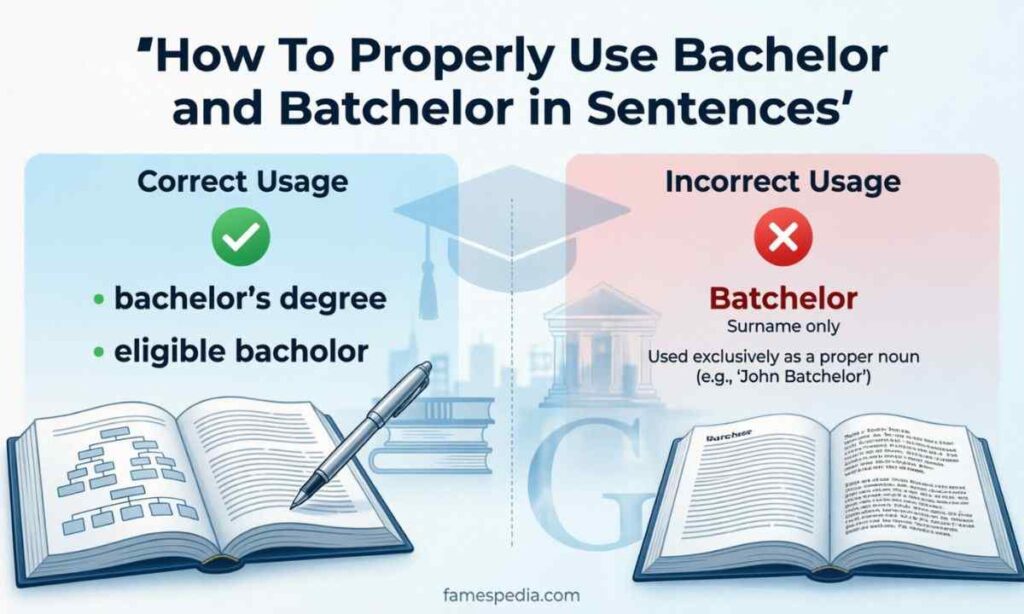
Understanding the correct usage of both terms comes down to context. Here is how to apply each one with confidence.
Using “Bachelor” in a Sentence
Use “bachelor” whenever you are referring to an unmarried man, an academic degree, or any standard English context.
The word functions as a noun and can appear in a variety of sentence structures. It can be used on its own or as part of a longer title or phrase.
Tips for using “bachelor” correctly:
- When referring to a degree, capitalize the full title: Bachelor of Arts, Bachelor of Science
- When referring to general marital status, use lowercase: He is a bachelor
- Add an apostrophe when indicating possession: bachelor’s degree (not bachelors degree)
- Do not add a “t” after the “a” — the correct spelling is bachelor, not batchelor
Using “Batchelor” in a Sentence
Batchelor is only appropriate in two specific situations.
The first is when writing someone’s surname. If a person’s legal name is Batchelor, you spell it exactly as they do. Changing it to “bachelor” would be incorrect and disrespectful of their name.
The second is in historical or archival writing where the original document used this older spelling and accuracy requires preserving it.
In every other case, default to “bachelor.” There is no modern writing scenario, formal or informal, where batchelor is the better choice.
More Examples of Bachelor & Batchelor in Sentences
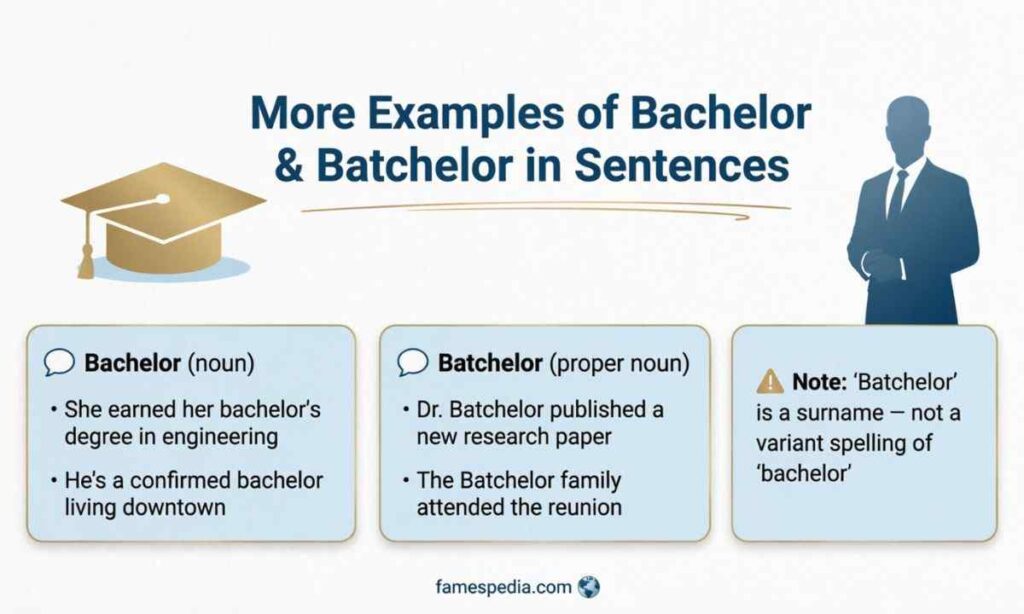
Seeing both words in context makes the distinction much easier to remember.
Examples Using “Bachelor”
- He earned his bachelor’s degree in three years instead of four.
- My older brother has been a bachelor his entire adult life and loves every minute of it.
- She completed a Bachelor of Science in computer engineering at a top university.
- The TV show follows an eligible bachelor as he dates multiple contestants simultaneously.
- They threw an unforgettable bachelor party for their best friend the night before his wedding.
- He applied to a bachelor’s program in economics at three different universities.
- Living in a bachelor pad downtown, he kept things simple and low-maintenance.
Examples Using “Batchelor”
- The biography was written by journalist John Batchelor, who covered international affairs for decades.
- The 18th-century document spelled the title as “Batchelor,” reflecting the orthographic conventions of the era.
- The Batchelor family has lived in that village for over two hundred years.
These examples highlight something important. Every instance of “Batchelor” above is either a surname or a reference to historical writing. Nothing else.
Common Mistakes To Avoid
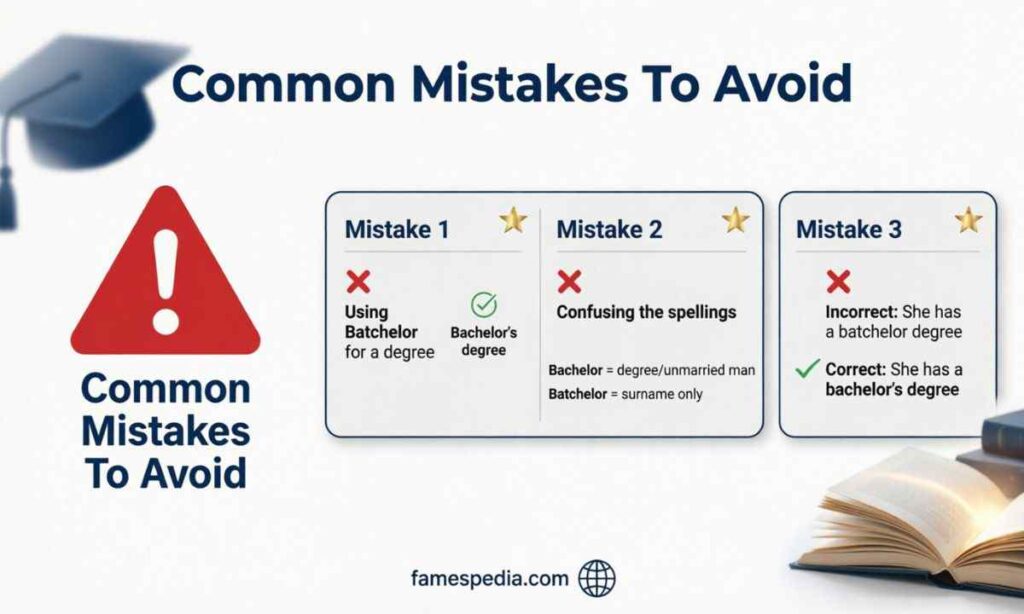
Writers make the same errors with these two words over and over. Here is what to watch out for.
1. Using “Batchelor” Instead of “Bachelor”
This is the most frequent mistake. It usually happens because people try to spell the word phonetically, inserting a “t” after the “a” to match the way it sounds in speech.
The fix is straightforward. Memorize this: there is no “t” in bachelor. The letters go B-A-C-H-E-L-O-R. Run a spell check before submitting any formal document, and it will catch this error every time.
2. Using “Bachelor” Alone for a Degree
Another slip-up is writing “bachelor degree” without the apostrophe-s. The correct phrase is bachelor’s degree, because the degree belongs to the bachelor who earned it.
Similarly, when writing out the full formal title, capitalize correctly: Bachelor of Arts, not bachelor of arts or Bachelor Of Arts.
3. Confusing “Bachelor” with “Bachelorette”
Bachelor typically refers to an unmarried man, while bachelorette refers to an unmarried woman. These are not interchangeable. If you are planning an event or writing about someone’s marital status, make sure you are using the gender-appropriate term.
A “bachelorette party” is specifically for the bride-to-be. Calling it a “bachelor party” would be applying the wrong word entirely.
4. Overlooking Context
Using “batchelor” in a modern professional email, a college application, or a social media post is always wrong. Some writers assume it is an acceptable variant spelling. It is not. In any standard, contemporary English context, batchelor is a mistake, and most readers will recognize it as one.
Context Matters
The context in which you use these words determines everything.
For academic writing, always use “bachelor” with the correct capitalization and punctuation. A “Bachelor of Science” is a formal title and deserves formal treatment.
For social or casual writing, “bachelor” works perfectly. You might refer to someone as an eligible bachelor, mention a bachelor party, or describe someone living the bachelor life.
For historical or archival writing, “batchelor” may occasionally appear in source material. When quoting or referencing those documents directly, preserve the original spelling. When writing your own analysis, use the modern “bachelor.”
For proper nouns and surnames, always follow the individual’s actual spelling. If their name is Batchelor, write Batchelor. If it is Bachelor, write Bachelor.
Also Read This: Transferred or Transfered: Which Is Correct to Use?
Exceptions to the Rules
Language is rarely black and white, and this topic has a few grey areas worth knowing.
Surnames: As mentioned, Batchelor is a legitimate proper noun. This is not an exception to a spelling rule. It is simply a different category of word. The rule against “batchelor” applies to the common noun, not to family names.
Historical documents: You may come across older texts that use “batchelor” as standard spelling. This was once acceptable in earlier versions of English. Recognizing it in context is a mark of language awareness, not confusion.
Informal online content: Some websites and social media posts use “batchelor” carelessly. Seeing it used online does not make it correct. The internet is full of spelling errors, and this one is among the most repeated.
Brand names and titles: Occasionally, a business or publication may intentionally use “Batchelor” in their name, either as a surname reference or a stylistic choice. In that case, follow their specific usage.
Practice Exercises: Bachelor vs Batchelor
Test what you have just learned. These exercises take only a few minutes and will solidify the correct usage in your memory.
Exercise 1: Fill in the Blank
Fill in each blank with the correct word: bachelor or Batchelor.
- He remained a confirmed _______ well into his forties.
- She earned her _______ of Arts degree last spring.
- The book was authored by journalist John _______.
- They organized a surprise _______ party for him the weekend before his wedding.
- He wrote “batchelor” in his resume, but the correct spelling is _______.
Answers: 1. bachelor 2. bachelor 3. Batchelor 4. bachelor 5. bachelor
Exercise 2: Sentence Correction
Each sentence below contains an error. Rewrite it correctly.
- She completed her batchelor’s degree in nursing last year.
- He is a well-known batchelor living in the city.
- The report was written by Dr. Bachelor, a respected historian.
- They threw a batchelor party at a rooftop venue downtown.
Corrected Sentences:
- She completed her bachelor’s degree in nursing last year.
- He is a well-known bachelor living in the city.
- The report was written by Dr. Batchelor, a respected historian. (If that is his actual surname)
- They threw a bachelor party at a rooftop venue downtown.
Conclusion
The bachelor vs batchelor question really does have one clear answer. Bachelor is the word you want in virtually every situation. It is the standard, accepted, modern English spelling, and it covers everything from marital status to academic degrees to cultural references.
Batchelor belongs in one of two places: as a surname or in a historical document. Outside of those two contexts, it is a mistake.The next time you write about an unmarried man, a college degree, or a pre-wedding celebration, you now know exactly which spelling to reach for. No more second-guessing, no more quiet embarrassment, and definitely no extra “t” where it does not belong.

Arslan is the creator and author behind FamesPedia, a platform focused on grammar, writing skills, and English language learning. Passionate about clear communication and effective writing, Arslan shares practical grammar tips, easy-to-follow language guides, and educational content to help readers improve their English with confidence.