Have you ever typed “immersion” in a sentence and then paused, wondering whether the word you actually needed was “emersion”? You are not alone. These two words look almost identical, sound remarkably similar, and yet point in completely opposite directions. One is about going in; the other is about coming out.
Despite being valid English words, emersion and immersion are among the most frequently confused word pairs in both academic writing and everyday conversation. From astronomy classrooms to language learning debates, the wrong choice can completely flip the meaning of what you are trying to say.
This article breaks down the definitions, proper usage, key differences, pronunciation, etymology, and real-world examples of both words. By the time you finish reading, you will know exactly when to use each one and why they are not interchangeable.
Definitions Of Emersion And Immersion
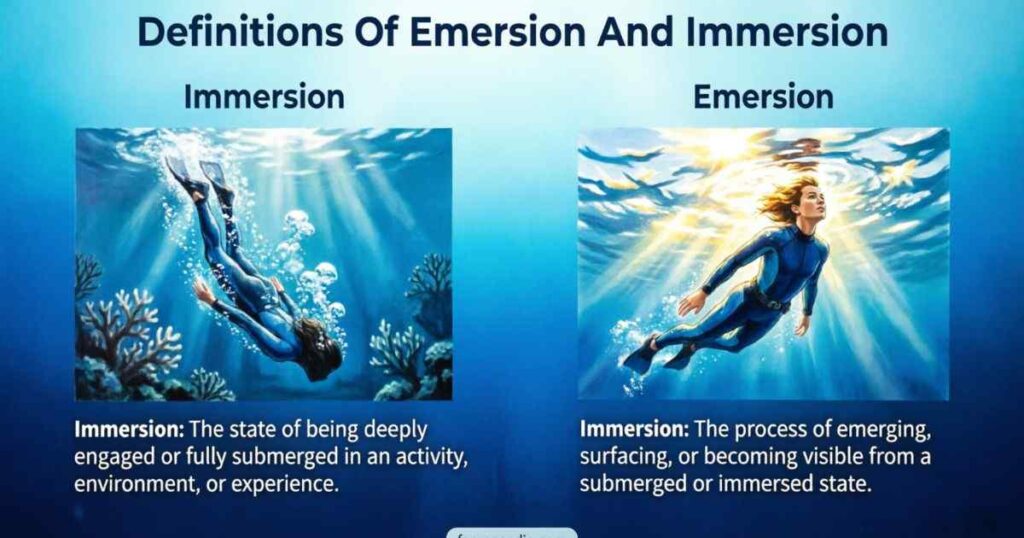
Before comparing the two words, it helps to understand what each one actually means on its own. The definitions reveal something important: these are not just slightly different words. They describe two opposite processes.
Definition Of Emersion
Emersion is a noun that refers to the act or process of emerging, rising out of, or coming forth from something that previously covered, concealed, or submerged it.
Think of a submarine slowly rising to the surface of the ocean. That moment of appearing above the water line, of becoming visible after being hidden below, is emersion. The word captures the transition from hidden to visible, from submerged to exposed, from concealed to revealed.
Here is a quick breakdown of what emersion means across different fields:
| Field | Meaning of Emersion |
| General usage | The act of rising out of or emerging from something |
| Astronomy | The reappearance of a celestial body after an eclipse or occultation |
| Environmental science | The exposure of a shoreline or organism as water recedes during low tide |
| Figurative use | Overcoming difficulties or emerging from a challenging period |
The word is relatively rare compared to immersion. You are more likely to encounter it in scientific literature, astronomy texts, or formal writing than in casual conversation. That said, it is a perfectly correct and useful word when the context calls for it.
Definition Of Immersion
Immersion is a noun that refers to the state or act of being completely submerged, deeply absorbed, or fully involved in something. It comes from the verb “immerse,” meaning to plunge or dip into a liquid or to engage deeply in an activity.
Immersion is far more widely used than emersion and appears across a stunning range of contexts, from language education to religious practice, from gaming to scientific experimentation.
Here is how immersion is understood across different fields:
| Field | Meaning of Immersion |
| General usage | The act of being submerged in a liquid or deeply engaged in an activity |
| Astronomy | The disappearance of a celestial body as it moves behind another |
| Linguistics/Education | A teaching method where a foreign language is used exclusively |
| Religion | Baptism by complete submersion in water |
| Mathematics | A differentiable function in differential geometry |
| Gaming and technology | The sensation of being fully absorbed in a virtual or narrative experience |
Unlike emersion, which is somewhat specialized, immersion is part of everyday vocabulary. You will hear it in language schools, gaming communities, workplaces, and anywhere people talk about focus, deep learning, or total engagement.
How To Properly Use Emersion And Immersion In A Sentence
Knowing a definition is one thing. Knowing how to deploy a word naturally in a sentence is another skill entirely. Here is a practical guide to using both words correctly.
How To Use The Word Emersion
Use emersion when you want to describe something or someone coming out, rising from, or becoming visible after a period of being concealed or submerged. The word implies direction: upward, outward, or into the open.
Key situations where emersion is the right word:
- When describing a natural object rising from water or fog
- When talking about the reappearance of a star or planet after an eclipse (the astronomical sense)
- When describing a figurative “coming out” from difficulty, hardship, or obscurity
- When referring to organisms or land masses that appear as water levels drop
Tips for using emersion correctly:
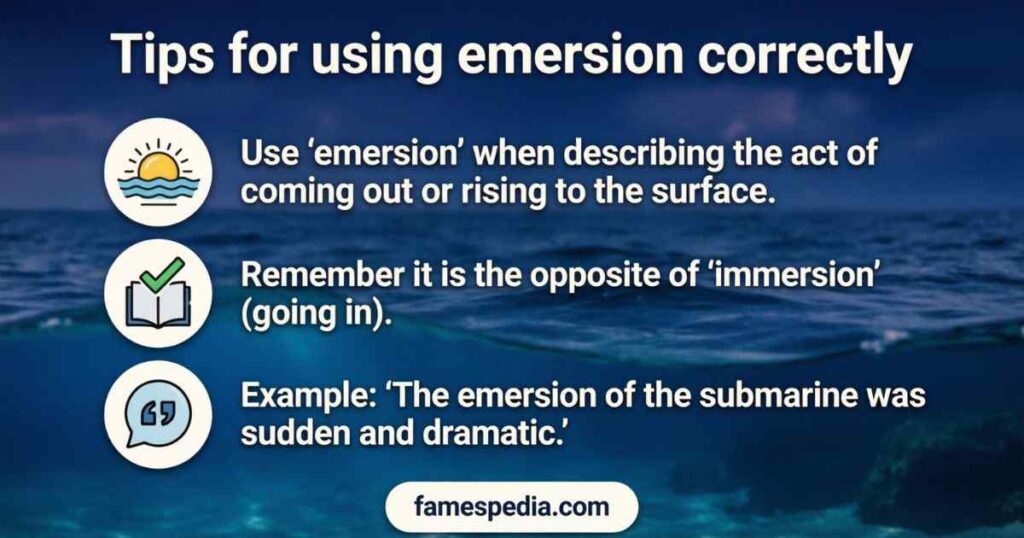
- Ask yourself: is something coming out or going in? If it is coming out, emersion is likely correct.
- Do not confuse it with “emergence.” While related, emersion is more specific and less common.
- In scientific writing, especially in astronomy or ecology, emersion is the precise technical term.
Example sentences using emersion:
- The emersion of the whale from the deep sent the crowd into applause.
- After years of hardship, her emersion from debt was a moment worth celebrating.
- Scientists recorded the exact time of emersion as the moon reappeared from behind Jupiter.
- The emersion of the coastal rocks during low tide revealed a surprising array of marine life.
How To Use The Word Immersion
Use immersion when you want to describe complete involvement, total submersion, or deep absorption in something. The word implies going into, not coming out of.
Key situations where immersion is the right word:
- When describing someone fully absorbed in work, study, or a hobby
- When discussing language learning programs that use only the target language
- When referring to baptism or religious ceremonies involving water
- When talking about being physically submerged in a liquid
- When describing deep engagement in gaming, storytelling, or virtual reality
Tips for using immersion correctly:
- If something is going in or going under, immersion is your word.
- “Total immersion” and “full immersion” are common fixed phrases. Use them when emphasizing intensity.
- In language education, “immersion program” and “immersion school” are established terms.
Example sentences using immersion:
- The immersion of the artifact in saltwater was part of the preservation process.
- She credits her fluency entirely to two years of total immersion in French culture.
- The game’s breathtaking graphics created a level of immersion that felt almost real.
- Immersion baptism remains a central practice in many Christian denominations.
Emersion vs. Immersion: Four Exciting Differences
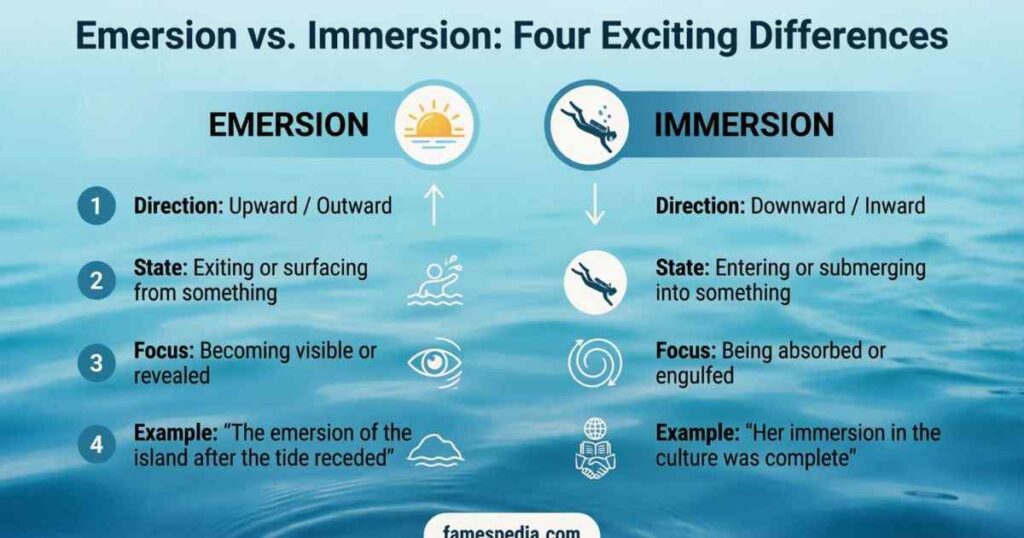
Now that the definitions and usage are clear, it is time to look at what actually sets these two words apart. The differences go beyond meaning and touch on history, structure, and linguistic roots.
1. Opposite Meanings
The most fundamental difference between emersion and immersion is that they are antonyms. They describe directly opposite processes.
Immersion means going in, sinking down, being enveloped, or becoming absorbed. Emersion means coming out, rising up, becoming visible, or breaking free.
Think of it like this:
- A diver enters the water. That is immersion.
- The same diver surfaces. That is emersion.
Or in the context of the night sky:
- A star disappears behind the moon. That is immersion.
- The same star reappears on the other side. That is emersion.
This directional opposition is the core difference. It is not a subtle distinction. The two words move in completely different directions, and using one when you mean the other reverses the meaning of your sentence entirely.
Quick reference:
| Feature | Emersion | Immersion |
| Direction | Coming out / rising | Going in / sinking |
| Relationship | Antonyms | Antonyms |
| Core idea | Emergence, visibility | Submersion, absorption |
| Frequency of use | Rare, specialized | Common, widely used |
2. History And Etymology
Both words have Latin roots, which is fitting given how much of the English scientific and academic vocabulary comes from Latin. However, their Latin ancestors point in different directions, just as the words themselves do.
Etymology of Emersion:
The word emersion dates back to the 1630s. It is a noun of action derived from the past participle stem of the Latin verb emergere, which means “to rise out or up.” That Latin verb is itself made up of two parts: the prefix ex (meaning “out of”) and the verb mergere (meaning “to dip” or “to sink”). So emergere literally means “to dip out” or “to rise from being dipped.”
The earliest recorded uses of emersion in English come from astronomical texts, where it described the reappearance of celestial bodies after being hidden during an eclipse or occultation.
Etymology of Immersion:
The word immersion is older in terms of written records, appearing around the early 1400s. It comes from the Late Latin word immersionem, which is the accusative form of immersio. That word derives from immergere, meaning “to plunge into” or “to dip into.” The Latin immergere combines the prefix in (meaning “into”) with mergere (meaning “to dip” or “to sink”).
So while both words share the root mergere (to dip, to sink), they branch in opposite directions based on their prefixes. The prefix ex (out of) gives you emersion. The prefix in (into) gives you immersion.
Summary of etymology:
| Word | Latin Root | Prefix Meaning | Combined Meaning |
| Emersion | emergere | ex (out of) | To rise out of / come forth |
| Immersion | immergere | in (into) | To plunge into / dip under |
3. Syllables And Pronunciation
One of the reasons these words cause so much confusion is that they look and sound almost the same. The difference in pronunciation is subtle, but it is real.
Emersion:
The word emersion has three syllables: e-mer-sion. It is pronounced /ih-mur-zhuhn/. The stress falls on the second syllable, “mer.” The opening sound is a short “ih” vowel, like the beginning of the word “it.”
Immersion:
The word immersion also has three syllables: im-mer-sion. It is pronounced /im-mur-zhuhn/. Again, the stress falls on the second syllable, “mer.” The opening sound is a slightly fuller “im” sound, like the start of “impact” or “improve.”
Side by side:
| Word | Syllables | Pronunciation | Stress |
| Emersion | 3 (e-mer-sion) | /ih-mur-zhuhn/ | Second syllable |
| Immersion | 3 (im-mer-sion) | /im-mur-zhuhn/ | Second syllable |
The only audible difference is in the very first syllable: a soft “ih” versus a slightly stronger “im.” This similarity is precisely why so many speakers end up using immersion in sentences where emersion is the correct choice. Listening carefully to the opening sound is the best way to keep them straight.
4. Root Verb
Both emersion and immersion are nouns formed by adding the suffix “-ion” to the stem of a verb. That suffix converts a verb into a noun of action, describing the process or result of the verb’s activity. But the root verbs themselves are different.
Root verb of emersion:
The root verb of emersion is emerge. To emerge means to rise out of, come into view, or become visible after being hidden. When you add the noun-forming suffix “-ion” to the appropriate stem, you get emersion: the act of emerging.
Root verb of immersion:
The root verb of immersion is immerse. To immerse means to plunge into, submerge, or absorb completely. Adding the “-ion” suffix gives you immersion: the act of immersing.
Root verb comparison:
| Word | Root Verb | Verb Meaning | Noun Form |
| Emersion | Emerge | To rise out, come into view | The act of emerging |
| Immersion | Immerse | To plunge in, absorb deeply | The act of immersing |
Keeping the root verbs in mind is one of the most reliable strategies for choosing the right word. Ask yourself: am I describing something that emerges (emersion) or something that immerses (immersion)?
List Of Examples Of Emersion And Immersion Use In Sentences
Seeing words used in context is one of the most effective ways to internalize their meaning and feel confident using them yourself. Here is a broad collection of example sentences that show both words in action across a variety of topics.
Emersion in sentences:
- The gradual emersion of the island’s shoreline told us the tide was finally pulling back.
- Astronomers at the observatory noted the emersion of Europa from behind Jupiter at precisely 11:42 p.m.
- His emersion from years of financial trouble gave him a renewed sense of purpose.
- After months of creative block, the artist described her return to painting as an emersion from a long, dark tunnel.
- The emersion of the submarine was greeted by cheers from the sailors waiting on the dock.
- In intertidal ecology, emersion refers to the period when organisms are exposed to air rather than water.
- The emersion of the company from bankruptcy took three years and several rounds of restructuring.
- She stood at the water’s edge and watched the emersion of the diver with quiet relief.
- The telescope captured the precise moment of emersion as the star blinked back into view.
- After the rain stopped, the emersion of the sun was slow but deeply welcome.
Immersion in sentences:
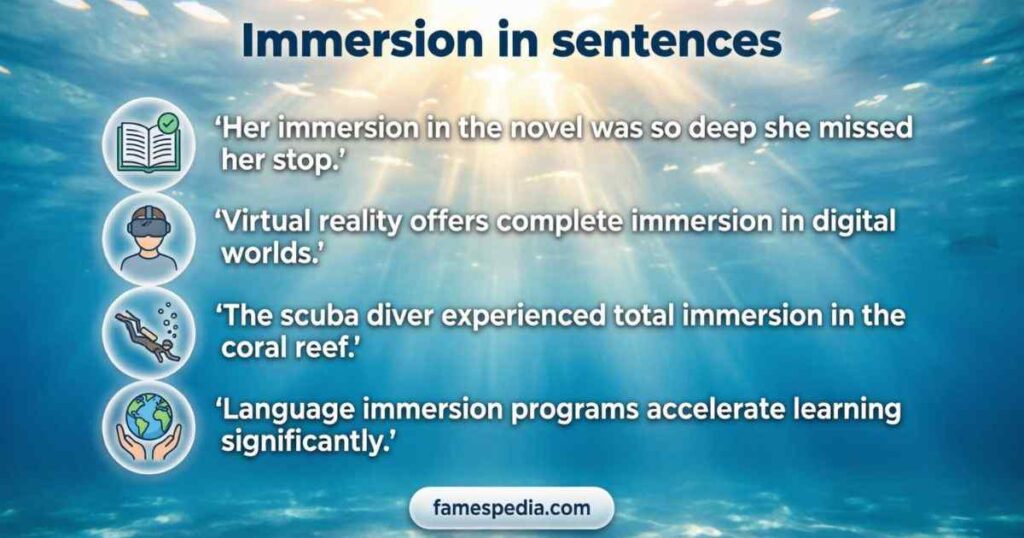
- Total immersion in the Japanese language for six months gave her a fluency that no textbook could have provided.
- The immersion of the surgical tools in a sterilization solution is a critical step in the procedure.
- Many educators argue that immersion programs are more effective than traditional language classes.
- The game’s designers built an environment specifically designed to maximize player immersion.
- Baptism by immersion is practiced in several Christian denominations as a symbol of spiritual rebirth.
- His complete immersion in the project meant he barely noticed the hours passing.
- The immersion of the photographic film in developer solution is a delicate and time-sensitive process.
- Cultural immersion during a year abroad changed her worldview in ways she had not anticipated.
- In astronomy, immersion marks the moment a celestial body disappears from view during an occultation.
- The therapy session used sensory immersion techniques to help patients manage anxiety.
- Learning through immersion rather than memorization is increasingly the preferred approach in modern classrooms.
- The immersion of the tea leaves in boiling water should last no more than three minutes for the best flavor.
Sentences that use both words together (for comparison):
- While immersion describes the diver’s plunge into the sea, emersion captures the dramatic moment of surfacing.
- In the study of eclipses, immersion and emersion mark the two bookend events of the phenomenon.
- The language coach explained the difference between immersion, which means diving into the culture, and emersion, which describes the emergence of a fluent speaker at the end of that process.
Also Read This: Courtesy vs Curtesy: When to Opt for One Term Over Another
Conclusion
Emersion and immersion are a genuinely fascinating word pair. They share the same Latin root, the same number of syllables, and a nearly identical sound. Yet they could not mean more different things. One points outward and upward. The other points inward and downward.
Remembering the distinction is simpler than it seems once you anchor yourself to the root verbs. Immersion comes from immerse: to plunge into. Emersion comes from emerge: to rise out of. If something is going in, you want immersion. If something is coming out, emersion is your word.
Whether you are writing about language learning, describing an astronomical event, or simply trying to express the idea of deep engagement versus liberation from it, choosing the right word matters. Precision in language is a form of respect for your reader, and for the craft of writing itself.

Arslan is the creator and author behind FamesPedia, a platform focused on grammar, writing skills, and English language learning. Passionate about clear communication and effective writing, Arslan shares practical grammar tips, easy-to-follow language guides, and educational content to help readers improve their English with confidence.