
Have you ever stopped mid-sentence wondering whether to write in-house, inhouse, or in house? You are not alone; this is one of the most common spelling confusions in English writing. This guide will give you the clear and simple answer you have been looking for!
Spelling mistakes can make even great writing look careless and unprofessional. Many people struggle with whether in-house, inhouse, or in house is the correct form to use. Keep reading and you will never second-guess this word again!
What Does “In-House” Mean?
In-house refers to work, services, or activities that are performed within an organization by its own employees, rather than being outsourced to a third party or external agency.
When a company handles its own legal matters, builds its own software, or runs its own training programs using internal staff, all of that is described as in-house.
Common in-house usage in business includes:
- In-house legal counsel
- In-house marketing team
- In-house training programs
- In-house software development
- In-house production and manufacturing
The phrase can function as both an adjective (modifying a noun) and an adverb (modifying a verb or action). Both uses require the hyphen.
Inhouse or In-House or In House? A Quick Comparison
| Form | Correct? | When to Use |
| In-house | ✅ Yes | Always adjective or adverb in business writing |
| In house | ⚠️ Rarely | Only as a literal physical reference (with “the”) |
| Inhouse | ❌ No | Not standard; avoid in formal writing |
The Grammatical Basis for Saying “In-House”
The rule behind this hyphen is simple: compound adjectives get a hyphen when they appear before a noun.
A compound adjective is formed when two or more words work together as a single describing unit. English grammar requires a hyphen between those words to signal that they are functioning as one idea. Without the hyphen, each word floats independently and the sentence becomes harder to parse instantly.
Consider the difference:
- We hired an in-house designer. Clear: the designer works internally.
- We hired an in-house designer. Unclear: “in” and “house” seem disconnected.
Both the Cambridge Dictionary and Oxford Dictionary define the term exclusively as in-house, with a hyphen, and recognize it as both an adjective and an adverb. Neither dictionary lists “inhouse” or “in house” as accepted variants.
Style guides including APA, Chicago Manual of Style, and AP Style all support hyphenation for compound adjectives like this one. Google Ngram Viewer data confirms that in-house is overwhelmingly the dominant form in published writing over the past century.
Why “Inhouse” Is Incorrect
Writing it as a single word inhouse strips away the grammatical structure that signals meaning. It occasionally shows up in branding, informal blog posts, or tech jargon, but it is considered a grammar mistake in formal, professional, and academic writing. Using it can quietly undermine your credibility in documents, resumes, legal contracts, or business communications.
Why “In House” (No Hyphen) Is Usually Wrong
Without the hyphen, in house becomes a prepositional phrase rather than a compound adjective. This changes the meaning. “In house” as two words point to a physical location, a building or a space. It does not convey the business meaning of internal operations. That is why this form is generally avoided in professional writing.
Other Correct Ways of Saying “In-House”
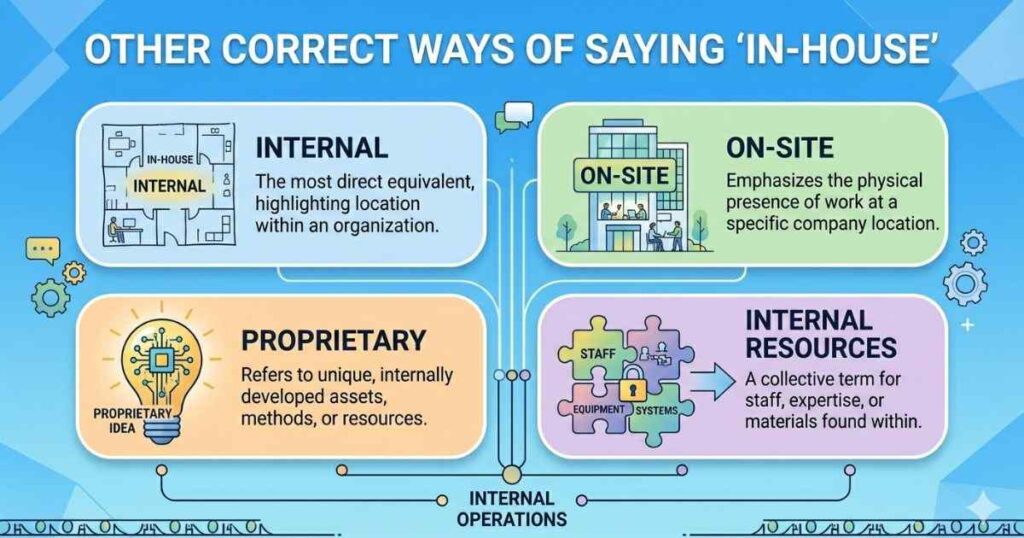
Sometimes you need variety in your writing, or you want to avoid repeating the same phrase. Several alternatives carry a similar meaning:
- Handled internally great for business reports and formal memos
- Within the organization emphasizes the structure of the company
- By internal teams highlights the people doing the work
- On-site when referring to work done at the company’s physical premises
- Company-owned useful when discussing proprietary tools or IP
- Proprietary when referring to internally developed systems or software
- Domestically produced occasionally used in manufacturing contexts
Each of these alternatives suits slightly different contexts. However, in most professional and business settings, in-house remains the clearest and most widely understood term.
Also Read Information From Here: Rug vs. Rag: How Are These Different? When To Use Them?
Why “In the House” Works Better Than “In House”
When you genuinely want to refer to a physical location, an actual building or dwelling the phrase in the house is the grammatically sound choice, not in house.
Adding the before “house” makes the reference specific and clear. It anchors the phrase to a real, definite place. Compare:
- The meeting was held in the house. Clearly a physical location.
- The meeting was held in house. Grammatically awkward; lacks clarity.
In professional writing, if your intent is location-based, use in the house. If your intent is to describe internal organizational activity, use in-house. The distinction matters because conflating the two creates confusion for readers.
Capitalization: When to Write “In-House” vs. “In-House”
In everyday sentences, there is no need to capitalize either word, write it as in-house in lowercase.
However, when the phrase appears in a title, heading, or heading-style format, capitalize both parts: In-House. This follows standard title case conventions used in résumés, job postings, article headings, and professional documents.
- Title: Building an In-House Content Team
- Sentence: We manage all operations in-house.
Examples of Using “In-House” in a Sentence
Seeing the word used correctly across different contexts is one of the best ways to lock in the rule. Here are varied, real-world examples:
As an adjective (before a noun):
- The firm relies on its in-house legal team to review all contracts.
- We launched a new in-house training program for junior employees.
- Their in-house developers built the entire platform from scratch.
- She serves as in-house counsel for one of the largest banks in the country.
- The restaurant prides itself on its in-house bakery, which produces fresh bread daily.
As an adverb (modifying an action): 6. Instead of hiring an agency, we decided to manage social media in-house. 7. All graphic design work is handled in-house to maintain brand consistency. 8. The company manufactures its products in-house to ensure quality control. 9. We moved customer support in-house after growing our team last year.
Incorrect forms (what to avoid):
| ❌ Incorrect | ✅ Correct |
| The inhouse lawyers disagreed. | The in-house lawyers disagreed. |
| We handle it in house. | We handle it in-house. |
| Our inhouse team is growing. | Our in-house team is growing. |
In-House vs. Outsourced: A Quick Context Guide
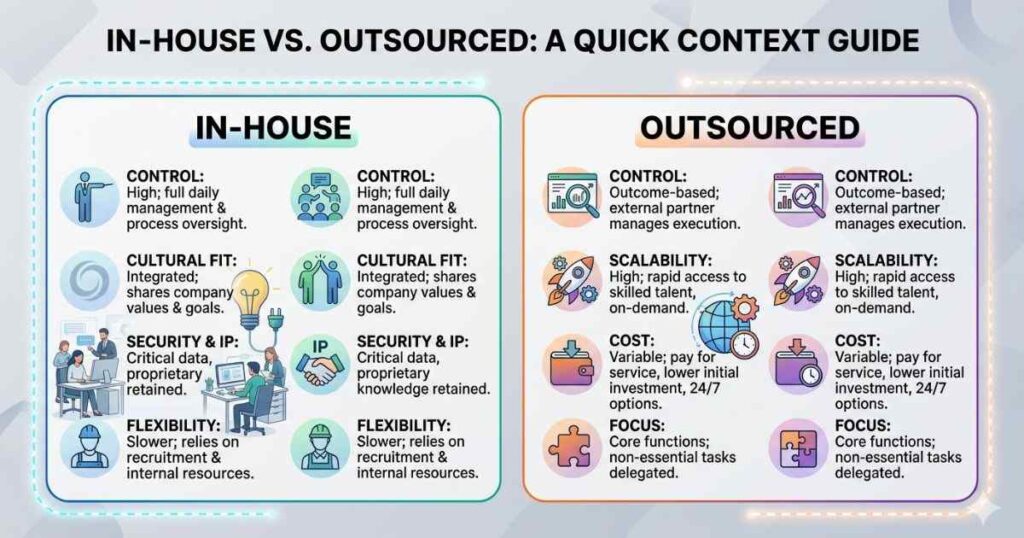
Understanding when in-house applies is just as important as spelling it correctly.
| Activity | In-House | Outsourced |
| Marketing | Internal team creates campaigns | External agency manages campaigns |
| IT Support | Company employs its own IT staff | Third-party tech firm handles issues |
| Legal | Staff attorneys review documents | Law firm is hired for legal work |
| Training | Managers train employees internally | External trainers are brought in |
| Software Dev | Developers on payroll build the product | Contractors or agencies build it |
Conclusion
The correct spelling is in-house, and now you know exactly when and how to use it. Getting small grammar details right makes your writing look more professional and polished. Use this knowledge in your next email, report, or document with full confidence!
Understanding whether to write in-house, inhouse, or in house can save you from common writing mistakes. The hyphenated form is the standard choice accepted by most style guides. Keep this rule in mind and your writing will always stay clear and correct!

Arslan is the creator and author behind FamesPedia, a platform focused on grammar, writing skills, and English language learning. Passionate about clear communication and effective writing, Arslan shares practical grammar tips, easy-to-follow language guides, and educational content to help readers improve their English with confidence.