
If you have ever paused mid sentence wondering whether to type hoodie or hoody, you are not alone. This spelling mix up shows up in emails, product listings, school essays, and social posts every single day. Hoodie is the correct and standard spelling in modern English, while hoody is an accepted but far less common variant. This guide breaks down the difference, shows you exactly when to use each form, and clears up every related grammar question.
Hoody or Hoodie: What’s the Difference?
There is no difference in meaning between the two words. Both describe a hooded sweatshirt or jacket with a drawstring hood and a front pocket. The only real difference is spelling frequency and formality, and hoodie wins on both counts.
Hoodie is the version listed as the primary entry in Merriam Webster and used across fashion retail, journalism, and everyday speech. Hoody appears as a secondary or variant spelling in most dictionaries, and it shows up more in older British texts and casual branding than in polished writing.
Comparison Table
| Feature | Hoodie | Hoody |
| Dictionary status | Primary, preferred entry | Listed as a variant spelling |
| Common region | US, UK, Canada, Australia | Occasionally British or Irish informal writing |
| Formal writing | Recommended | Not recommended |
| E-commerce and branding | Standard across Nike, Adidas, Champion | Rare, used for stylistic effect |
| Search volume | Much higher | Much lower |
| Pronunciation | /ˈhʊdi/ | /ˈhʊdi/ |
Is Hoodie vs Hoody a Grammar, Vocabulary, or Usage Issue?
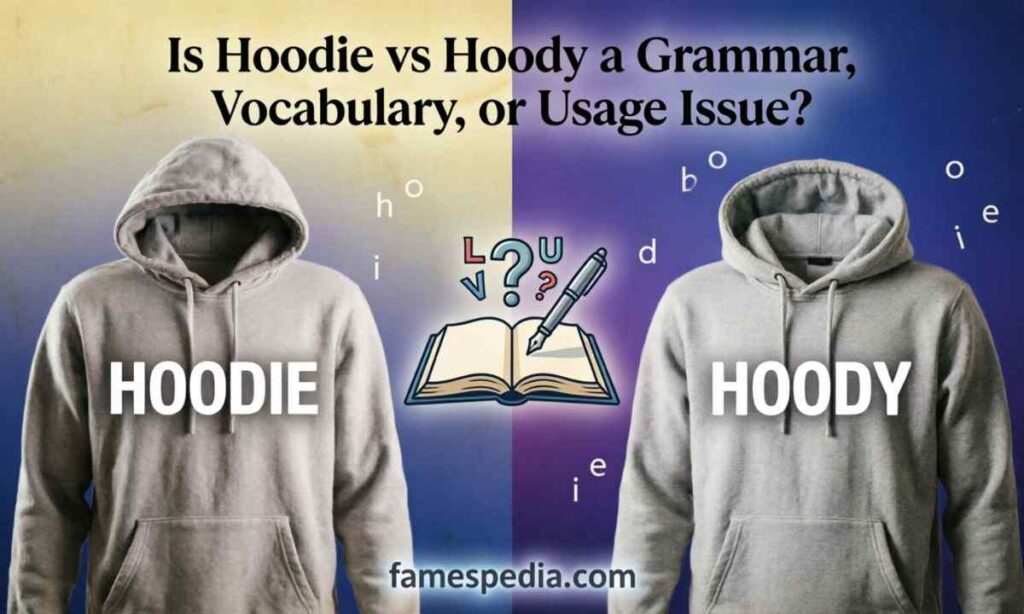
This is purely a spelling and usage issue, not a grammar rule. Both words follow the same grammar patterns as any regular countable noun, so the confusion sits entirely in which spelling a reader expects to see.
Interchangeable or Not
The two words are technically interchangeable in meaning, but they are not interchangeable in tone. Swapping hoody into a business email or a product title can look like a typo, even though the word is real.
Formal vs Informal Usage
Hoodie fits every formal context, including academic writing, journalism, business copy, and product descriptions. Hoody leans casual and works best in relaxed conversation, social captions, or brand voices built around a laid back vibe.
Academic vs Casual Context
Teachers, editors, and style guides expect hoodie in essays, reports, and articles. Save hoody for text messages or casual blog posts where a looser tone is welcome.
How to Use Hoodie Correctly
Hoodie is the safe, professional choice for nearly every writing situation, from office memos to research papers to online stores.
Workplace Example
“Employees may wear a company hoodie during casual Friday events.”
Academic Example
“The study examined how streetwear, including the hoodie, became a symbol of youth identity in the late twentieth century.”
Technology Example
“The online store updated its search filters so shoppers could sort by hoodie color, size, and fabric type.”
Usage Recap
Use hoodie when writing for clients, teachers, editors, search engines, or any audience where clarity and credibility matter most.
How to Use Hoody Correctly

Hoody remains grammatically valid, and it still appears in dictionaries, but it belongs in looser, more relaxed writing rather than polished content.
Workplace Example
“Grab your hoody, it’s chilly in the warehouse today.”
Academic Example
“One student’s essay used hoody instead of hoodie, which a strict grammar checker flagged as nonstandard.”
Technology Example
“An older forum thread joked that autocorrect always changes hoody back to hoodie.”
Usage Recap
Reserve hoody for casual chats, personal blogs, or brand voices deliberately aiming for a retro or streetwear feel.
When You Should NOT Use Hoodie or Hoody
Avoid both words entirely when referring to the plain fabric hood on a jacket that has no attached sweatshirt body, since that piece is simply called a hood. Also skip both spellings in strictly technical or legal documents where the standard term hooded sweatshirt reads more precise. Product descriptions aimed at international buyers unfamiliar with slang terms benefit from the same fuller phrase.
Common Mistakes and Decision Rules
Most mistakes come from writers assuming the two spellings are a British versus American split, similar to color and colour. That assumption is wrong, since both American and British dictionaries prefer hoodie.
Correct vs Incorrect Sentences
Correct: “She bought a gray hoodie for the hiking trip.” Incorrect for formal writing: “She bought a gray hoody for the hiking trip.” Correct: “The brand’s hoodie collection sold out in two days.” Incorrect for a product title: “The brand’s hoody collection sold out in two days.”
Decision Rule Box
Ask three quick questions before typing either word.
- Is this formal, academic, or client facing writing? Choose hoodie.
- Is this a product listing meant to rank in search results? Choose hoodie.
- Is this a casual text, personal caption, or intentional retro brand voice? Either word works, though hoody fits the mood better.
Is it hoody or hoodie?
It is hoodie. This single spelling is recognized by every major dictionary as the primary form, used by nearly every major clothing brand, and searched far more often online, which makes it the safest and most professional choice in almost any situation.
Hoodie and Hoody in Modern Technology and AI Tools

Spell checkers, grammar tools, and AI writing assistants default to hoodie and often flag hoody as a possible error. Search engines and AI Overview style summaries also favor hoodie, since it matches the phrasing found in dictionaries and top ranking retail and editorial pages. Writers who want their content to surface correctly in AI generated answers and voice search results should default to hoodie unless a specific brand or quote requires the other spelling.
Word Origin and Etymology
The word traces back to hood, from Old English hod, meaning a covering for the head. The playful ie ending, seen in words like cookie, movie, and selfie, attached itself to hood sometime in the twentieth century, giving English the friendly, informal sounding hoodie. The garment itself became widely known after Champion produced hooded sweatshirts for cold storage workers in the 1930s, and the word hoodie gained mainstream traction through sportswear and youth culture in the following decades.
Expert Perspective
Lexicographers at major dictionary publishers classify hoody as a legitimate but secondary variant, a pattern common with informal English coinages that later split into a dominant and a minor spelling, similar to how movie eventually outpaced the older moving picture.
Author Expertise
This guide draws on dictionary entries, style guide conventions, and real world usage patterns across retail, journalism, and academic writing to give a clear, trustworthy answer rather than a guess.
Case Study One: Ecommerce Search Optimization
An online apparel retailer tested product titles using both spellings across similar hoodie listings. Pages using hoodie consistently pulled in more organic search clicks, since shoppers overwhelmingly typed that spelling into search bars. After switching all product titles and descriptions to hoodie, the retailer saw stronger visibility in search results within a few weeks, confirming that spelling choice directly affects discoverability.
Case Study Two: Editorial Consistency in Online Media
A lifestyle publication once mixed hoodie and hoody across different writers, which created an inconsistent voice and confused readers scanning multiple articles. After the editorial team set a style rule requiring hoodie in every article, reader feedback improved, and the site’s internal search tool returned more consistent, relevant results for readers looking up hoodie related content.
Error Prevention Checklist
- Default to hoodie in any formal, academic, or business writing.
- Use hoodie in product titles, meta descriptions, and SEO content.
- Save hoody only for casual conversation or deliberate stylistic branding.
- Never assume this is a British versus American spelling split.
- Run spell check, since most tools will flag or auto correct hoody.
- Stay consistent within a single document or website.
Also Read This: Does Anybody or Do Anybody: Which One Should You Use?
Related Grammar Confusions You Should Master
- Movie vs movy
- Cookie vs cooky
- Color vs colour
- Grey vs gray
- Transferred vs transfered
Getting hoodie or hoody right comes down to knowing your audience and matching the tone of your writing. Choose hoodie whenever clarity, professionalism, or search visibility matters, and save hoody for relaxed, casual moments where a looser spelling fits naturally.
Small spelling choices carry more weight than most writers realize, shaping how readers judge trust, polish, and professionalism in a single glance. Mastering the hoodie versus hoody question is a small step that sharpens every piece of writing you produce going forward.
Conclusion
A single letter should never carry this much weight, yet it does. Every time you type hoodie instead of hoody, you are quietly telling your reader that you know the difference between casual guesswork and careful writing, and that kind of small signal builds trust faster than most people realize.
Language keeps shifting, but this particular question has a clear answer today. Keep hoodie as your default, save hoody for the rare moment it fits, and you will never have to second guess this word again.

Arslan is the creator and author behind Healthy Leeks, a platform focused on grammar, writing skills, and English language learning. Passionate about clear communication and effective writing, Arslan shares practical grammar tips, easy-to-follow language guides, and educational content to help readers improve their English with confidence.