
If you have ever typed out a leave request or scheduled a team event and paused mid-sentence thinking, “Wait, is it half day or half-day?” you are absolutely not alone. This tiny punctuation question trips up native English speakers, working professionals, and students every single day.
The good news? Once you understand the logic behind the hyphen, you will never second-guess yourself again. This guide covers everything you need to know: the correct forms, the grammar rules, real-world examples, common mistakes, and a quick memory trick that makes it stick for good.
Half Day or Half-Day? Which is Correct?
Both forms are correct. The real question is not which one is right, but which one fits your sentence.
Here is the short answer you can bookmark right now:
| Form | Part of Speech | Example |
| Half day | Noun | I am taking a half day tomorrow. |
| Half-day | Adjective (compound modifier) | We have a half-day training session. |
The difference comes down to one simple function. When the phrase stands on its own as a thing, you drop the hyphen. When it describes another noun, you add the hyphen. That is the entire rule.
Understanding the Key Difference
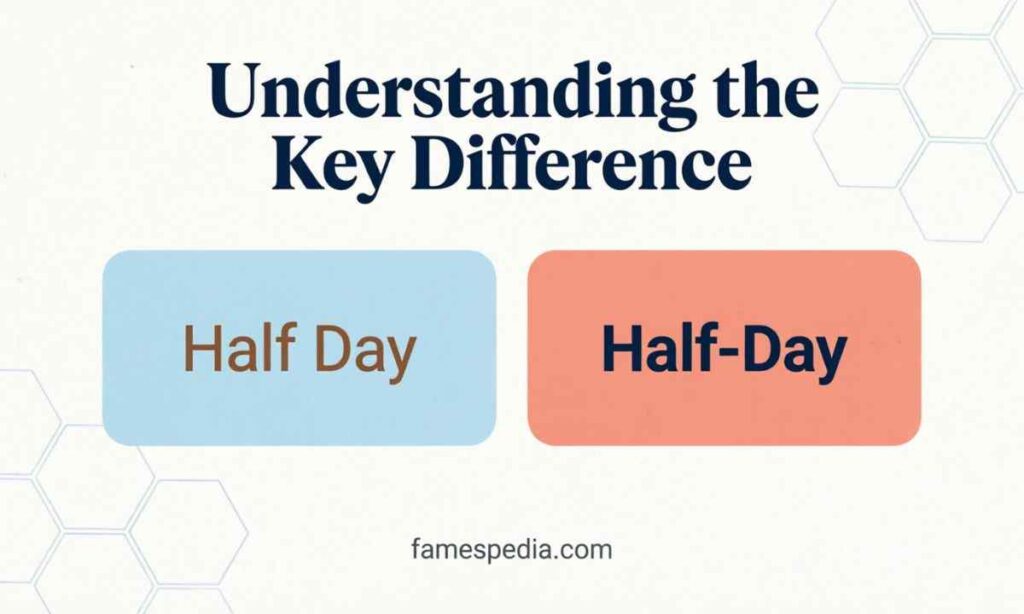
Think of the hyphen as a connector that links two words into a single descriptive unit. Without it, each word stands independently. With it, they merge into one idea that points at something else.
Half day (no hyphen) acts as a noun phrase. It is the subject or object of your sentence. You are referring to a specific block of time, roughly four hours, that stands alone as a concept.
Half-day (with hyphen) acts as a compound modifier or compound adjective. It reaches forward to describe the noun coming right after it. The hyphen signals to the reader that these two words belong together and should be read as a single unit before reaching the noun they describe.
This is not a minor stylistic preference. It is a standard grammar rule applied consistently across both American English and British English. Whether you follow the AP Stylebook or the Chicago Manual of Style, both style guides recommend hyphenating compound adjectives placed before a noun for clarity and readability.
Half Day: Meaning and Usage as a Noun
As a noun, “half day” refers to a period of time covering approximately half of a full working or school day. It is the thing itself, not a description of something else.
You use it when:
- Requesting time off from work
- Describing a shortened school schedule
- Referring to a reduced work period in general conversation
The noun form can be singular or plural depending on context. “I need a half day” is singular. “She works half days on Fridays” shifts it to a plural noun, and both are perfectly correct.
The key test: if you can replace the phrase with a standalone time block and the sentence still makes sense, you are using the noun form and no hyphen is needed.
Half-Day: Meaning and Usage as an Adjective
As a compound adjective, “half-day” modifies a noun that follows it directly. The hyphen fuses the two words into a single descriptive modifier, and the noun always appears right after it.
Common nouns that pair with the adjective form include:
- Half-day workshop
- Half-day training
- Half-day session
- Half-day event
- Half-day schedule
- Half-day leave
- Half-day excursion
- Half-day retreat
Notice the pattern. In every case, “half-day” is answering the question “What kind of workshop?” or “What kind of leave?” That is the defining signal for adjective use.
When the Hyphen Becomes Essential
The hyphen is not just a grammar formality. It actively prevents ambiguity and helps your reader process the sentence without stumbling.
Consider this phrase without the hyphen:
“We organized a half day workshop.”
A reader could briefly parse “half” and “day workshop” as two separate ideas before correcting the course. It creates a tiny moment of confusion.
Now add the hyphen:
“We organized a half-day workshop.”
The hyphen immediately signals that “half-day” is a single unit working together to describe “workshop.” There is no pause, no misread, no ambiguity.
This clarity matters especially in:
- Professional emails and leave requests
- Business proposals and HR documentation
- School announcements and event invitations
- Blog posts and web content where readers skim quickly
The hyphen becomes essential whenever a compound modifier precedes a noun and removing it could cause even a half-second of confusion for the reader.
There is one exception worth knowing. When the compound modifier comes after a linking verb (is, was, seems, appears), the hyphen is often optional. “The training session was half day” is acceptable in informal contexts, though many writers keep the hyphen for consistency.
Examples of Using “Half Day” in a Sentence
Here are clear examples of “half day” functioning correctly as a noun:
- The manager approved my half day off for the dentist appointment.
- Friday will be a half day for the entire school.
- After working overtime all week, we were given a half day on Monday.
- She requested a half day to attend her child’s graduation ceremony.
- I only need a half day to finish the report.
- Working half days suits her current schedule better than full-time hours.
- We wrapped up early and everyone left after a half day.
- He took a half day to handle some personal errands.
- The team agreed to a half day before the long weekend.
- A half day is often enough time to recharge mid-week.
In every sentence above, “half day” is the noun. It is the thing being discussed, not a word describing something else.
Examples of Using “Half-Day” in a Sentence
Here are clear examples of “half-day” functioning correctly as a compound adjective:
- The company organized a half-day team-building retreat.
- We attended a half-day seminar on workplace communication.
- The school announced a half-day schedule for parent-teacher conferences.
- Her manager approved a half-day leave request for Tuesday.
- Employees were invited to a half-day wellness workshop.
- The orientation included a half-day tour of the facility.
- There is a half-day training session on the new software next week.
- The venue offered a half-day package for smaller events.
- They planned a half-day excursion along the coast.
- A half-day conference was scheduled for key stakeholders.
In every sentence above, “half-day” directly precedes and describes a noun. That is the adjective form in action.
Also Read This: Commit vs Comit: When To Use Each One In Writing
Grammar Rules Behind the Hyphen
The grammar rule at work here is called the compound modifier rule, sometimes also referred to as the phrasal adjective rule.
Here is how it works:
Rule 1: Hyphenate before a noun. When two or more words work together to describe a noun and come directly before it, join them with a hyphen.
Rule 2: No hyphen after a linking verb (often). When the compound comes after the noun and a linking verb, the hyphen is frequently dropped in informal writing. Example: “The session was half day.”
Rule 3: Noun form never takes a hyphen. When the phrase acts as the subject or object of the sentence rather than describing another noun, no hyphen is used.
This same rule governs dozens of similar expressions in English:
| Noun Form | Adjective Form |
| Full day | Full-day event |
| Long term | Long-term goal |
| Part time | Part-time employee |
| Short notice | Short-notice meeting |
| High school | High-school diploma |
Recognizing this pattern across familiar phrases makes it easier to apply the rule consistently, including with “half day.”
Common Mistakes to Avoid
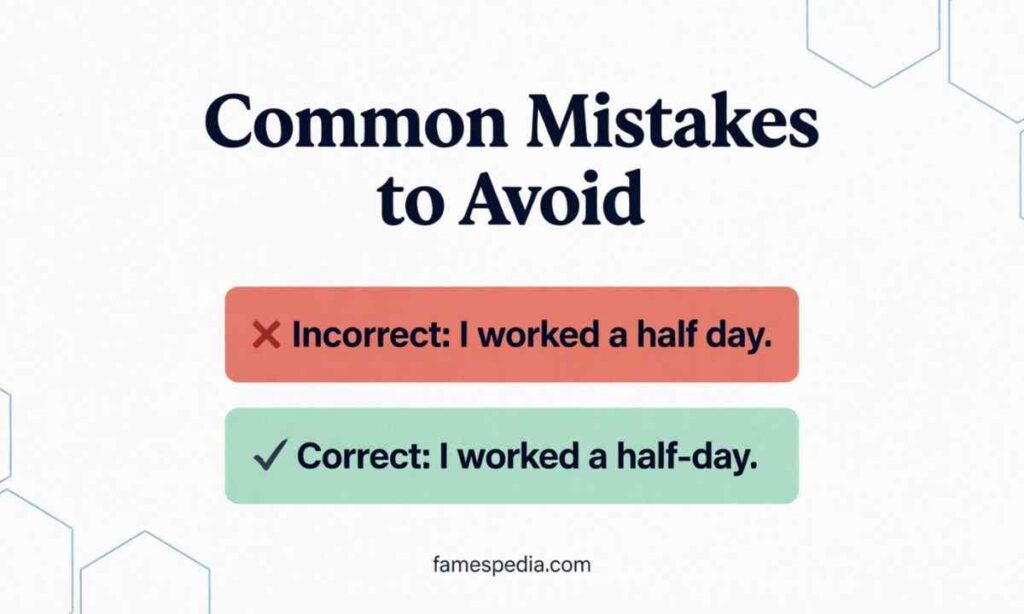
Even careful writers make these errors regularly. Here are the most frequent mistakes and how to fix them:
Mistake 1: Hyphenating the noun form Incorrect: “I am taking a half-day tomorrow.” Correct: “I am taking a half day tomorrow.” (Here, “half day” is the object of the verb. It is a noun, not an adjective.)
Mistake 2: Skipping the hyphen before a noun Incorrect: “We scheduled a half day meeting.” Correct: “We scheduled a half-day meeting.” (Here, “half-day” is modifying “meeting.” The hyphen is required.)
Mistake 3: Using both forms interchangeably The two forms serve different grammatical functions and cannot be swapped without changing the sentence’s clarity. Treating them as identical leads to inconsistent writing.
Mistake 4: Forgetting the adjective test If you are unsure which form to use, ask: “Is this phrase describing the noun right after it?” If yes, use the hyphen. If no, leave it out.
Mistake 5: Dropping the hyphen in formal documents In HR letters, official schedules, and business proposals, skipping the hyphen in the adjective form looks unprofessional and can reduce the perceived quality of your writing.
Quick Reference Guide and Memory Tricks
Use this summary table whenever you need a fast answer:
| Situation | Form to Use | Example |
| Asking for time off | Half day (noun) | I want a half day on Friday. |
| Describing an event | Half-day (adjective) | A half-day workshop starts at noon. |
| Referring to a schedule | Half-day (adjective) | The school announced a half-day schedule. |
| Talking about time itself | Half day (noun) | A half day is usually four hours. |
| Making a leave request | Half-day (adjective) | Please approve my half-day leave. |
The fastest memory trick: Ask yourself, “Is there a noun right after this phrase that it is describing?” If yes, add the hyphen. If the phrase ends the thought or stands alone, leave the hyphen out.
Another easy way to remember it: noun = no hyphen, adjective = add hyphen. The two “A” sounds in “adjective” and “add” help link the rule together.
Conclusion
Mastering “half day” vs. “half-day” takes about five minutes once you understand the underlying logic. Both forms are correct English. What changes is their grammatical role in a sentence.Use half day without the hyphen when you are talking about the time period itself as a noun. Use half-day with the hyphen when you are using it as an adjective to describe another noun directly after it.
That single test, “Is a noun following this phrase that I am describing?”, is all you need to get it right every single time.Apply this consistently in your emails, leave applications, event invitations, and professional documents. It is a small detail, but correct punctuation signals attention to language and adds credibility to everything you write.

Arslan is the creator and author behind FamesPedia, a platform focused on grammar, writing skills, and English language learning. Passionate about clear communication and effective writing, Arslan shares practical grammar tips, easy-to-follow language guides, and educational content to help readers improve their English with confidence.