Choosing the right word matters more than most people realize. When you write “she had an indulgent evening” versus “she had a sober evening,” you are painting two completely different pictures. One suggests rich food, laughter, and zero regrets. The other suggests clear thinking, restraint, and purpose.
Indulgent and sober are not synonyms. They sit on opposite ends of the behavior spectrum, and mixing them up in writing or conversation leads to real confusion. This guide breaks down both words clearly, covering their definitions, correct usage, common mistakes, and plenty of sentence examples so you can always pick the right one with confidence.
Indulgent
Indulgent means allowing yourself or someone else to enjoy pleasures freely, often without worrying about limits or consequences. It describes behavior that leans toward comfort, luxury, or emotional satisfaction.
The word comes from the Latin indulgere, meaning to be kind or yield. In modern use, it covers everything from eating a second slice of cake to spoiling a child with too many gifts to writing a long, flowery passage in a novel.
Key traits of indulgent behavior:

- Prioritizes short-term pleasure over long-term discipline
- Often linked to food, spending, parenting, or creative excess
- Can carry a slightly negative tone when referring to lack of self-control
- Also used positively, as in treating yourself after hard work
Part of speech: Adjective Related forms: indulge (verb), indulgence (noun), indulgently (adverb)
Sober
Sober means being in a state of clear thinking, self-control, and emotional restraint. Its most common meaning refers to not being under the influence of alcohol or drugs. However, its figurative meaning is just as widely used and describes a serious, calm, and measured approach to life or communication.
A sober tone in writing means direct, unembellished, and serious. A sober decision means rational and well-considered. A sober person in a room full of excited people is the one thinking practically.
Key traits of sober behavior:
- Values rational thinking and long-term outcomes
- Linked to emotional moderation, discipline, and practicality
- Used both literally (no alcohol) and figuratively (serious mindset)
- Often appears in professional, academic, or formal writing
Part of speech: Adjective Related forms: soberly (adverb), sobriety (noun)
Indulgent vs Sober Meaning
Here is a side-by-side comparison to make the difference crystal clear:
| Feature | Indulgent | Sober |
| Core meaning | Giving in to pleasures or desires | Self-controlled, clear-headed, serious |
| Tone | Warm, lenient, sometimes excessive | Calm, disciplined, restrained |
| Literal use | Rich food, luxuries, leniency | Free from alcohol or drugs |
| Figurative use | Excessive praise, self-rewarding writing | Serious tone, rational decision-making |
| Common contexts | Food, parenting, lifestyle, creative writing | Professional settings, recovery, personality |
| Positive connotation | Treating yourself, enjoying life | Responsible, grounded, clear-minded |
| Negative connotation | Lacking self-discipline, excessive | Overly serious, rigid, joyless |
The simplest way to remember this: indulgent leans toward pleasure, while sober leans toward restraint.
How To Properly Use The Words In A Sentence
How To Use “Indulgent” In A Sentence
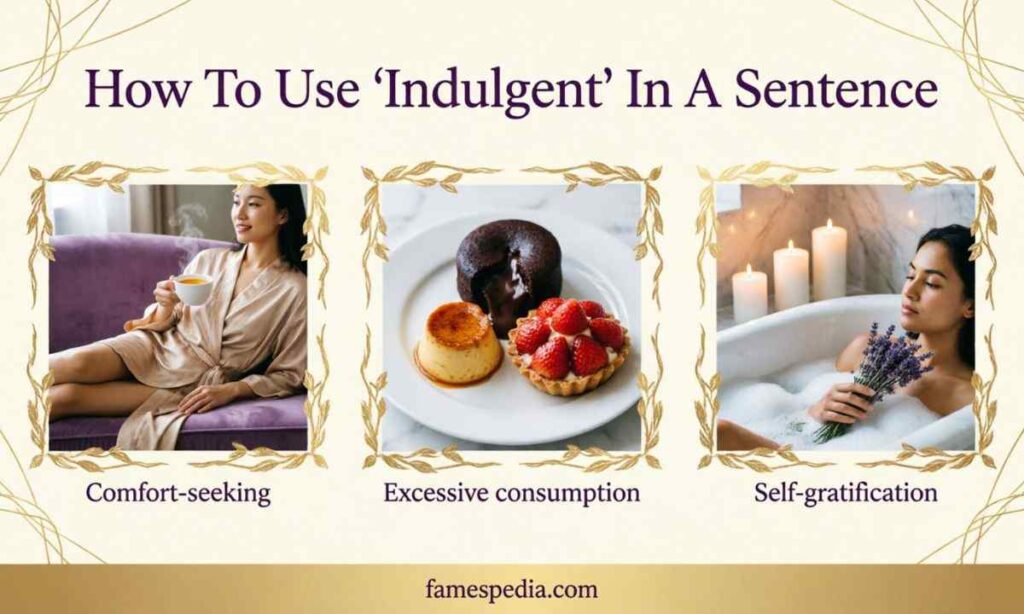
Use indulgent when you want to describe something or someone that freely allows enjoyment, comfort, or excess. It works as a descriptive adjective placed before a noun or after a linking verb.
Patterns to follow:
- Indulgent + noun: “an indulgent meal,” “an indulgent parent”
- Subject + linking verb + indulgent: “The dessert was completely indulgent.”
- Adverb form: “She indulgently smiled at his request for more candy.”
Quick usage tips:
- Use it for food, lifestyle choices, parenting styles, or creative writing tone
- It works in both positive contexts (treating yourself) and critical ones (lack of discipline)
- Pair it with nouns like meal, treat, behavior, parent, or fantasy
How To Use “Sober” In A Sentence
Use sober when you want to describe someone or something that reflects clear thinking, restraint, or freedom from intoxication. It also works as a predicate adjective or a modifier before a noun.
Patterns to follow:
- Sober + noun: “a sober assessment,” “a sober reminder”
- Subject + linking verb + sober: “He remained sober throughout the event.”
- Adverb form: “She soberly delivered the difficult news.”
Quick usage tips:
- Use it in professional, medical, or serious emotional contexts
- It pairs well with words like tone, assessment, decision, reminder, and lifestyle
- In figurative use, sober often replaces words like “serious” or “clear-headed”
More Examples Of Indulgent & Sober Used In Sentences

Examples Of Using “Indulgent” In A Sentence
- The hotel offered an indulgent spa package that included a full-day massage and private pool access.
- His indulgent parenting style meant the kids rarely heard the word no.
- She treated herself to an indulgent breakfast of waffles, whipped cream, and fresh berries.
- The film’s final act felt slightly indulgent, running twenty minutes longer than necessary.
- An indulgent afternoon nap on a rainy Sunday is one of life’s small pleasures.
- The chef prepared an indulgent tasting menu featuring truffle, lobster, and aged beef.
- Her writing was warm but occasionally too indulgent, losing focus in long descriptive sections.
- He gave himself an indulgent hour of video games before getting back to work.
Examples Of Using “Sober” In A Sentence
- After two years, he remained completely sober and was proud of how far he had come.
- The report offered a sober analysis of the company’s financial risks going forward.
- She delivered the news in a sober tone, making sure everyone understood the gravity of the situation.
- His sober response to the chaos in the room impressed the entire leadership team.
- The documentary took a sober look at the environmental damage caused by fast fashion.
- She chose to stay sober at the wedding and was fully present for every moment.
- The architect presented a sober design focused on function rather than decoration.
- A sober reminder arrived in the form of a letter from the bank about missed payments.
Common Mistakes To Avoid
Many writers use indulgent and sober interchangeably without realizing the words carry opposite meanings. Here are the most frequent errors:
- Swapping them in lifestyle descriptions: Writing “she had a sober evening of rich food and wine” when you mean indulgent contradicts the word’s meaning entirely.
- Using sober to mean enjoyable: Sober does not mean fun or relaxed. Calling a party “sober and festive” creates a tonal contradiction.
- Using indulgent to mean serious or thoughtful: Indulgent cannot replace words like “measured,” “considered,” or “rational.”
- Confusing indulgent parenting with sober parenting: These describe opposite approaches. Indulgent parents are permissive. Sober parents here would mean disciplined and grounded.
- Treating sober as only alcohol-related: In figurative writing, sober often means serious or restrained, not just drug-free.
Tips To Avoid These Mistakes
- Before using either word, ask yourself: is this situation about pleasure and excess or about restraint and clarity?
- Replace the word mentally with a synonym. Indulgent can often swap with “lavish,” “permissive,” or “self-gratifying.” Sober can swap with “serious,” “clear-headed,” or “restrained.”
- Read the sentence aloud after writing it. If the tone feels off, the wrong word is likely the cause.
- When writing about personalities, use indulgent for someone who prioritizes enjoyment and sober for someone who values discipline.
- In professional writing, sober is almost always the safer and more appropriate choice.
Context Matters
The same situation can call for either word depending on what you are describing. Context is everything.
Consider a dinner party:
- “It was an indulgent dinner party” means the food was rich, plentiful, and luxurious.
- “It was a sober dinner party” means the atmosphere was serious, or no alcohol was served.
Consider a news article:
- “The indulgent coverage focused heavily on celebrity gossip.” Here, indulgent criticizes the lack of editorial discipline.
- “The sober coverage stayed focused on facts and avoided sensationalism.” Sober here is a compliment.
Consider parenting:
- An indulgent parent says yes to most requests and avoids conflict.
- A sober parent makes decisions based on long-term outcomes rather than short-term emotions.
Context also shifts tone. Indulgent can be a compliment (“You deserve this indulgent spa day”) or a mild criticism (“The script was a little indulgent”). Sober can be a compliment (“Her sober analysis was spot-on”) or a subtle criticism (“The party felt too sober for a birthday celebration”).
Exceptions To The Rules
Language is rarely black and white. A few exceptions are worth noting:
- “Sober color palette” in design does not mean alcohol-free. It means muted, restrained, or neutral tones.
- “Indulgent fondness” can sometimes imply warm leniency rather than harmful excess, especially in parenting or relationship contexts.
- In literary criticism, calling a novel “indulgent” does not always mean it is bad. Some readers enjoy an author who dwells lovingly in descriptive prose.
- In recovery language, sober carries deep personal and cultural weight that goes far beyond its dictionary definition.
You May Also Like This: Copys or Copies: Which Is Correct? Grammar Guide
Practice Exercises: Indulgent vs Sober
Exercise 1: Fill in the Blank
Choose either indulgent or sober to complete each sentence correctly.
- After months of dieting, she allowed herself one ________ weekend of her favorite foods.
- The CEO gave a ________ speech that addressed the company’s challenges without sugarcoating anything.
- His ________ attitude toward his children meant they grew up without clear boundaries.
- She stayed ________ at the party so she could drive everyone home safely.
- The critic described the film’s final hour as self-________ and overlong.
- His ________ assessment of the situation helped the team avoid a costly mistake.
Answer key: 1. indulgent 2. sober 3. indulgent 4. sober 5. indulgent 6. sober
Exercise 2: Sentence Writing
Write one original sentence for each word in the context listed below.
- Use indulgent to describe a meal.
- Use sober to describe a person’s tone during a difficult conversation.
- Use indulgent to describe a parenting style.
- Use sober to describe the design of a building.
- Use indulgent to describe a reading habit.
There are no wrong answers here. Focus on whether the word fits the emotional tone of the sentence.
Exercise 3: Context Clues
Read each sentence and decide whether the underlined word is used correctly or incorrectly. Explain why in one line.
- “After his promotion, he celebrated with a sober five-course meal and champagne.” (Correct / Incorrect?)
- “She gave an indulgent presentation packed with data, charts, and evidence-based conclusions.” (Correct / Incorrect?)
- “His sober judgment saved the company from signing a disastrous contract.” (Correct / Incorrect?)
- “The bakery was known for its indulgent pastries filled with cream and dark chocolate.” (Correct / Incorrect?)
Answers: 1. Incorrect (sober contradicts celebrating with champagne) 2. Incorrect (evidence-based and data-driven is sober, not indulgent) 3. Correct 4. Correct
Conclusion
Indulgent and sober describe two very different ways of moving through the world. Indulgent leans into pleasure, comfort, and emotional generosity. Sober pulls toward clarity, restraint, and rational thinking. Neither is better by default. Both serve a purpose depending on the context.
The key is knowing which one fits the moment. When you are describing a luxurious meal, a lenient parent, or a richly written novel, indulgent is your word. When you are describing clear-eyed analysis, a drug-free lifestyle, or a disciplined creative approach, sober is the right choice.
Use the exercises above to test yourself, and the next time you reach for one of these words, you will know exactly which one belongs in the sentence.

Arslan is the creator and author behind FamesPedia, a platform focused on grammar, writing skills, and English language learning. Passionate about clear communication and effective writing, Arslan shares practical grammar tips, easy-to-follow language guides, and educational content to help readers improve their English with confidence.