
If you have ever typed this word mid-sentence and suddenly stopped to stare at it, you are not the only one. The confusion between training and trainning is one of the most common spelling slip-ups in English, and it happens to experienced writers too. Both versions sound completely identical when spoken. That is exactly what makes this mistake so easy to fall into.
The answer is quick and clear. Training is the correct spelling. Trainning is a misspelling that does not exist in any dictionary, style guide, or credible language source. Keep reading to understand the full reasoning behind this, the history of the word, and how to make sure you never get it wrong again.
Understanding the Correct Spelling
The correct and only accepted spelling is training, spelled T-R-A-I-N-I-N-G, with a single “n.”
This word follows a completely standard English rule. When you add the suffix “-ing” to a base verb, you simply attach it without changing the base word, as long as certain conditions are not met. The verb here is train. Add “-ing” and you get training. No letters are doubled, removed, or altered in any way.
Both the Oxford English Dictionary and Merriam-Webster recognize training as the only valid form. Trainning does not appear in any of these sources because it simply is not a word.
Why “Training” Is Correct

Training follows the standard English rule for adding “-ing” to a verb.
The rule for doubling a consonant before “-ing” applies only in a specific situation. You double the final consonant when three conditions are all true at the same time:
- The base word ends in a single consonant
- That consonant is immediately preceded by a single short vowel
- The stress falls on the final syllable
Now apply that to the word train. The base word ends in the letter “n,” but it is preceded by “ai,” which is a vowel digraph, meaning two vowels working together to make one long sound. That breaks the doubling rule entirely. Since “ai” is not a single short vowel, there is no reason to double the “n.”
Compare it to words where doubling is required:
| Base Word | Rule Applies? | Correct “-ing” Form |
| run | Yes (short vowel + single consonant) | running |
| plan | Yes (short vowel + single consonant) | planning |
| swim | Yes (short vowel + single consonant) | swimming |
| train | No (vowel digraph “ai”) | training |
| read | No (vowel digraph “ea”) | reading |
| wait | No (vowel digraph “ai”) | waiting |
The pattern is clear. Train belongs in the same category as “read” and “wait,” not in the same category as “run” or “plan.”
Why “Trainning” Is Incorrect
Trainning is incorrect because it breaks the basic consonant-doubling rule of English spelling.
Doubling the “n” implies that the vowel before it is short and stressed, like the “u” in “run” or the “a” in “plan.” But the “ai” in the train is a long vowel sound. There is no phonetic or grammatical reason to add a second “n.”
Beyond grammar, trainning is not listed in any recognized dictionary. It has no definition, no accepted use, and no context in which it would be considered correct. It does not matter whether you are writing a casual text, a formal email, a business proposal, or an academic paper. Trainning is wrong in every single one of those settings.
Spell-check tools on platforms like Microsoft Word, Google Docs, and Grammarly will flag “trainning” as an error immediately. That is your built-in safety net, and it flags this word for very good reason.
The Origin and Meaning of “Training”
Etymology
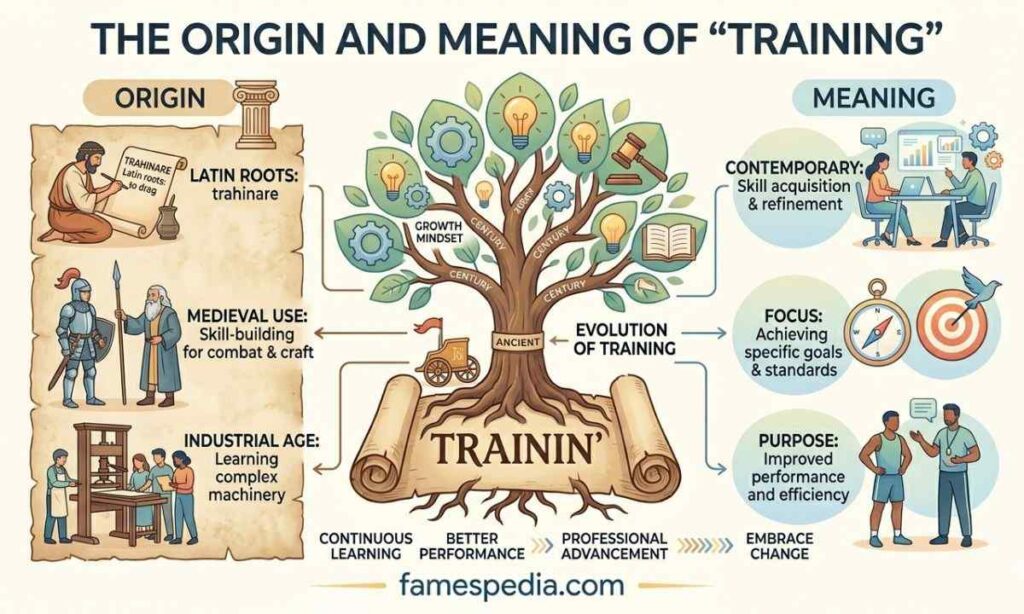
The word training has a genuinely interesting backstory. It traces back to the Old French word “trainer,” meaning “to pull,” “to drag,” or “to draw.” That Old French root came from the Vulgar Latin word “traginare,” which itself derived from the Latin “trahere,” meaning “to pull” or “to draw.”
The earliest English uses of “train” in the 14th century carried that same idea of pulling or leading something along. Over time, the meaning shifted from physical movement to guiding a person toward a skill or goal. By the time the word reached Middle English, it had evolved to mean teaching, instructing, and developing someone’s abilities through practice. The “-ing” form simply turned that verb into a noun describing the ongoing process.
Definition
Training is primarily used as a noun in modern English. It refers to the process of teaching, learning, or developing a skill through repeated practice, instruction, or guided experience.
It can also appear as a present participle, as in “she is training for a marathon,” where it functions as part of a verb phrase.
As a noun, training describes both the activity itself and the structured program designed to build capability in a specific area.
Common Contexts for “Training”
Training appears across nearly every field and industry. Here are the most common contexts where the word is used:
- Workplace and corporate settings: Employee onboarding, leadership development, compliance training, and skills workshops all fall under this category.
- Sports and athletics: Physical conditioning programs, coaching sessions, and pre-season preparation are all referred to as training.
- Education and academics: Teacher training, student skill development, and vocational preparation programs use this word regularly.
- Military: Soldiers undergo physical and tactical training as a core part of their service.
- Technology and AI: Machine learning models are built through a process called model training, making this word extremely common in tech writing.
- Healthcare: Medical professionals complete clinical training and continuing education throughout their careers.
Examples
Here are clear sentence examples showing training used correctly across different contexts:
- “The new employees attended a two-day onboarding training session.”
- “She has been in training for the national swimming championship since January.”
- “The company invested heavily in leadership training this year.”
- “His training as a nurse gave him confidence to handle emergencies calmly.”
- “The AI model requires extensive data training before it can produce accurate results.”
- “Corporate training programs help staff stay updated on compliance regulations.”
Why Spelling Accuracy Matters
Real-World Consequences
Spelling mistakes in professional writing carry real costs. A single error like writing “trainning” in a resume, business proposal, or client-facing document can signal a lack of attention to detail. Hiring managers, clients, and colleagues all notice these things, even if they do not say anything out loud.
Consider this: a misspelled word in a training proposal or HR document not only looks unprofessional but may also reduce the credibility of the entire document. In industries where precision matters, such as healthcare, law, finance, and technology, spelling errors can undermine trust quickly.
Communication Clarity
Correct spelling is not just about following rules. It is about making sure your reader understands exactly what you mean without friction or confusion. When someone reads “trainning,” their brain pauses for a split second to process the error. That interruption, however small, slows down communication and weakens your message.
Using training correctly keeps your writing clean, confident, and easy to read. It shows that you respect both the language and the person reading your work.
Side-by-Side Comparison
| Feature | Training | Trainning |
| Correct spelling | Yes | No |
| Found in dictionaries | Yes | No |
| Follows English spelling rules | Yes | No |
| Accepted in professional writing | Yes | No |
| Flagged by spell-check | No | Yes |
| Valid in any context | Yes | No |
Tips for Remembering the Correct Spelling

Mnemonics and Memory Aids
One of the simplest ways to lock in the correct spelling is to visualize a train. A train moves forward on one track. There is one “n” in the word train, and adding “-ing” keeps it that way. The train does not split or double its track, and neither does the letter “n.”
Another helpful approach is to break the word into its two parts every time you write it: train + ing = training. Say it out loud in two pieces. Once you see and hear it as a combination of a familiar base word and a suffix, the correct spelling becomes obvious.
Pronunciation Rules
The word training is pronounced with a long “ai” sound, like the word “rain” or “plain.” That long vowel sound is your clue. In English, long vowel sounds before a consonant do not trigger consonant doubling. Short vowel sounds do. Since you clearly hear a long sound in the train, you know the “n” stays single.
Common Misspelling Patterns
Knowing the most frequent errors helps you avoid them. Writers typically misspell this word in these ways:
- Trainning: Doubles the “n” incorrectly, which is the most common mistake
- Traning: Drops the second “i,” creating an incomplete and unrecognizable word
- Traing: Removes the “n” entirely, which changes the sound and meaning
- Trainging: Adds an extra “g,” likely from muscle memory errors on a keyboard
All of these are wrong. The correct form is always training, with one “n,” one “i,” and one “g.”
Also Read This: Infront or In Front? Which Is Correct? Simple Grammar Guide
Special Cases
Applications Requiring Accuracy
There are specific situations where spelling training correctly is especially important:
- Resumes and job applications: Misspelling a core professional term like training on a resume can eliminate you from consideration before an interview.
- HR and compliance documents: These are reviewed carefully by legal and management teams. A spelling error in a training policy or compliance record looks careless.
- E-learning and course content: When you build online training materials, the word appears constantly. A repeated spelling mistake across a course destroys the credibility of the instructor.
- Email communication: Professionals judge writing quality in emails. Using “trainning” in a workplace email can affect how colleagues and supervisors perceive your attention to detail.
Importance Across Industries
Every major industry uses the word training constantly. In healthcare, staff training records must be accurate for audits and licensing. In finance, employee compliance training is a legal requirement. In technology, model training is a technical term that appears in documentation, research papers, and product descriptions. In education, teacher training programs are evaluated and accredited based on formal written records.
No matter which industry you work in, spelling training correctly is part of maintaining professional standards. The stakes vary by field, but the rule is always the same.
Conclusion
The spelling debate between training and trainning has one straightforward answer: training is always correct, and trainning is always wrong. The reason comes down to a simple English rule about vowel digraphs and consonant doubling, and once you understand it, you will never second-guess this word again.
Think of it this way: “train” plus “ing” equals training, every single time, in every context, across every industry. Whether you are writing a corporate training plan, a sports coaching article, or a quick email to a colleague, the spelling stays the same. Keep it simple, keep it correct, and let your writing reflect the care and accuracy you bring to everything else you do.

Arslan is the creator and author behind Healthy Leeks, a platform focused on grammar, writing skills, and English language learning. Passionate about clear communication and effective writing, Arslan shares practical grammar tips, easy-to-follow language guides, and educational content to help readers improve their English with confidence.