Have you ever typed the word “chear” and stopped to wonder if it looks right? You are not alone. This is one of the most common spelling confusions in English, and it happens because both words sound completely identical when spoken out loud. The difference comes down to just one vowel, but that single letter changes everything in writing.
The short answer is simple. Cheer is the correct modern spelling. Chear is an outdated, obsolete form that no longer belongs in any type of writing, whether casual or formal. Keep reading to understand the full picture, including definitions, proper usage, fun history, and real sentence examples.
Definitions Of Cheer And Chear
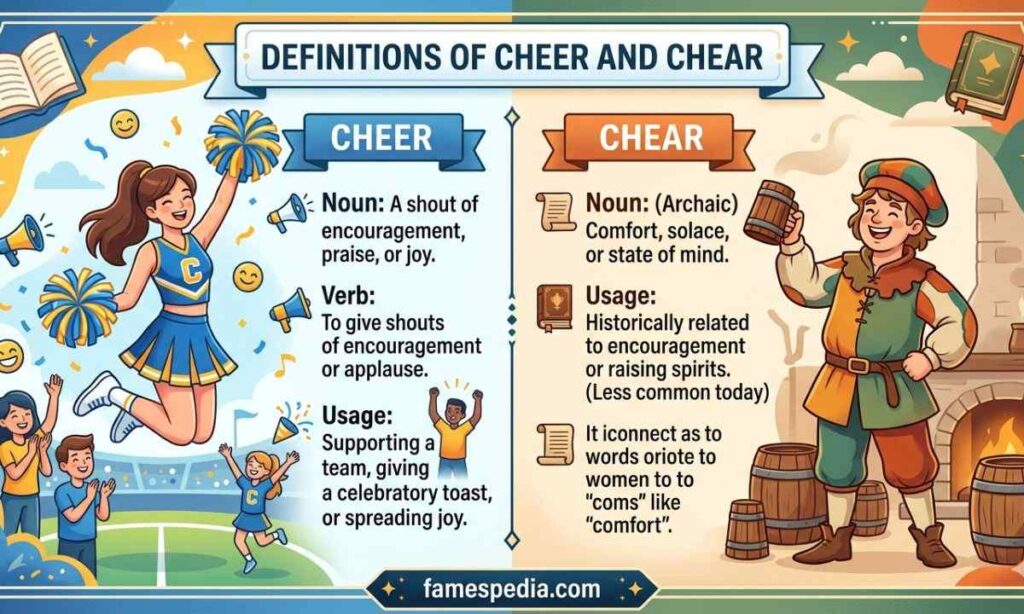
Before choosing between two similar-looking words, the best thing you can do is understand what each one actually means. Many people simply guess or rely on autocorrect. But when you know the definitions well, you will never second-guess yourself again.
What Is The Definition Of Cheer?
Cheer is a versatile English word that works as both a verb and a noun.
As a verb, cheer means to shout with joy, give encouragement, or offer emotional support to someone. When fans cheer at a game, they are expressing loud approval and excitement. When a friend tries to cheer you up after a bad day, they are offering comfort.
As a noun, cheer refers to a loud cry of happiness, a general mood of happiness, or a festive and joyful atmosphere. Holiday cheer, good cheer, and a round of cheers all fall under this meaning.
Here is a quick breakdown:
| Form | Meaning | Example |
| Verb | To shout with joy or encouragement | “The fans cheer every time he scores.” |
| Verb | To comfort or uplift someone | “She stayed to cheer her friend up.” |
| Noun | A shout of approval | “A loud cheer rose from the crowd.” |
| Noun | A feeling of happiness or optimism | “The room was full of holiday cheer.” |
More Meanings Of Cheer
Cheer goes beyond just joy and applause. Here are more meanings you will come across in everyday writing and conversation:
- Good cheer refers to a warm, generous, and optimistic spirit. It is commonly used around holidays and celebrations.
- Cheer up is a phrasal verb meaning to become happier or to help someone feel better after sadness or disappointment.
- Cheer on means to actively encourage someone during a competition or challenge.
- Three cheers is a traditional expression used to celebrate someone, usually followed by the person’s name.
- Christmas cheer or holiday cheer describes the warm, festive energy of the season, including food, music, and company.
- In older usage, cheer could also refer to food and drink offered to guests, as in “a table full of good cheer.”
Each of these meanings connects back to one core idea: positivity, support, and warmth.
What Is The Definition Of Chear?
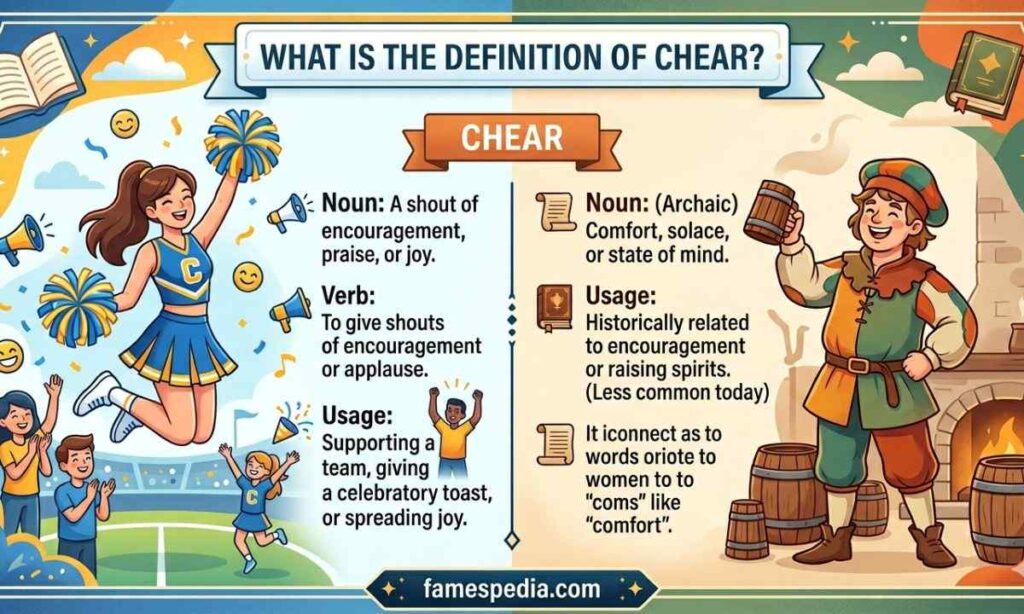
Chear is simply an old and obsolete spelling of the word cheer. It was used in English writing during the 16th and 17th centuries, a time when spelling had not yet been fully standardized. Back then, writers would often swap vowels without any fixed rules, so you might find “chear” in old poems, letters, and manuscripts from that era.
Today, chear is no longer accepted in modern English. It does not appear in current dictionaries as a valid word. Spell-check tools will flag it as an error, and using it in emails, essays, or any written content will make your writing look careless.
Bottom line: If you see chear in a very old text, that is historical usage. In any writing you do today, always use cheer.
Cheer Vs Chear Meaning
Here is a simple side-by-side comparison to make the distinction crystal clear:
| Word | Modern Status | Meaning | Use It? |
| Cheer | Correct and current | Joy, encouragement, support, applause | Yes, always |
| Chear | Obsolete and incorrect | Old spelling of cheer | No, never in modern writing |
The two words are homophones, meaning they sound the same when spoken. That is exactly why writers get confused. But when it comes to writing, only one of them belongs on the page.
How To Properly Use Cheer And Chear In A Sentence
Using cheer correctly is straightforward once you know its two main roles. Since chear is not a valid modern word, you will only ever need to use cheer.
When cheer works as a verb:
Follow the standard sentence structure: subject + cheer + object or complement.
- “The fans began to cheer as soon as the player walked onto the field.”
- “She called her brother to cheer him up after he failed the test.”
- “Let us cheer them on and show our support.”
You can also conjugate it like any regular verb:
- Present: I cheer, she cheers, they cheer
- Past: He cheered loudly at the concert.
- Progressive: The crowd was cheering non-stop.
When cheer works as a noun:
Place it where you would place any other noun in the sentence.
- “A cheer went up from the stands the moment the final whistle blew.”
- “There was a warm sense of cheer at the office holiday party.”
- “Her kind words brought real cheer to everyone in the room.”
One quick rule to remember:
If you feel the urge to write “cheer,” pause and replace it with “cheer.” Every single time, without exception.
Cheer Vs Chear: Fun Facts About These Words
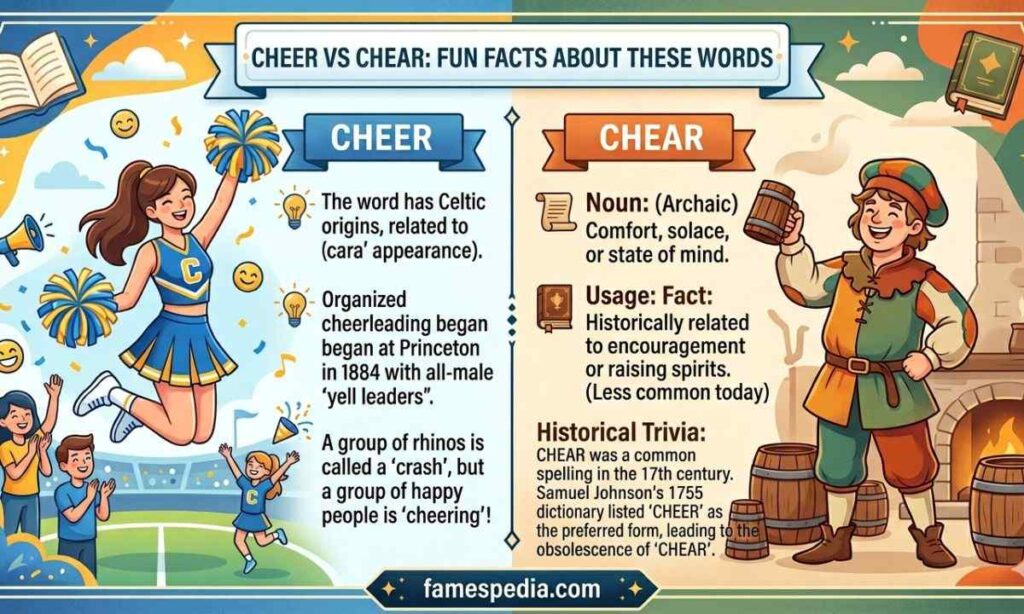
The history behind these two words is genuinely interesting. Here are some facts that top grammar resources and etymology experts have confirmed:
1. Cheer once meant a face, not a feeling. The word cheer entered English around the 13th century from Anglo-French “chere,” which itself came from Medieval Latin “cara” and the Greek “kara,” both meaning “head” or “face.” So when someone had “good cheer” in medieval times, it meant they had a happy expression on their face, not that they were cheering out loud.
2. The meaning slowly shifted from face to feelings. By the mid-13th century, cheer had grown to describe a person’s mood or state of mind. Eventually, by around 1400, the positive sense of happiness and gladness became the dominant meaning.
3. Cheer as a shout is actually a newer development. The familiar meaning of cheer as a loud shout of encouragement or applause only came about around the early 1700s. Some language historians believe it may have started as nautical slang among sailors.
4. Chear was a natural spelling variation, not a mistake. During the 1500s and 1600s, English spelling was not standardized. Writers routinely used variant spellings, and “chear” appeared in poems and literary works of that period. It was not wrong then. It is simply no longer used today.
5. The Oxford English Dictionary lists 16 meanings for the verb cheer. Six of those meanings are now labelled as obsolete. This shows just how much the word has evolved over centuries of use.
6. “Three cheers” as an expression dates back to 1751. The tradition of offering three cheers as a form of group celebration is centuries old and still completely alive in modern English.
List Of Examples Of Cheer And Chear In Your Sentences
Below are clear, practical sentence examples to show you how cheer works in real writing. No example uses “chear” because it is not a correct modern word.
Cheer as a verb (to encourage or shout with joy):
- The entire stadium started to cheer when the home team scored in the last minute.
- Her teammates ran to cheer her after she crossed the finish line first.
- People lined the streets to cheer the marathon runners as they passed.
- He asked his friends to cheer him on at his first public performance.
- The children began to cheer when the teacher announced there would be no homework.
Cheer as a verb (to comfort or uplift):
- She baked a batch of cookies to cheer her neighbor on after a difficult week.
- A short walk outside helped to cheer him up more than he expected.
- He sent a funny video to cheer his sister up when she was feeling low.
Cheer as a noun (a shout or sound of joy):
- A loud cheer filled the arena the moment the winner was announced.
- The cheer from the crowd gave the players the energy to push harder.
Cheer as a noun (a mood or atmosphere of happiness):
- The office was full of holiday cheer during the end-of-year celebration.
- Her laugh brought cheer into every room she walked into.
- He greeted everyone with warmth and good cheer at the family gathering.
Showing the contrast between cheer (correct) and chear (incorrect):
- Correct: “She gave a loud cheer after winning the spelling competition.” Incorrect: “She gave a loud cheer after winning the spelling competition.”
- Correct: “Everyone joined in to cheer the team on during the final match.” Incorrect: “Everyone joined in to cheer the team on during the final match.”
You May Also Like These: Comprable vs Comparable: Decoding Common Word Mix-Ups
Conclusion
The cheer vs cheer debate is really not a debate at all. Cheer is the correct word, and chear belongs only in history books. Whether you are using it as a verb to encourage someone, a noun to describe a joyful shout, or a way to describe the warm energy in a room, cheer is the word you need every single time.
One easy tip: if your spell-check highlights a word in red, trust it. Any time you see “cheer” flagged, replace it with “cheer” and move on. The cleaner your spelling, the stronger your writing credibility. Use cheer with confidence, and you will never have to second-guess this one again.

Arslan is the creator and author behind Healthy Leeks, a platform focused on grammar, writing skills, and English language learning. Passionate about clear communication and effective writing, Arslan shares practical grammar tips, easy-to-follow language guides, and educational content to help readers improve their English with confidence.