You typed it fast, hit send, and then stared at the screen wondering: did I just write “infront” as one word? If this sounds familiar, you are absolutely not alone. This tiny spacing question trips up writers, students, and even seasoned bloggers every single day.
The short answer is simple. “In front” is correct. “Infront” is not a real word in the English language. But understanding why this rule exists and how to apply it confidently is what this guide is all about. By the time you finish reading, you will never second-guess this again.
Infront or In Front: Which Is Correct?
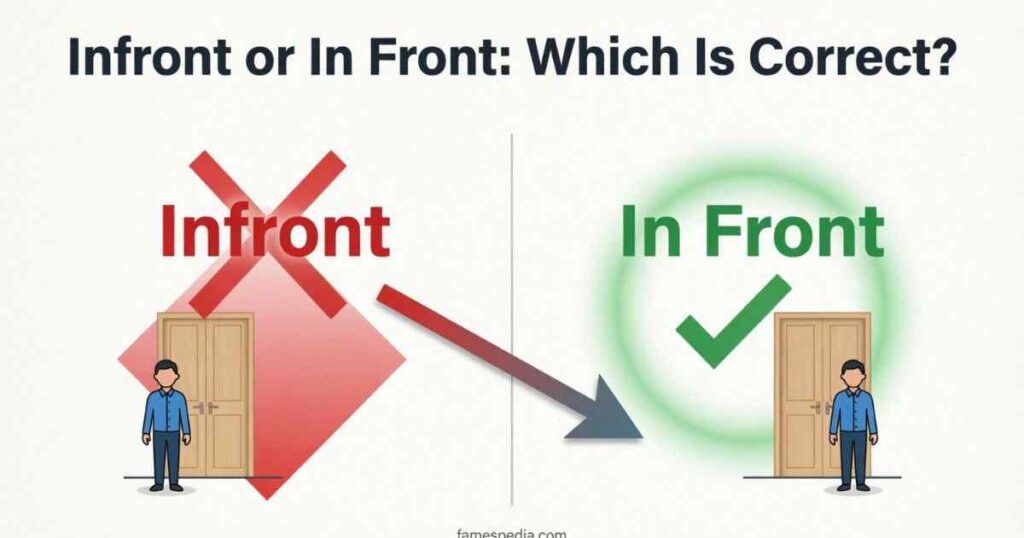
The correct spelling is always in front, written as two separate words with a space between them.
“Infront” is not recognized in standard English. There is no such word in the English dictionary, making its usage incorrect. It is crucial to remember to separate “in” and “front” with a space to convey meaning accurately.
Here is a quick reference to settle the debate once and for all:
| Version | Correct? | Example |
| in front | Yes | She stood in front of the class. |
| infront | No | She stood infront of the class. |
No major dictionary lists “infront” as valid. Oxford, Cambridge, and Merriam-Webster all agree that the space is required, not optional.
So if your spell-checker underlines “infront” in red, trust it. That squiggly line is doing its job.
Understanding “In Front” as a Phrase
Now that you know which version is correct, it helps to understand what kind of phrase “in front” actually is. This knowledge makes the rule stick much better than simply memorizing it.
“In front” indicates a position or location relative to the front side of something. According to the Cambridge Dictionary, “in front” means “in a position just ahead of or further forward than someone or something else.”
The phrase works in a variety of contexts:
Physical position: Describing where something is located in space. Example: The dog sat in front of the door all morning waiting for its owner.
Facing or visible presence: Describing something placed before an audience or another person. Example: The performer rehearsed her lines in front of a mirror for hours.
Leadership or competition: Describing someone who is ahead in a race, game, or ranking. Example: The home team moved in front during the second half.
Metaphorical use: Expressing something that takes priority or stands out. Example: She always puts her responsibilities in front of her personal desires.
As you can see, “in front” is flexible. It shows up in everyday conversation, formal writing, sports commentary, directions, and storytelling. It is one of the most frequently used positional phrases in the English language.
Grammatical Basis for Saying “In Front” and Not “Infront”
This is where it gets interesting. Why exactly is “infront” wrong? The answer lies in how the English language builds words and phrases.
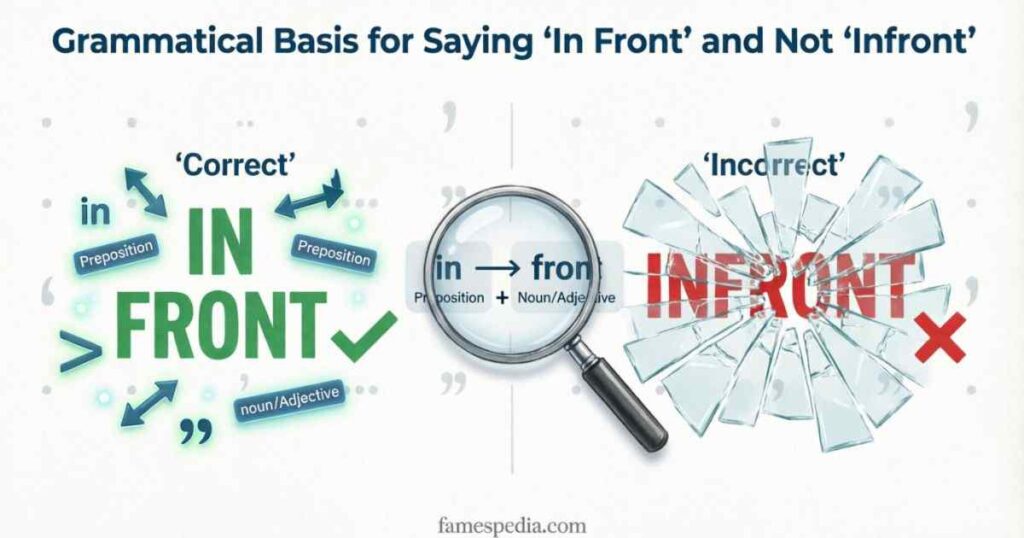
“In front” is a two-part expression that combines the preposition “in” with the noun “front,” indicating a position ahead of or before another point or object. The English language typically maintains a space between a preposition and its object. Joining these two would be against word formation rules.
Think of it this way. The word “in” is a preposition. It tells us about position or direction. The word “front” is a noun that refers to the forward-facing side of something. Together, they form a prepositional phrase, not a compound word.
“In front” is a prepositional phrase, and prepositional phrases are not merged into single words unless they become officially accepted compounds. English keeps these parts separate because each word contributes meaning.
Here is a helpful comparison showing how this works across similar phrases:
| Phrase | Written As | Type |
| in front | Two words | Prepositional phrase |
| at home | Two words | Prepositional phrase |
| on top | Two words | Prepositional phrase |
| in fact | Two words | Prepositional phrase |
| inside | One word | Compound word (accepted over time) |
| into | One word | Compound word (accepted over time) |
The mix-up happens because words like “inside” and “into” did combine over time. However, “in front” never went through this change and stays as two words.
The key takeaway: just because two words appear together often does not mean they merge into one. “In front” has been used in English for centuries as a two-word phrase, and that has never changed.
Examples of Using “In Front” in a Sentence
Seeing a grammar rule in action is one of the best ways to internalize it. Here are real-world sentence examples showing how “in front” works across different situations:
Everyday situations:
- The children lined up in front of the school gate before the bell rang.
- A long queue had formed in front of the coffee shop by 8 a.m.
- He parked his bicycle in front of the library every morning.
Work and professional settings: 4. The manager presented the quarterly report in front of the entire board. 5. She confidently spoke in front of a large audience at the conference. 6. The new policy was announced in front of all department heads.
Descriptions and directions: 7. The pharmacy is located in front of the main hospital entrance. 8. There is a beautiful garden in front of their house. 9. Turn left when you see the gas station in front of the park.
Sports and competition: 10. The sprinter surged in front with just 50 meters remaining. 11. Our team is now three points in front after the second quarter.
These examples show how flexible the phrase can be in everyday English. The teacher stood in front of the board. There is a garden in front of my house. She placed the book in front of her laptop.
Notice that “in front” is almost always followed by “of” when describing position relative to a specific object or person. The complete phrase “in front of” functions as a complex preposition in those cases.
Other Correct Ways of Saying “In Front”
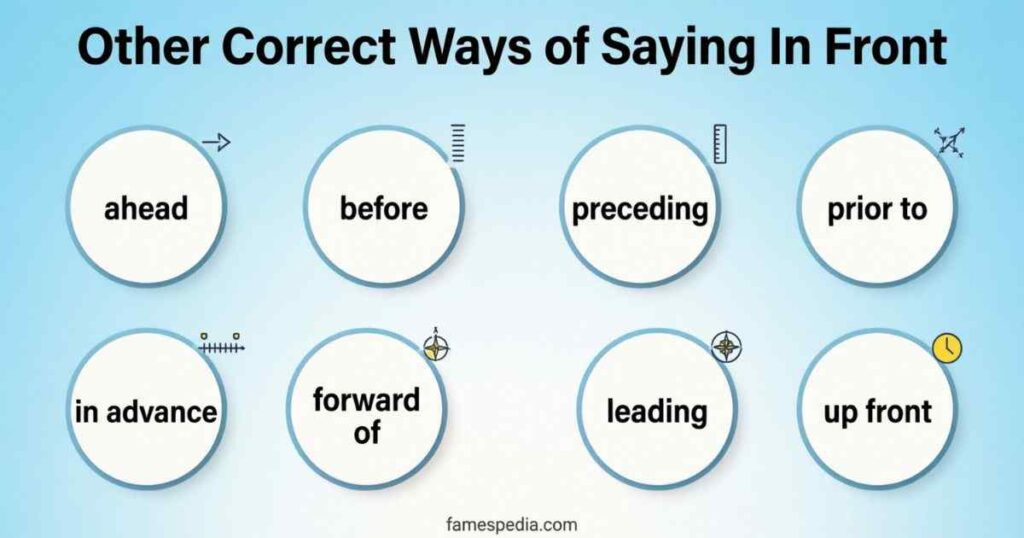
Good writing avoids repetition. If you find yourself using “in front of” too many times in a paragraph, you have several strong alternatives that carry the same or very similar meaning.
Here are the best synonyms and alternatives:
Ahead of Used when describing forward position or progress. Example: She walked ahead of the group to check the trail.
Before Works well for both physical position and time. Example: He stood before the judge and stated his case clearly. Example: The meeting was scheduled before noon.
Facing Used when one thing is directly turned toward another. Example: The windows are facing the courtyard.
Opposite Works when two things are directly across from each other. Example: The pharmacy is directly opposite the bus stop.
Preceding More formal, often used in writing to indicate what comes first. Example: The introduction preceding the main chapter sets the context well.
At the forefront of a more emphatic phrase used in professional or academic writing. Example: This company has always been at the forefront of innovation.
Leading Often used in competition or ranking contexts. Example: The home side is currently leading by two goals.
These alternatives help keep your writing fresh and natural without sacrificing clarity or correctness.
Also Read These: Is There Any vs Are There Any: Use Correctly 2026
Common Mistakes and How to Avoid Them
Knowing the rule is half the battle. The other half is actually applying it consistently, especially when you are typing fast or writing casually. Here are the most common errors people make and practical ways to fix them.
Mistake 1: Writing “infront” as one word
This is the most widespread error. It almost always happens during fast typing.
Wrong: He was standing infront of the door. Right: He was standing in front of the door.
The mistake usually appears when people type quickly or rely on how the phrase sounds instead of how it is structured.
Fix: Turn on your grammar checker. Tools like Grammarly or even standard spell-check in Word and Google Docs will flag “infront” immediately.
Mistake 2: Forgetting the word “of”
Many learners drop the preposition “of” when it is needed to connect the phrase to a noun.
Wrong: She stood in front of the mirror. Right: She stood in front of the mirror.
Fix: When “in front” is followed by a noun or pronoun, you almost always need “of” to complete the phrase.
Mistake 3: Confusing it with compound words
People confuse “in front” because words like “inside” and “into” are single words. This causes confusion. However, “in front” functions as a prepositional phrase, similar to “at home” or “on top,” where each word plays a distinct grammatical role.
Fix: Remember the rule. Prepositional phrases stay separate. Think “at home” not “athome,” “on top” not “ontop,” and “in front” not “infront.”
Mistake 4: Assuming informal use makes it acceptable
You may see “infront” written regularly on social media, text messages, or comment sections online. A spelling mistake repeated thousands of times online remains a spelling mistake. Popularity does not equal correctness.
Fix: Apply the correct form in all your writing, whether it is a tweet, an email, or a formal report. Correct habits built in casual writing transfer to professional writing naturally.
Conclusion
The verdict is clear and it is not even close. “In front” is the only correct form, and “infront” is simply a misspelling that has spread through fast typing and informal writing habits. Remembering why this rule exists makes it far easier to follow. “In front” is a prepositional phrase where both words carry their own meaning, and English grammar keeps those parts separated.
Next time you write it, picture the space between the two words as a tiny reminder that each word has its own job to do. Keep them separate, your grammar sharp, and your writing professional.

Arslan is the creator and author behind Healthy Leeks, a platform focused on grammar, writing skills, and English language learning. Passionate about clear communication and effective writing, Arslan shares practical grammar tips, easy-to-follow language guides, and educational content to help readers improve their English with confidence.