If you have ever typed a sentence and paused to wonder whether you meant “pent” or “pants,” you are not alone. These two words share the same first three letters, which is enough to trip up even careful writers. But the confusion ends there. One word belongs to the world of grammar and emotions. The other one belongs in your wardrobe.
This guide breaks down the full difference between pent and pants. You will learn their definitions, how to use each word correctly in a sentence, common mistakes to dodge, and the contexts where each word fits best. By the end, choosing the right word will feel completely natural.
Define Pent
Pent is an adjective that means confined, shut up, restrained, or held back. It is most commonly seen in the phrase pent up, which describes emotions, energy, or tension that has been bottled inside and not yet released.
According to Merriam-Webster, pent means “shut up: confined, repressed, usually used with up.” The word traces back to the mid-1500s as a variant of penned, the past participle of the Old English verb “to pen,” meaning to enclose or confine. Its earliest recorded use in written English dates to around 1542, according to the Oxford English Dictionary.
Pent does not work as a standalone everyday word in modern English. You will almost never see it used on its own. Instead, it appears in fixed phrases like pent-up anger, pent-up demand, pent-up energy, or pent-up frustration. Think of pent as the word you reach for when something has been building up inside, waiting to come out.
Part of speech: Adjective (past participle of “to pen”)
Common form: Pent up (also written pent-up with a hyphen)
Tone: Formal, literary, slightly archaic in standalone use
Define Pants

Pants is a plural noun that refers to a garment worn on the lower body, covering each leg separately, typically extending from the waist down to the ankles. In American English, pants is the standard, everyday word for what the British call trousers. In British English, however, pants most often refers to undergarments or underwear, which is why this word trips people up across different regions.
The word pants entered English in the early 1800s as a shortened version of pantaloons, tight-fitting leg garments popular in the 19th century. Pantaloons itself came from the French “pantalon” and Italian “pantalone,” both derived from a comical stock character named Pantaloon who wore long, tight trousers as part of his costume. By the mid-1800s, “pants” had become widely used in American English to mean trousers of any kind.
Because pants is a plural noun (like scissors or glasses), you never say “a pant.” You say a pair of pants or simply pants.
Part of speech: Plural noun
American English meaning: Trousers, leg garments
British English meaning: Undergarments or underwear
Common usage: Everyday, casual, and formal clothing contexts
| Feature | Pent | Pants |
| Part of speech | Adjective | Plural noun |
| Meaning | Confined, restrained, held back | Lower body clothing / undergarments (UK) |
| Common form | Pent up / pent-up | A pair of pants |
| Tone | Literary, formal | Everyday, casual to formal |
| Modern usage | Mostly in fixed phrases | Extremely common |
| Origin | Old English “pen” (to confine) | Italian “pantalone” (a character in commedia dell’arte) |
How To Properly Use The Words In A Sentence

Knowing what these words mean is only half the job. Using them correctly inside a sentence is what actually matters for clear writing and communication. Here is how each one works.
How To Use “Pent” In A Sentence
Pent works as an adjective. It describes a noun by telling you that something has been held back, confined, or restrained. In nearly every case, pent appears alongside the word up, forming the compound adjective pent up or pent-up.
When pent-up comes before a noun, use a hyphen. When it comes after a linking verb, skip the hyphen.
Rules for using pent correctly:
- Always pair it with “up” in modern English usage
- Use a hyphen when it sits before a noun: pent-up rage
- No hyphen when it follows a verb: the rage was pent up
- Never use pent as a replacement for any clothing word
Examples of correct usage:
- The athlete’s pent-up energy exploded off the starting block.
- After months of silence, her pent-up emotions finally surfaced.
- There is a massive amount of pent-up consumer demand following the lockdowns.
- His voice was calm, but his feelings were clearly pent up inside.
How To Use “Pants” In A Sentence
Pants is a plural noun, so it takes a plural verb. You would say “the pants are” not “the pants are.” You never use “a pant” because the word does not have a standard singular form in general usage. When you want to refer to one garment, say a pair of pants.
Rules for using pants correctly:
- Always treat it as plural: “these pants are too tight”
- Use “a pair of pants” when indicating a single garment
- Be mindful of your audience’s regional English (American vs. British)
- Do not use pants as a synonym for specific clothing types like jeans or shorts
Examples of correct usage:
- She packed three pairs of pants for the business trip.
- His pants were freshly pressed and ready for the interview.
- Can you hand me those pants hanging on the chair?
- He bought a pair of khaki pants to wear to the dinner.
- In British English, “pants” at a formal meeting might raise eyebrows since it means underwear.
More Examples Of Pent & Pants Used In Sentences
Seeing a word in action across different contexts helps lock in the correct usage. Here is a fuller collection of example sentences for both words.
Examples Of Using Pent In A Sentence
- After three years of being stuck indoors, the entire city had pent-up excitement about the festival.
- She could feel the pent-up tension in the room the moment she walked through the door.
- The coach warned that pent-up frustration on the bench could become a problem in the second half.
- His pent-up creativity finally found an outlet when he started painting.
- The financial market saw a surge driven by years of pent-up demand.
- There is something powerful about releasing what has been pent up for too long.
- The child’s pent-up laughter burst out and the second class was dismissed.
- Therapists often say that pent-up grief can affect physical health over time.
- The village was flooded by pent-up rainfall that finally broke through the dam.
- He wrote in his journal every night to avoid carrying pent-up stress into the morning.
Examples Of Using Pants In A Sentence
- She tried on seven pairs of pants before finding the right fit.
- The store had a huge sale on dress pants for the holiday season.
- His work pants were worn out at the knees after months on the construction site.
- She prefers wearing wide-leg pants because they are both stylish and comfortable.
- He spilled coffee on his pants right before the presentation.
- The children ran inside to change their muddy pants after playing in the yard.
- I need to hem these pants before the wedding next week.
- The tailor asked whether she wanted the pants taken in at the waist.
- He always keeps a spare pair of pants in his desk drawer just in case.
- The school dress code required pants or skirts in navy blue or black.
Common Mistakes To Avoid
Most errors with pent and pants come from visual similarity, regional confusion, or grammatical blind spots. Here are the most frequent mistakes and how to sidestep each one.
Using “Pent” Instead Of “Pants”
This is the most basic mix-up. Because pent and pants share the letters P-E-N-T, some writers accidentally type or say “pent” when they mean “pants.”
Wrong: He wore a pent to the office.
Right: He wore pants to the office.
Pent is not a clothing word at any point in modern English. If your sentence involves a garment, pants is the correct choice every time. Reserve pent for describing confined or restrained feelings and energy.
Using “Pants” Instead Of “Trousers”
This mistake matters most in British English contexts. In the United Kingdom, saying “I spilled soup on my pants” during a formal meeting means something very different from what an American speaker would intend. British English reserves pants for underwear, while trousers cover the outer leg garment.
American English: “I bought new pants for the job interview.” (Correct and clear)
British English: “I bought new trousers for the job interview.” (The safe, standard choice)
If you are writing for a British audience or a global audience, default to trousers for the outer garment to avoid any awkward misreadings.
Using “Pants” Instead Of “Jeans”
Pants is a general category word. Jeans are a specific type of pants made from denim fabric. Using pants when you mean jeans is not wrong, but it is imprecise. In clothing, fashion, or retail writing, the specific term is always stronger.
Imprecise: She always wears pants on weekends.
Precise: She always wears jeans on weekends.
If the context calls for detail, use the specific term. If you are speaking generally about leg garments, pants work just fine.
Using “Pants” As A Singular Noun
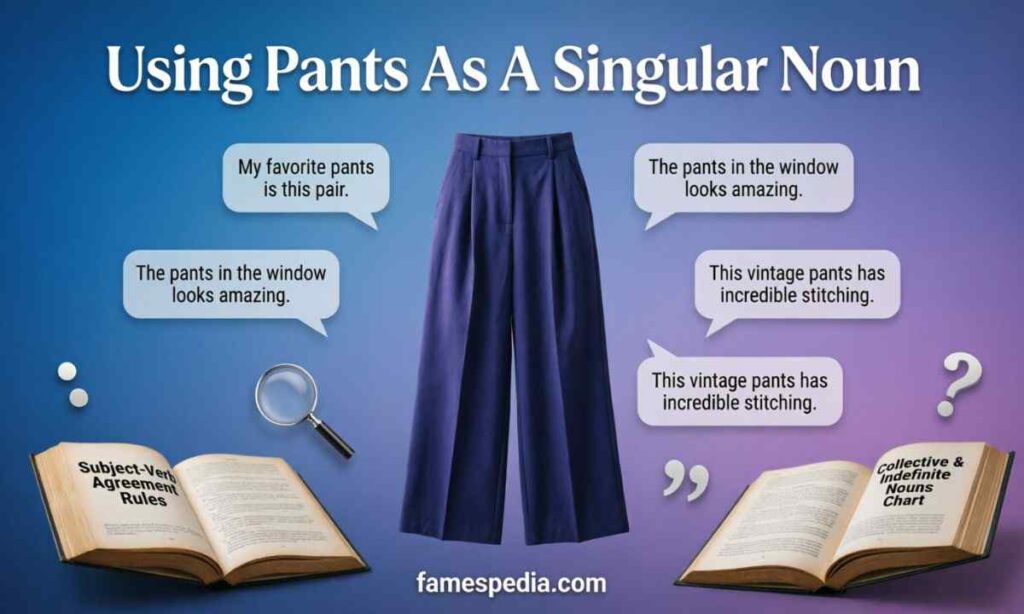
Because pants looks like it ends in a plural “s,” some writers try to use it as a singular noun or pair it with a singular verb. This is incorrect.
Wrong: These pants are too long.
Wrong: The pants fit well.
Right: This pair of pants is too long.
Right: The pants fit well.
In clothing retail, you may occasionally see “pant” used as a fashion industry shorthand (like “a wide-leg pant”), but in standard everyday English, always use pants as a plural or say “a pair of pants.”
Tips To Avoid These Mistakes
- Create a memory hook: Link “pent” to “pent-up emotions” and “pants” to “what you wear.” Two separate mental folders.
- Check your audience’s English variety before publishing. British readers and American readers interpret “pants” very differently.
- Use the pair test: If you can say “a pair of” before the word, it is pants. You would never say “a pair of pent.”
- Read your sentence aloud. If pent appears in your sentence but no emotion or confinement is involved, you have the wrong word.
- Proofread for specificity. Ask yourself: are you describing a garment, or an emotion? That question alone sorts out 90% of pent vs. pants confusion.
Context Matters
The same word can carry completely different meanings depending on where, how, and to whom you are writing. Both pent and pants shift in meaning based on context, and understanding this is what separates a competent writer from a great one.
Examples Of Different Contexts
Formal Writing / Academic Context:
Pent-up demand is a well-established economic term. Economists and journalists use it regularly to describe consumer or market energy that has been built without an outlet. In this context, “pent” is entirely appropriate and professional.
Example: “The post-pandemic economy saw a surge fueled largely by pent-up consumer demand.”
Casual / Everyday Speech (American English):
Pants is the default, natural word for leg garments. No one in the United States thinks twice about saying “I need new pants.” It is the expected term.
Example: “These pants are too hot for summer.”
Formal / Business Writing (British English):
In the UK, using “pants” to refer to an outer garment in a formal document or professional email is a significant blunder. The correct word is “trousers.”
Example: “Please dress in formal trousers and a button-down shirt.”
Literary / Emotional Writing:
Pent-up works powerfully in fiction and personal essays to describe psychological or emotional states. Writers use it to build tension or empathy.
Example: “She had spent years swallowing her pent-up grief, and now it was finally breaking free.”
Fashion / Retail Writing:
Precision matters here. Pants are acceptable as a broad category, but jeans, chinos, trousers, slacks, or leggings will be more useful depending on what exactly you are describing.
Example: “These high-waisted trousers pair beautifully with a tucked-in blouse.”
Emotional / Psychological Context:
Pent-up is widely used in mental health writing to describe suppressed feelings.
Example: “Counselors often encourage clients to express pent-up emotions rather than bottling them up indefinitely.”
Exceptions To The Rules
Language is never completely rigid. There are situations where the usual rules for pent and pants bend based on region, context, or historical period.
1. Regional Differences
The biggest exception involves pants in British English. While American English speakers use pants to mean trousers, British English speakers use it to mean underwear. Australian English leans closer to American usage, with pants used for outer garments as well. Canadian English also follows the American pattern.
If you are writing for an international audience, this regional divide is the most important exception to keep in mind. There is no single universal meaning for pants across all English-speaking countries.
Additionally, the choice between “pent” and related terms can vary in regional literature. Older British texts may use pent in ways that seem unusual to modern readers because the word carried broader meanings in earlier centuries.
2. Contextual Usage

In some creative or formal contexts, the rules flex. For example:
The fashion industry occasionally uses “pant” as a singular shorthand in product descriptions, such as “a tailored pant” or “a cropped pant.” This usage appears primarily in fashion retail copy and style magazines. It is not standard grammar, but it is widely accepted within that industry.
In economic writing, pent-up is used as a fixed compound adjective so consistently that it functions almost like its own standalone term. You will rarely see it broken apart or restructured in professional financial writing.
In poetry or older prose, pent may appear on its own without “up,” simply meaning confined or enclosed. This usage is rare in modern writing but not technically incorrect in a literary context.
3. Historical Usage
Historically, the word pent had a broader range of meanings. In Middle English and early Modern English, it was used more freely to describe physical confinement, enclosed spaces, and even physical restraint. As English evolved, the word narrowed in use until today it almost exclusively appears as pent-up.
Similarly, pants as a word went through social controversy. In 19th-century American usage, “pants” was considered informal, even vulgar in some circles. Style guides of the 1800s preferred “pantaloons” or “trousers” as more refined alternatives. By the early 20th century, pants had fully entered mainstream American usage and lost its informal stigma entirely.
If you are writing historical fiction set in the 1800s or earlier, these historical shifts are worth factoring into your word choices to maintain authenticity.
Practice Exercises
Test your understanding with these two exercises. Work through them on your own before checking the answers.
Exercise 1:
Fill in the blank with either pent or pants (or the correct form of each).
- He has a lot of ________ energy right now because he has not been able to exercise all week.
- She bought two pairs of ________ for her new job.
- The dam finally broke after years of ________ up pressure from the rising water levels.
- His ________ were wrinkled, so he ironed them before the interview.
- After months of silence, her ________ up emotions finally came pouring out.
- They asked all students to wear navy blue ________ and a white shirt to the ceremony.
Answers:
- pent-up
- pants
- pent
- pants
- pent
- pants
Exercise 2:
Identify the error in each sentence below and rewrite it correctly.
- “She wore a pent to work yesterday.”
- “He was feeling very pants about the situation.”
- “The pent fit perfectly after the tailor adjusted the waist.”
- “There is a massive pent-up of demand in the housing market.” (Hint: check the grammar structure)
- “In British English, I told my boss my pants looked great, and he gave me a strange look.”
Answers:
- Error: “pent” used as a clothing word.
Correct: “She wore pants to work yesterday.” - Error: “pants” used to describe an emotion or feeling.
Correct: “He was feeling very pent up about the situation.” - Error: “pent” used as a clothing item.
Correct: “The pants fit perfectly after the tailor adjusted the waist.” - Error: “pent-up” followed by “of” creates an awkward construction. Pent-up is an adjective, not a noun.
Correct: “There is massive pent-up demand in the housing market.” - Error: In British English, pants means underwear. The intended meaning is trousers.
Correct: “In British English, I told my boss my trousers looked great, and he gave me a nod.”
You May Also Like This: Indulgent vs Sober: Deciding Between Similar Terms
Conclusion
Pent and pants are two words that look similar at a glance but live in completely separate corners of the English language. Pent belongs in sentences about emotions, restraint, and things held back under pressure. Pants belong in sentences about what you wear from the waist down.
The most important things to remember are these: use pent up when something has been confined or suppressed, always treat pants as a plural noun, and pay attention to your audience’s regional English when using the word pants to make sure you are sending the right message. Get those three things right, and you will never mix up pent and pants again.

Arslan is the creator and author behind FamesPedia, a platform focused on grammar, writing skills, and English language learning. Passionate about clear communication and effective writing, Arslan shares practical grammar tips, easy-to-follow language guides, and educational content to help readers improve their English with confidence.