You are halfway through typing an email or writing an essay and suddenly your fingers stop. Is it challenge or challange? That tiny moment of doubt is more common than you think. Millions of people search this exact question every year. This guide settles it once and for all with clear definitions, real examples, memory tricks, and everything you need to spell this word right every single time.
Quick Answer for Busy Readers
Challenge is the only correct spelling. Challange is a misspelling and does not exist in any standard English dictionary, including Merriam-Webster, Oxford, and Cambridge. No grammar tool, spell checker, or academic institution accepts it. If you write “challange” in a professional document, it will be flagged as an error immediately.
The short rule: always use challenge, never challange.
What Does “Challenge” Mean? (With Real-World Context)
Simple Definition
A challenge is anything that tests your ability, effort, or determination. It can be a difficult task, a competitive situation, or a formal objection. According to Merriam-Webster, the word comes from Middle English, entering the language through Anglo-French and ultimately from the Latin calumniari, meaning to accuse falsely. Over centuries, it shifted meaning from legal accusation to general difficulty or test.
How Meaning Changes by Context
The word carries different weight depending on where you use it. In casual conversation, a challenge is a fun dare. In a courtroom, it is a formal legal objection. In a gym, it is a fitness goal. In school, it describes a hard assignment. The spelling stays exactly the same across every context, but the emotional weight shifts completely.
How “Challenge” Is Used in Modern English
As a Noun
As a noun, challenge refers to a task, obstacle, or competition that demands effort.
Examples:
- “Learning a new language is a real challenge.”
- “She accepted the challenge without hesitation.”
- “The project was a challenge for the entire team.”
As a Verb
As a verb, challenge means to question, dispute, or invite someone into a competition.
Examples:
- “He decided to challenge the court ruling.”
- “She challenged her colleague to a debate.”
- “They challenged the data in the research report.”
Why “Challange” Is Incorrect
Challange is a phonetic mistake, not an alternate spelling. The Middle English spelling chalenge points to the letter “e” after the “l,” which is why the correct modern spelling is challenge, with the “enge” ending, not “ange.”
The word has no recognized meaning, no grammar function, and no regional variation that makes it acceptable. You will not find it in any reputable dictionary. Spell checkers flag it instantly. If you submit a document with “challange” to a teacher, employer, or editor, it reads as careless.
The root of the word has always carried the “enge” sound structure, borrowed from Old French and Latin. There was never a version of this word spelled with “ange” at the end in any accepted form.
Why People Commonly Misspell “Challenge”
Sound-Based Spelling
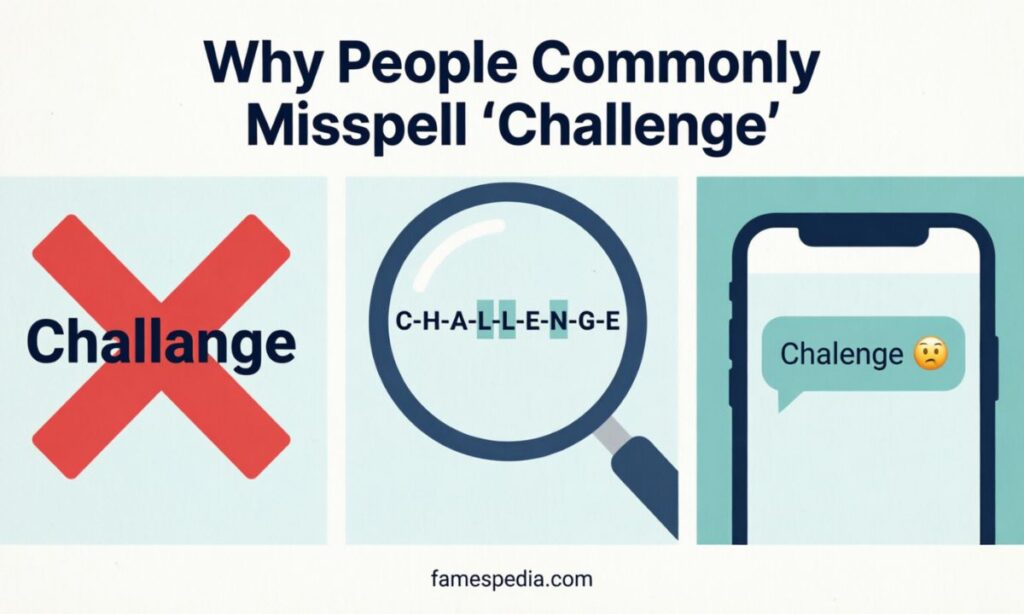
English pronunciation does not always match how words are spelled. The “enge” sound in challenge can trick learners into writing “ange,” especially when typing quickly or writing from memory. When you say the word out loud, the ending sounds soft and blended, which makes it easy to reach for the wrong letters.
Confusion With Similar Words
Words like manage, arrange, and exchange end with “ange,” which leads some writers to overapply that pattern when spelling challenges. The brain looks for familiar endings and sometimes pulls the wrong one.
Fast Typing and Weak Proofreading
Speed is a major culprit. When you are typing fast, your fingers can swap letters without your brain catching the error. Without a strong proofreading habit, the mistake lives in your document and nobody spots it until it is too late.
English as a Second Language (ESL) Influence
ESL learners often hear a word before they see it written. Since “challenge” is pronounced with a soft “G,” it can easily be mistaken and written as “challange” by those learning English. This is completely normal, but it is important to correct early before the wrong spelling becomes a habit.
Common Misspellings Related to “Challenge”
| Incorrect Spelling | Why It Happens |
| challange | “ange” pattern borrowed from other words |
| chalenge | Missing one “l” |
| challeng | Dropped the final “e” |
| challanging | Wrong base word plus wrong suffix |
| challendge | Added a “d” from pronunciation confusion |
| chalinge | Wrong vowel in the middle syllable |
All of these forms are wrong. The only correct base form is challenge.
Side-by-Side Comparison: Challenge vs. Challange
| Feature | Challenge | Challange |
| Correct spelling | Yes | No |
| Found in dictionaries | Yes | No |
| Accepted by spell checkers | Yes | No |
| Used in academic writing | Yes | No |
| Used in professional documents | Yes | No |
| Recognized by grammar tools | Yes | No |
| Has any valid meaning | Yes | No |
Everyday Usage of “Challenge” in Real Life
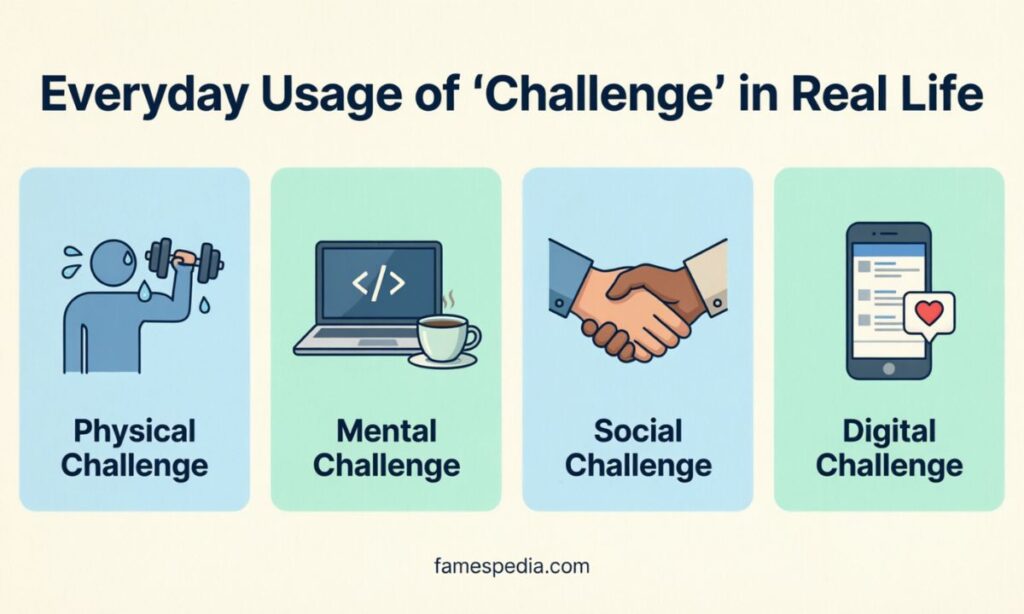
In School and Education
Teachers use the word constantly. A student faces a challenging exam. A class takes on an academic challenge. The word signals difficulty paired with growth. Spelling it correctly in essays, assignments, and emails to professors reflects attention to detail.
In Work and Business
Business writing is full of this word. Teams tackle operational challenges. Leaders challenge outdated systems. Proposals address market challenges. One spelling mistake in a pitch or report can shift how a reader perceives your credibility.
In Fitness and Personal Growth
Fitness culture practically runs on this word. You see 30-day challenges, step challenges, and strength challenges everywhere. Personal growth communities talk about rising to the challenge as a core mindset. The word carries motivation and momentum in this space.
In Law and Formal Disputes
In law, a challenge refers to a formal objection, such as a challenge to the polls (objecting to a juror) or a challenge to the array (objecting to the entire body of jurors). In this context, precision in language is non-negotiable.
In Everyday Conversation
People use challenges dozens of times a week without realizing it. “That was a tough one.” “I dare you.” “Let’s compete.” All of these are forms of challenge. In texts, social media captions, and casual emails, the correct spelling still matters because it reflects your overall communication standard.
You May Also Like This: Pent vs Pants: The Main Differences And When To Use Them
How to Remember the Correct Spelling (Memory Tricks That Work)
The “Change” Inside “Challenge” Trick
Look at the word challenge and find the word change hiding near the end: ch-all-enge. Actually, a simpler trick: notice the word contains the letters C-H-A-L-L-E. The key letter after the double “l” is E, not A. Say it to yourself: “After the two L’s, it is always E.” That single memory anchor removes most errors.
The “ENG” Sound Rule
Say the word slowly: chal-lenj. You hear “lenj,” not “lanj.” Train your ear to catch the “ENG” sound and your hand will follow. If it sounds like “enj,” it is spelled with “e,” not “a.”
Muscle Memory Through Repetition
Write a challenge five times right now. Then use it in three sentences. Then check your next document and spot whether you typed it correctly. Repetition builds the correct spelling pattern into your muscle memory so the right version comes out automatically.
Why Correct Spelling of “Challenge” Matters
Professional Credibility
One misspelled word in a resume, proposal, or business email can quietly reduce trust. Readers may not say anything, but they notice. Orthographic accuracy signals that you pay attention to detail, and that matters in every professional setting.
Academic Performance
Teachers and professors mark spelling errors. In essays, reports, and exam answers, writing “challange” instead of challenge costs you points. It also signals a surface-level understanding of the English language that can affect your overall grade.
First Impressions in Digital Communication
Whether it is a LinkedIn post, a website article, or a professional email, people make fast judgments about your writing quality. A spelling mistake in the first few lines can undermine everything else you say, no matter how strong your ideas are.
Mini Case Studies: How One Letter Changed Perception
Case Study 1: Student Essay
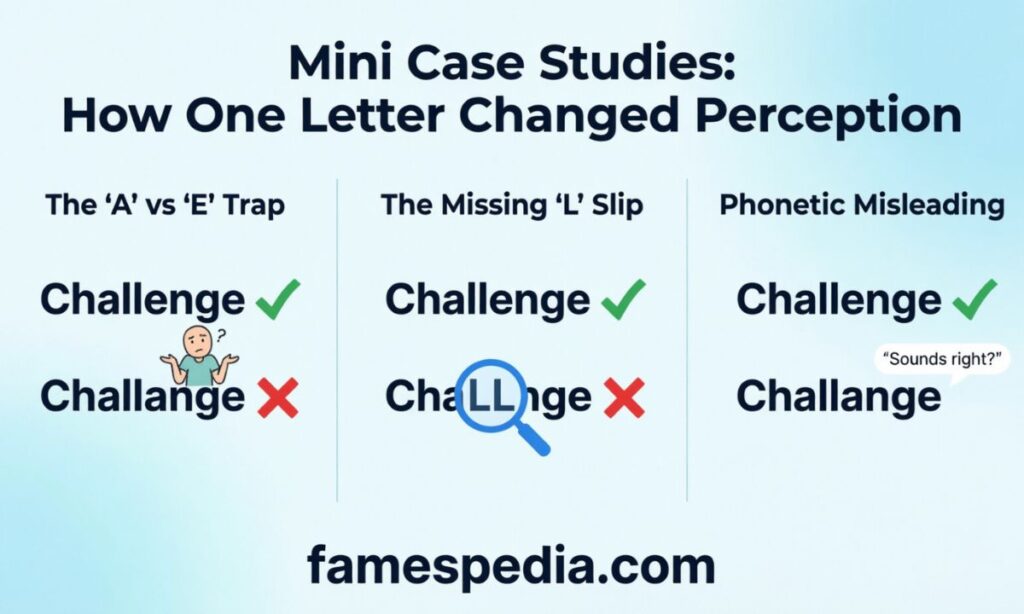
A student submitted a ten-page history essay and used “challange” seven times throughout. The teacher marked each one as a spelling error and noted a pattern of weak proofreading. The grade dropped by half a letter. After fixing the spelling and resubmitting, the same essay scored higher with zero content changes.
Case Study 2: Business Proposal
A freelance consultant sent a project proposal to a potential client. The word “challange” appeared in the executive summary. The client later shared that it raised an early question about the consultant’s attention to detail. The contract went to a competitor. Spelling credibility is real and invisible at the same time.
Case Study 3: Blog SEO Impact
A blog post targeting the keyword “business challenge” was published with multiple instances of “challange” in the body. Google’s crawlers flagged low content quality signals. The post ranked on page four. After correction and light updating, the same post climbed to page one within eight weeks. Correct spelling directly affects SEO performance and search engine trust.
Useful Forms of the Word “Challenge”
| Word Form | Example |
| Challenge (noun) | “This is a big challenge.” |
| Challenge (verb) | “I will challenge that decision.” |
| Challenged | “She was challenged by the task.” |
| Challenging | “This is a challenging situation.” |
| Challenger | “He was a strong challenger.” |
| Challenges | “We face daily challenges.” |
| Unchallengeable | “The evidence was unchallengeable.” |
All of these forms use the correct “enge” base. None use “ange.”
Quotes That Capture the Spirit of “Challenge”
These memorable lines show how the word is used by strong communicators:
- “Accept the challenges so that you can feel the exhilaration of victory.” (George S. Patton)
- “The challenge is not to be perfect. It is to be whole.” (Jane Fonda)
- “A smooth sea never made a skilled sailor.” (Franklin D. Roosevelt, paraphrased as a metaphor for challenge)
- “Every challenge you face today makes you stronger tomorrow.”
Practical Checklist: Never Misspell Challenge Again
Use this quick checklist every time you write the word:
- Did I use E after the double L, not A?
- Does the word end in “enge,” not “ange”?
- Did I run a spell check before publishing or sending?
- Did I say the word out loud and listen for the “enj” sound?
- Did I proofread at least once after writing?
If all five boxes are checked, you are good to go.
The bottom line is simple.
There is only one correct spelling: challenge. The version with an “a” after the double L is always wrong, in every context, for every reader. It does not exist in any dictionary, grammar guide, or style manual. Once you lock in the correct spelling with one of the memory tricks above, you will never hesitate again. Accept the challenge, get it right, and move forward with confidence. above, you will never hesitate again. Accept the challenge, get it right, and move forward with confidence

Arslan is the creator and author behind FamesPedia, a platform focused on grammar, writing skills, and English language learning. Passionate about clear communication and effective writing, Arslan shares practical grammar tips, easy-to-follow language guides, and educational content to help readers improve their English with confidence.