If you have ever typed the plural of copy and paused to ask yourself whether it should be “copys” or “copies,” you are not alone. This is one of the most searched spelling questions in everyday English, and it trips up students, professionals, and native speakers alike.
The good news is that the answer is simple, and once you understand the grammar rule behind it, you will never second-guess yourself again. This guide breaks down the correct spelling, explains exactly why one form is right and the other is wrong, and gives you clear, real-world examples to lock it in for good.
Whether you are writing a professional email, printing documents, or just brushing up on English spelling rules, this guide covers everything you need.
Copys or Copies: Which Is Correct?
The correct word is copies.
“Copys” is not a valid word in standard English grammar. It does not appear in any reputable dictionary, and using it in professional or academic writing is considered a spelling error.
Here is the short answer in one clear table:
| Form | Correct? | Usage |
| Copies | Yes | Plural noun and third-person verb form |
| Copys | No | Incorrect in all contexts |
Many people instinctively reach for “copys” because adding a simple s to a word is the most common way to form a plural in English. That logic works for words like “book” (books) or “chair” (chairs), but it does not apply to words that end in a consonant followed by y.
“Copy” ends in the letter p, which is a consonant, followed by y. That combination triggers a different rule entirely, one that changes the spelling rather than just attaching an s.
The result is copies, not copys, and this applies in every context, whether you are using the word as a noun or a verb.
Why Copies Is the Correct Spelling?

The reason comes down to one of the most consistent pluralization rules in the English language. Understanding this rule not only fixes the copys vs copies confusion but also helps you spell dozens of other similar words correctly.
Pluralization of Copy as a Noun
When copy is used as a noun, it refers to a single instance of a document, file, book, printed page, or any reproduced item. The moment you have more than one, you need the plural form, which is where the spelling rule kicks in.
The rule is this: when a noun ends in a consonant plus y, you drop the y, replace it with i, and add es.
Here is how it works step by step:
- Start with the base word: copy
- Identify that the letter before y is p, which is a consonant
- Drop the y
- Add ies in its place
- Result: copies
This is not an exception or a quirk. It is a consistent English grammar pattern that applies to many common words. Look at how the same rule works across other familiar words:
| Base Word | Ends In | Plural Form |
| Copy | Consonant + y | Copies |
| Baby | Consonant + y | Babies |
| City | Consonant + y | Cities |
| Story | Consonant + y | Stories |
| Party | Consonant + y | Parties |
| Lady | Consonant + y | Ladies |
Every single one follows the same pattern. If the letter before y is a consonant, you change y to ies.
Now compare that with words where y is preceded by a vowel, like “key,” “monkey,” or “day.” For those words, you simply add s: keys, monkeys, days. The vowel before y changes everything.
Since copy has the consonant p before y, it follows the consonant plus y rule, and the correct plural of copy is always copies.
A quick memory tip that works: whenever you see consonant plus y at the end of a word, just say to yourself, “drop the y, add ies.” This simple habit will help you spell words like these correctly every time without having to think twice.
Pluralization of Copy as a Verb
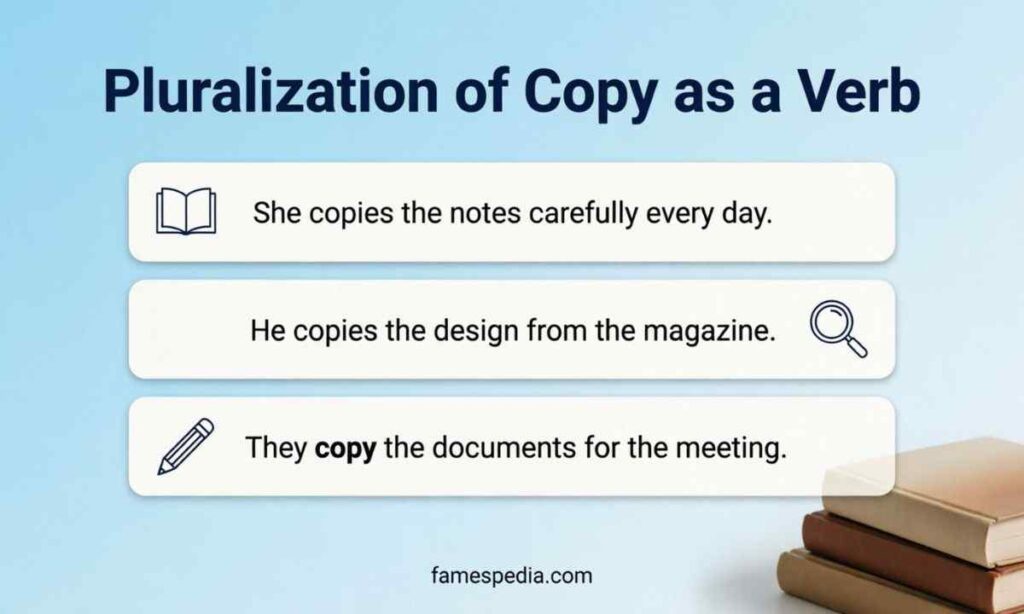
“Copy” is not just a noun. It also functions as a verb, meaning to duplicate, reproduce, or imitate something. This is where a second layer of confusion sometimes appears.
When copy is used as a verb, you do not pluralize it the way you do a noun. Instead, you conjugate it according to the subject.
Here is how the verb copy is conjugated in the simple present tense:
| Subject | Verb Form |
| I | copy |
| You | copy |
| He / She / It | copies |
| We | copy |
| They | copy |
Notice that the third-person singular forms, he, she, and it, use copies, not copys. The same consonant plus y rule applies here too.
“She copies the files every morning” is correct. “She copys the files every morning” is always wrong.
This means whether you are using copy as a noun or a verb, the correct spelling with any ies ending is copies. The word “copys” does not exist as a valid noun form or a valid verb conjugation in standard English.
A common mistake writers make is assuming that because “copy” in advertising or content marketing is often used as an uncountable noun, the plural rules do not apply. That is not the case. When referring to multiple pieces of content, documents, or reproductions, copies is still the only correct plural form.
Examples of Using “Copies” in a Sentence
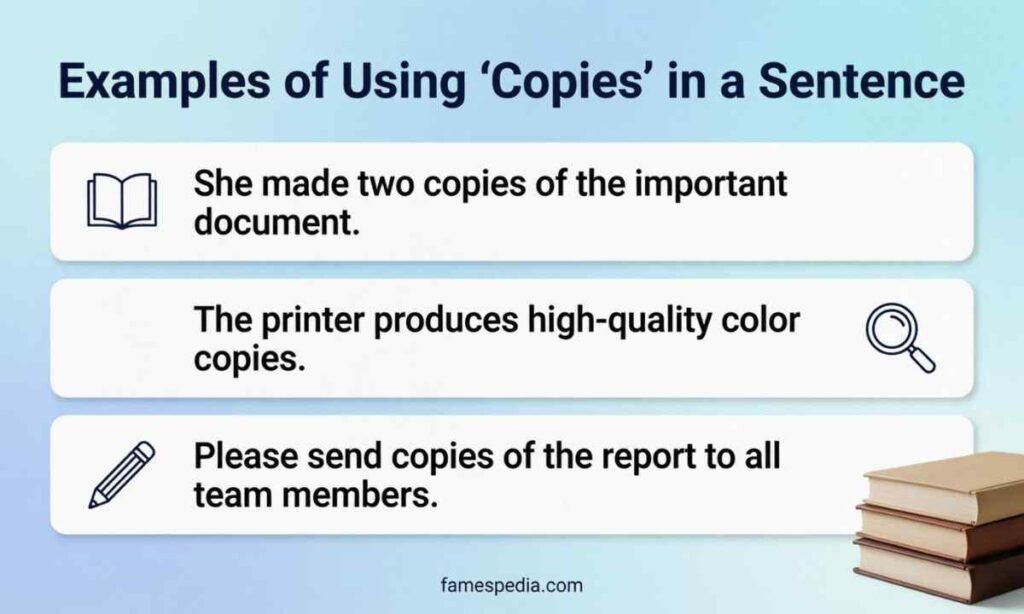
Seeing the word used in real sentences is one of the best ways to make the rule stick. Below are examples organized by context, covering both the noun form and the verb form of copies.
Copies as a Noun (plural of copy):
- The teacher printed 30 copies of the worksheet for the class.
- Please keep at least two backup copies of every important file.
- The publisher released over a million copies of the novel in the first week.
- I need three copies of this contract before the meeting starts.
- The office ran out of copies because the printer jammed twice.
- The photographer handed out copies of the edited photos to each client.
- We ordered extra copies of the brochure for the trade show.
- All copies of the report must be submitted by Friday.
Copies as a Verb (third-person singular present tense):
- She copies every important document before sending the originals.
- He copies the board notes into his notebook at the end of each lecture.
- The software automatically copies your data to the cloud every night.
- My sister always copies my style, which I actually find flattering.
- The intern copies the files to the shared drive every morning without fail.
Incorrect Usage (what to avoid):
- I need five copys of this form. → I need five copies of this form.
- Please print extra copys for the team. → Please print extra copies for the team.
- She copys the documents daily. → She copies the documents daily.
Looking at these examples side by side makes the pattern very clear. Every time you reach for “copys,” replace it with copies, and your writing instantly becomes more accurate and professional.
Also Read This: Pentoxide vs Pentaoxide: Differences And Uses For Each One
Conclusion
The answer to “copys or copies” is clear: copies is always correct, and “copys” is always wrong. The rule behind it is simple: when a word ends in a consonant followed by y, you change the y to ies to form the plural.This same rule applies whether you are using copy as a noun or conjugating it as a verb in the third-person singular.
Copy becomes copies, city becomes cities, baby becomes babies, and the pattern stays the same across all similar words.Knowing this one rule improves your spelling accuracy across a wide range of common English words. The next time you are writing an email, drafting a document, or filling out a form, you will type copies with complete confidence and move on without a second thought.

Arslan is the creator and author behind FamesPedia, a platform focused on grammar, writing skills, and English language learning. Passionate about clear communication and effective writing, Arslan shares practical grammar tips, easy-to-follow language guides, and educational content to help readers improve their English with confidence.